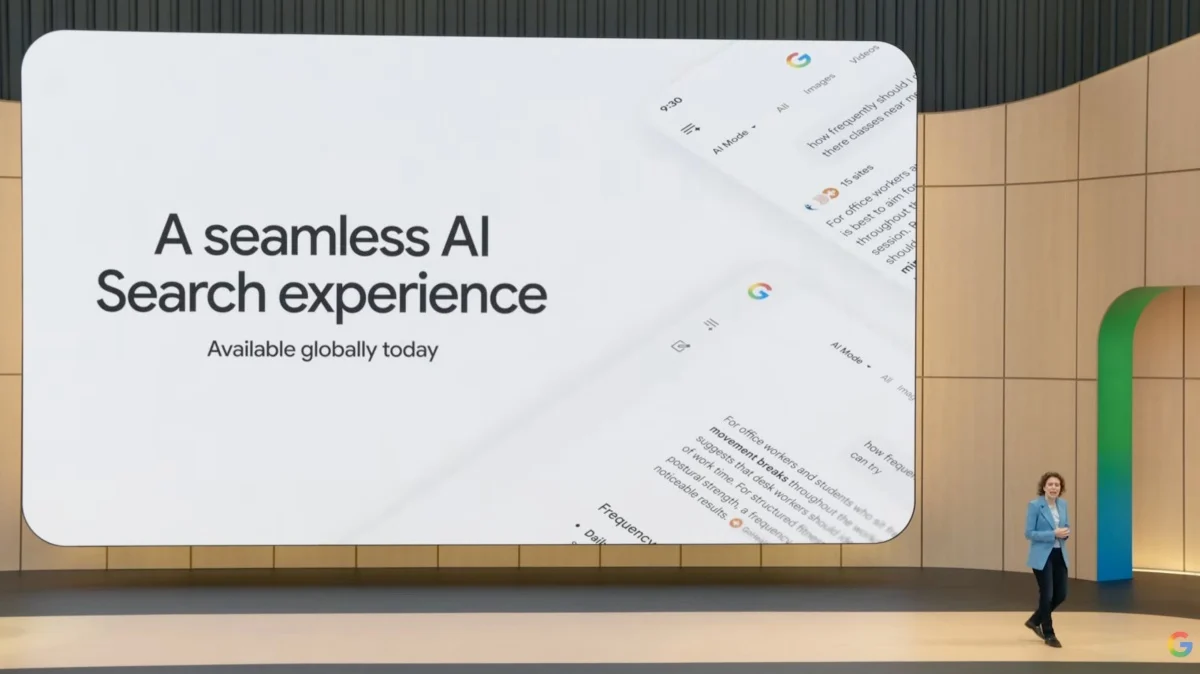
At the Google I/O 2026 symposium, the technology giant announced that its core computational engine and primary economic cornerstone, Google Search, is embarking upon its most expansive re-architecture in over a quarter-century. By comprehensively integrating the newly manifested Gemini 3.5 Flash model, the search ecosystem not only introduces a dynamic, multimodal-native entry interface but formally heralds the epoch of autonomous Search Agents.
The impending evolution dictates that Google Search will cease to function merely as a passive aggregator of hyperlink indexes. Instead, the platform will operate persistently in the background 24/7 to monitor specialized data streams, orchestrate telephonic restaurant reservations, and programmatically construct bespoke, ephemeral web applications—or Mini Apps—tailored to specific complex inquiries.
To sustain this significantly augmented computational and algorithmic burden, Google has designated Gemini 3.5 Flash as the default foundational infrastructure powering its global AI Mode search tier, injecting frontier intelligence and hyper-accelerated operational responsiveness into the ecosystem.
-
The Re-engineered Intelligent Search Frame: This represents the most profound user-interface metamorphosis enacted upon the Google search bar in twenty-five years. The contemporary canvas possesses fluid expanding capabilities, granting users sufficient structural space to articulate intricate, multi-layered directives. Moving beyond traditional autocompletion heuristics, it delivers advanced, AI-synthesized contextual suggestions while establishing native support for multimodal inputs; operators can now directly introduce imagery, files, video streams, or active Google Chrome tabs into the search frame as source reference material.
-
Frictionless Iterative Querying: Upon receiving an initial AI Overview canvas, users can execute subsequent follow-up inquiries with organic continuity. The underlying model preserves conversational context throughout the diagnostic journey, continuously rendering highly relevant reference citations and scholarly publications.
The most revolutionary breakthrough within this release cycle centers on the transition of the search engine toward absolute proactivity, manifested through the deployment of autonomous Information Agents engineered to streamline tedious monitoring and logistical reservation tasks.
- Persistent 24/7 Background Surveillance: Once an operator delegates a precise objective—such as isolating real estate listings conforming to strict criteria, or tracking the commercial release window of an athlete’s limited-edition footwear—the agent conducts continuous, round-the-clock scans of digital media, journalistic outlets, social graphs, and live data repositories. Upon isolating congruent data points, the agent autonomously dispatches a consolidated analytical brief. This functionality is scheduled to debut this summer for Google AI Pro and Ultra subscribers.
- Automated Logistics and Delegated Telephony: The Search Agent possesses the capability to arbitrate everyday micro-transactions. Upon receiving specific parameters (e.g., securing a private karaoke suite accommodating six guests and providing late-night culinary services this Friday), the system aggregates real-time pricing and availability metrics, rendering direct reservation conduits. Remarkably, across designated service sectors like home remediation, aesthetics, or veterinary care, operators can command Google to execute outbound telephonic voice calls to negotiate appointments directly with merchants. This specialized delegation framework will achieve comprehensive commercial deployment across the United States this summer.
Synthesizing the Google Antigravity framework with the programmatic synthesis proficiency of Gemini 3.5 Flash, the upcoming generation of Google Search outcomes permanently sheds its static, textual heritage.
- Generative UI (Generative User Interfaces): When an operator interrogates the system regarding advanced astrophysical concepts or demands an structural breakdown of horological mechanics, Google Search can, within a millisecond envelope, programmatically author and render a customized web layout populated with interactive visualizations, mathematical tables, dynamic charts, or physical simulations. This Generative UI framework will be provisioned to all users globally at no financial cost this summer.
- Bespoke Mini Apps: Confronted with long-horizon initiatives—such as orchestrating a wedding itinerary or engineering a novel physical conditioning regimen—the search architecture can natively synthesize a personalized custom dashboard or tracking metric. For example, it can fuse real-time meteorological forecasts, localized spatial mapping, and consumer critique data to programmatically render a private fitness-tracking Mini App, allowing the user to return iteratively to advance their progress. This advanced capability will roll out to AI Pro and Ultra subscribers in the United States within the impending months.
To optimize the system’s comprehension of individual user context, Google announced the expansion of its “Personal Intelligence” framework within AI Mode to approximately 200 countries and territories, supporting 98 linguistic variations under a non-subscription, complimentary access tier.
Operating under rigid privacy guarantees and absolute user sovereignty, individuals can securely link Gmail, Google Photos, and ultimately Google Calendar directly to the search engine. This integration empowers the underlying artificial intelligence to evaluate personal correspondence histories, archival imagery, and logistical scheduling constraints when formulating resolutions, yielding a profoundly tailored contextual output.
Confronted with aggressive market maneuvers from emerging AI-native applications like OpenAI’s ChatGPT and Perplexity, Google has orchestrated a monumental counter-offensive at Google I/O 2026, systematically redefining the boundaries of what a search engine can achieve.
The integration of Gemini 3.5 Flash and multimodal processing merely establishes parity with contemporary competitors; the structural introduction of Search Agents and real-time Generative UI represents the creation of an unassailable technical defensive moat.
As Google Search transitions from merely identifying relevant web documentation to actively auditing secondary vehicle pricing, executing voice calls to secure coveted dining reservations, and programmatically engineering tailored physical optimization software, user behavior fundamentally pivots from passive information retrieval to the active delegation of operational tasks.
This paradigm shift drastically heightens consumer lock-in within the Google ecosystem while maximizing the tech giant’s absolute home-field advantage: its possession of the world’s most expansive, real-time repository of global data assets and localized merchant telemetry via Google Maps. The subsequent twenty-five years of the search engine will be defined not by the indexing of hyperlinks, but by the orchestration of physical, real-world action.
Support Our Threat Intelligence
If you find our technology report and cybersecurity news helpful, consider supporting our work.
 Buy Me a Coffee
PayPal
Buy Me a Coffee
PayPal