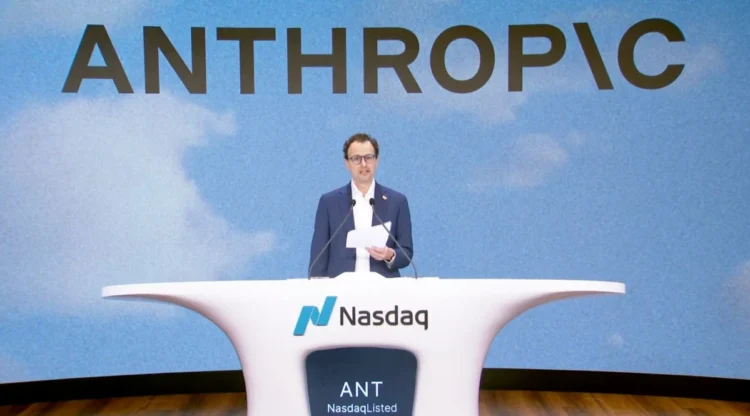
Racing ahead of chief rival OpenAI, enterprise AI developer Anthropic officially entered the public markets on November 19. Trading under the ticker symbol ANT on the Nasdaq Global Select Market, the company achieved two historic milestones. Specifically, Anthropic became the first publicly listed frontier AI laboratory and executed the largest initial public offering in Wall Street history.
Driven by intense institutional demand, Anthropic priced its offering at $83 per share, exceeding its initial $70 to $78 target range. By issuing 980 million Class A common shares, the historic Anthropic Nasdaq IPO generated $81.34 billion in base proceeds. Consequently, this listing surpassed SpaceX’s $75 billion base offering from June. Including a concurrent $26 billion private placement, total capital raised topped $107.3 billion.
At the opening bell, shares surged 34 percent to $111.50 and briefly touched an intraday peak of $115.10. At that height, Anthropic’s fully diluted valuation momentarily crossed the $2 trillion threshold. Although a broader market sell-off exceeding 2 percent pulled shares down toward $95 at midday, the stock recovered to close at $97.17. Ultimately, this 17 percent first-day gain firmly cemented Anthropic inside the trillion-dollar technology club.
Four Highlights From Anthropic’s Record-Breaking Wall Street Listing
Notably, this landmark listing did not occur during an effortless bull market rally. Instead, Anthropic powered through severe sector anxiety and macroeconomic headwinds:
- Record Capital Raise and Trillion-Dollar Valuation: Priced at $83 per share, the offering secured $81.34 billion in base capital under lead underwriters Goldman Sachs and Morgan Stanley, who also hold a 147 million share greenshoe option. Following the opening surge past $2 trillion, Anthropic closed with a basic market capitalization above $1.28 trillion and a fully diluted valuation exceeding $1.5 trillion.
- Resilience Amid NVIDIA Turbulence and Market Losses: Investor nerves ran high prior to the debut. Even though NVIDIA reported Q3 revenue doubling to $115.8 billion on Tuesday, fallout from founder Jensen Huang’s resignation last week drove NVIDIA shares down 36 percent from their October 6 peak. Alongside Thursday’s 2 percent drop across major US indices, Anthropic’s rally signaled strong capital rotation into foundational model leaders.
- Confronting Post-Midterm Federal Regulatory Scrutiny: Following decisive Democratic victories in this month’s US midterm elections, Wall Street anticipates stricter federal rules on AI safety and data center energy consumption in January. Addressing these concerns before ringing the opening bell, Co-Founder and President Daniela Amodei stated: “To everyone who feels uneasy about AI, or uncertain about what it means for you: this technology needs you – not your trust, and not your usage, but your voice.”
- S-1 Filing Reveals Rapid Revenue and $900.9 Billion Compute Commitments: Public filings show Q3 2026 revenue reached $17 billion, representing 1,127 percent year-over-year growth and an annualized run rate nearing $81 billion by late October. Meanwhile, quarterly operating losses narrowed to $567 million. To fuel future model scaling, however, Anthropic carries $900.9 billion in long-term compute and infrastructure commitments, including $451.6 billion due before year-end 2030.
Anthropic vs. OpenAI: Comparing Two Frontier AI IPO Strategies
Looking back at early June, Anthropic and OpenAI filed confidential S-1 registration drafts with the SEC just days apart, on June 1 and June 8 respectively. Yet five months later, Anthropic rang the Nasdaq opening bell while OpenAI CEO Sam Altman ruled out a 2026 listing and pushed his target window to 2027. Examining their financial health, governance structures, and commercial models reveals why their timelines diverged so sharply.
Financial, Governance, and Commercial Comparison
Unlike OpenAI’s complex corporate restructuring, Anthropic built Anthropic’s public benefit mission and governance framework directly into its founding charter. This clean legal structure minimized regulatory friction during SEC review. The table below contrasts both frontier labs across key market metrics.
| Comparison Dimension | Anthropic (Listed Nov 19, 2026) | OpenAI (Targeting 2027 IPO Window) | Key Differences and Market Impact |
|---|---|---|---|
| Listing Progress and Ticker | Public S-1 filed Oct 26; listed on Nasdaq Nov 19 (Ticker: ANT), raising $81.34B base capital | Confidential S-1 filed June 8; no public prospectus, exchange, or ticker yet; targeting 2027 | Anthropic captured first-mover public pricing power and institutional liquidity |
| Latest Valuation Level | Briefly topped $2T fully diluted at open; closed at ~$1.28T float cap (>$1.5T diluted) | Valued at $852B in March private round; reportedly raising ~$30B in October toward $1.4T | Private valuations remain close, but Anthropic validated public secondary market demand |
| 2026 Q3 Revenue Scale | ~$17B (up over 11x YoY, with nearly half sold via cloud marketplaces) | Reportedly ~$10B (up ~50% QoQ, with no audited financial statements published yet) | Enterprise API and coding agent leader Anthropic overtook OpenAI in quarterly revenue |
| 2026 Q3 Operating Loss | Operating loss narrowed to $567M (GAAP net loss of $23.3B reflects non-cash convertible note adjustments) | Reportedly $10.9B adjusted quarterly operating loss (burning over $1 for every $1 earned) | High-margin B2B enterprise subscriptions contrast with heavy B2C free ChatGPT inference subsidies |
| Governance and Shareholders | Native Public Benefit Corporation (PBC); 7 co-founders hold 50.1% voting power; Google (14.99% cap) and Amazon (12% cap) hold non-voting Class N shares | Restructured into OpenAI Group PBC in Oct 2025 under non-profit foundation control; complex Microsoft revenue-sharing ties and California safety lawsuits | Anthropic’s clean PBC structure and capped cloud partner voting rights accelerated SEC clearance |
| Official Listing Rationale | Embraced transparent governance and public oversight to raise independent compute capital | Sam Altman cited a transitional year requiring private flexibility for long-horizon agent safety alignment | OpenAI prioritized private restructuring to address heavy cash burn and foundation governance disputes |
Support Our Threat Intelligence
If you find our technology report and cybersecurity news helpful, consider supporting our work.
 Buy Me a Coffee
PayPal