This represents perhaps the most audacious metamorphosis in Google’s computing trajectory since the inception of ChromeOS fifteen years ago. As the computational paradigm shifts from the traditional Operating System (OS) toward a pervasive Intelligence System, Google has officially unveiled its pioneering hardware lineage: the Googlebook.
Centering on Gemini Intelligence and forged through a profound integration with the Android ecosystem, this high-end notebook marks Google’s triumphant return to the premium hardware arena—following the legacy of the original Cr-48, the Chromebook Pixel, and the Google Pixelbook. It heralds a total reconstruction of the portable computing experience, slated for this autumn. The Googlebook is expected to debut “Aluminium,” a novel PC operating system built upon an Android architecture; however, Google maintains that this will coexist with ChromeOS, aiming instead to transpose the fluidity of the mobile experience onto a desktop form factor.
Defined as the inaugural laptop engineered from its genesis for Gemini Intelligence, the Googlebook’s most striking innovation lies in its reimagining of the mouse cursor—a tool that has remained stagnant for decades. In collaboration with DeepMind, Google introduced the Magic Pointer. By simply “wiggling” the cursor, the pointer “awakens,” summoning Gemini to provide proactive, context-aware suggestions based on its spatial position on the screen.
For instance, hovering over a date within an email will prompt an automatic meeting invitation; alternatively, selecting an image of a vacant living room alongside a photo of a new sofa allows the cursor to instantly synthesize a visualization of the furniture within the space. Google asserts that the Magic Pointer will empower users to traverse the path from “conception” to “execution” within a few mere clicks.
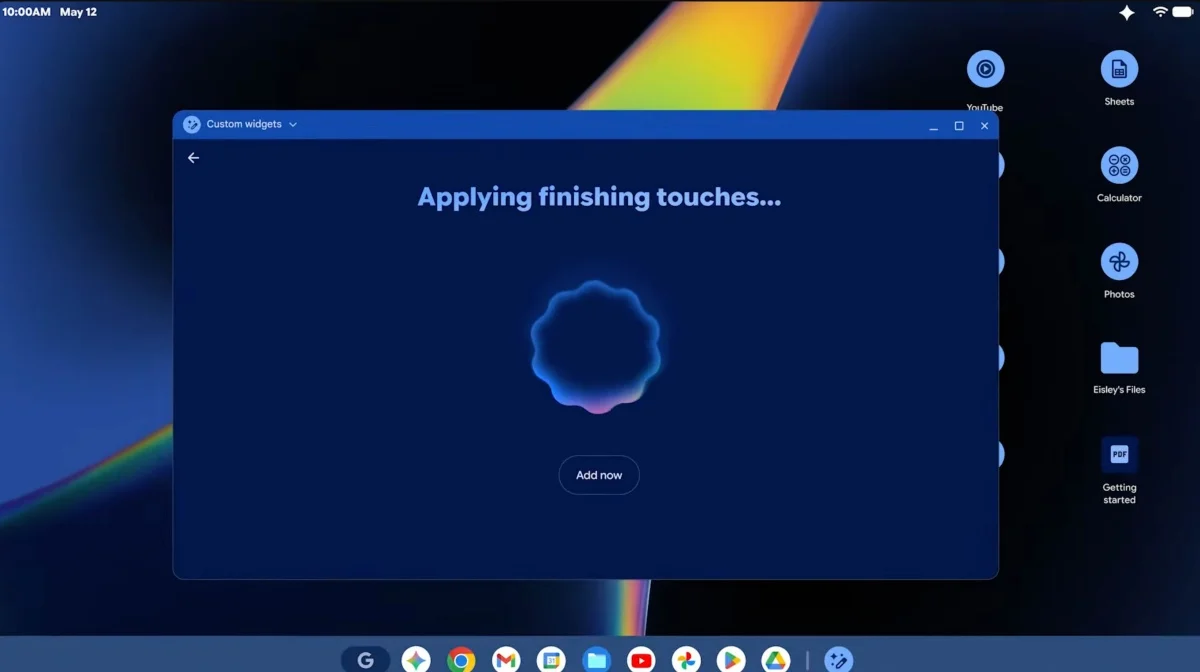
Furthermore, the Googlebook introduces the “Create Your Widget” feature. Unlike traditional menus, these tools are generated through natural language commands. A user planning a family excursion to Berlin might direct Gemini to aggregate flight details, lodging reservations, and a countdown timer into a bespoke “Berlin Odyssey” dashboard pinned directly to the desktop.
Historically, the synergy between Chromebooks and Android applications has been lackluster. The Googlebook addresses this with a “frictionless” cross-screen philosophy:
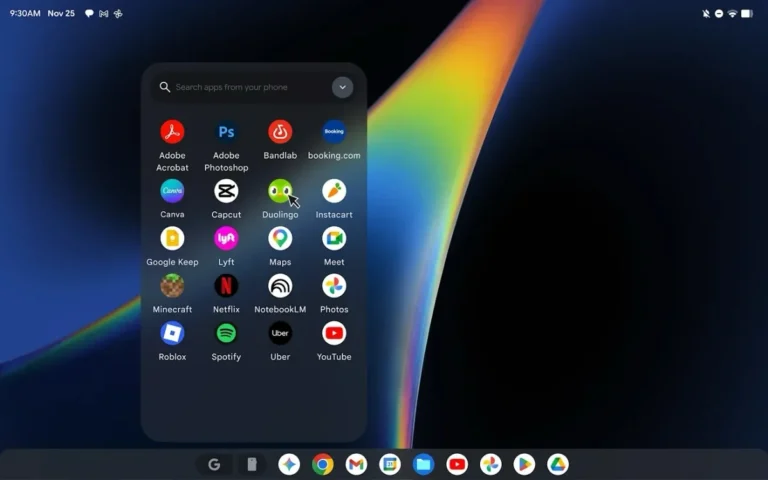
- Application Mirroring: Users no longer need to download redundant applications or endure the latency of emulators. The Googlebook “summons” and operates apps directly from the user’s smartphone. One might finalize a food delivery order or complete a Duolingo lesson on the laptop screen while the phone remains in a pocket.
- Quick Access File System: The file explorer natively integrates the smartphone’s storage, allowing users to browse and retrieve mobile files directly within the laptop’s file manager without the need for Bluetooth pairing or cloud intermediaries.
Shattering the “budget educational tool” stereotype, Google emphasizes that the Googlebook is a product of premium craftsmanship. Partnering with industry titans such as Acer, ASUS, Dell, HP, and Lenovo, Google has established a distinct visual hallmark for the series: the “Glowbar.” This luminous element serves as an unmistakable aesthetic signature while providing functional utility.
The genesis of the Googlebook signals an aggressive offensive into the territory long occupied by Windows and macOS. While ChromeOS successfully captured the educational sector, it struggled to achieve a breakthrough in the mainstream and professional markets due to its perceived limitations as a glorified browser. Now, Gemini and the Android ecosystem serve as the twin keys to dismantling those barriers.
The Magic Pointer mitigates the inherent friction of AI adoption; rather than forcing a user into a dialogue box, it renders the AI an intuitive extension of the cursor. By offering an interconnectivity that rivals—and perhaps surpasses—Apple’s Handoff or Microsoft’s Phone Link, Google is leveraging its global mobile dominance to drive hardware adoption.
As the autumn launch approaches, the ultimate intrigue lies in the system’s compatibility with third-party x86 and Arm software, as well as the pricing strategies of its partners. Should the Googlebook successfully harmonize a potent AI experience with superior battery longevity and competitive pricing, this “Glowbar”-adorned machine may very well become the definitive disruptor of the next-generation PC industry.
Support Our Threat Intelligence
If you find our technology report and cybersecurity news helpful, consider supporting our work.
 Buy Me a Coffee
PayPal
Buy Me a Coffee
PayPal