Tropical cyclones rank consistently among the most destructive natural disasters worldwide. Over the past fifty years, these catastrophic storms have tragically claimed more than 700,000 lives. Additionally, they have inflicted devastating economic damages exceeding 1.4 trillion dollars. For dedicated meteorologists, accurately projecting storm trajectories and intensities during nascent formation stages remains an arduous challenge.
A Breakthrough in Meteorological Science
Google DeepMind recently partnered with the esteemed Google Research team to publish groundbreaking findings in the prestigious journal Nature. Their comprehensive research highlights the revolutionary WeatherNext AI models, specifically engineered for extreme weather forecasting. Consequently, the results demonstrate a monumental advancement in predicting cyclone paths, core intensities, and complex wind field structures. Indeed, this innovation effectively propels traditional meteorological forecasting methodologies forward by a full decade. Subsequently, Google generously announced the complete open-sourcing of the model’s source code and weights.
Unprecedented Forecasting Accuracy
Historically, meteorological agencies faced a profound dilemma when analyzing tropical cyclones. Determining a storm’s trajectory heavily relies on massive global atmospheric circulation patterns, necessitating coarse global physical models. Conversely, predicting a cyclone’s destructive intensity requires analyzing highly localized thermodynamic processes near the storm’s core. Therefore, this specific task typically demands extremely high-resolution, localized models.
Consolidating Complex Data Streams
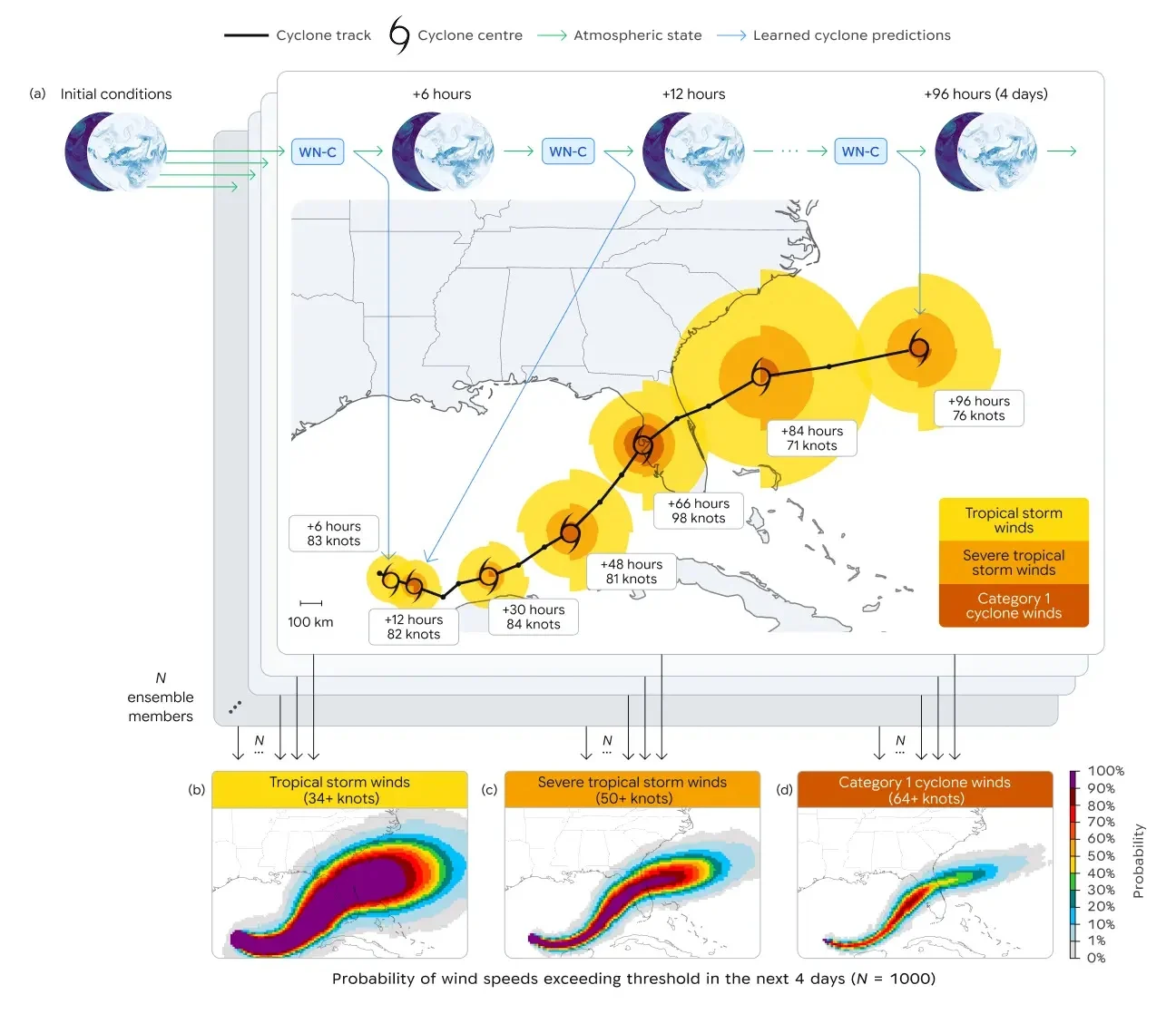
Google’s innovative WeatherNext model successfully integrates dynamic global atmospheric data with the extensive IBTrACS database. This comprehensive archive contains historical records from nearly 5,000 previous storms. Furthermore, developers rigorously trained the system using approximately 20 terabytes of atmospheric information. As a result, this unified artificial intelligence model masterfully grasps storm trajectories, intensities, and wind field structures simultaneously.
Extending Crucial Warning Windows
When compared against historical data, WeatherNext exhibits an astonishing predictive advantage. The system provides highly accurate forecasts a full 24 hours earlier than conventional methodologies. Previously, traditional models could only reliably predict weather patterns up to two days in advance. Consequently, this remarkable enhancement grants emergency management teams an entire additional day to implement critical disaster prevention protocols.
Mastering Extreme Event Detection
The sophisticated model strategically employs advanced Functional Generative Networks. This powerful architecture allows a Tensor Processing Unit to complete a comprehensive 15-day global meteorological simulation in under one minute. This year, the research team significantly expanded their probabilistic ensemble simulations to include 1,000 distinct members. Consequently, the system can precisely identify extreme, low-probability tail risks, such as rapid intensification events.
Shattering Traditional Computing Paradigms
One of the most striking breakthroughs involves a fundamental paradigm shift regarding computational resolution. Previously, the academic community firmly believed that accurate intensity predictions required exceptionally high-resolution supercomputer calculations. However, WeatherNext Cyclones achieves top-tier predictive performance using a remarkably coarse 28-by-28 kilometer data resolution. This specific metric is roughly 100 times less detailed than traditional physical models.
Efficiency Meets High Performance
Even the remarkably lightweight WeatherNext 2-mini model demonstrates exceptional forecasting capabilities. This compact version operates effectively at an even broader 111-by-111 kilometer resolution. This unprecedented ability to achieve high accuracy with minimal computational resources has sparked intense global scientific interest. In fact, this precise model already proved its immense practical value during the 2025 hurricane season.
Real-World Application Success
During that period, the Google team collaborated closely with the United States National Hurricane Center. Together, they successfully anticipated the sudden, rapid intensification of Hurricane Melissa. Furthermore, the system accurately predicted the storm’s eventual landfall location in Jamaica. Ultimately, this crucial intelligence provided local disaster relief organizations with vital time to orchestrate effective defensive responses.
Fostering a Global Defensive Ecosystem
Google aims to empower global communities against the escalating threats of extreme weather driven by climate change. Therefore, the company officially released the complete model weights and source code for WeatherNext 2 and WeatherNext Cyclones. By openly sharing these vital resources on GitHub, Google enables developers worldwide to engineer innovative derivative services. This open-access strategy facilitates widespread deployment, ultimately granting communities more preparation time to mitigate catastrophic damages.
Accessible Tools for Researchers
Beyond offering downloadable models for academic institutions and meteorological agencies, Google provides accessible alternatives. They released the efficient WeatherNext 2-mini model, explicitly designed to run on the free Colab Notebook platform. Additionally, developers significantly updated the Weather Lab platform within the Google Earth AI ecosystem. Consequently, global forecasters and researchers can utilize a highly visual interface to monitor temperature, precipitation, and cyclone dynamics instantly.
The Future of AI Meteorology
The introduction of WeatherNext symbolizes the decisive transition of AI meteorology from a supportive role to a dominant force. Traditional numerical weather prediction relies heavily on computationally expensive fluid dynamics and thermodynamic partial differential equations. These complex methods often require supercomputers to calculate results over several hours or even days. Conversely, Google has definitively proven the extraordinary power of cutting-edge deep learning and generative artificial intelligence architectures.
Democratizing Weather Forecasting
This innovative technology can generate thousands of ensemble predictions within mere seconds. Moreover, it completely shatters the long-held myth that high resolution is mandatory for high accuracy. Most importantly, Google’s commendable decision to fully open-source the models democratizes access to advanced forecasting. For developing nations lacking expensive supercomputers, this represents a monumental opportunity to leverage world-class storm prediction capabilities.
A Vital Tool for Survival
Regional meteorological units can now access these sophisticated AI tools with remarkably low hardware requirements. Extending the reliable forecasting window by a full 24 hours represents far more than a mere technical milestone. In our current era of increasingly frequent extreme weather events, this capability is a critical force for preserving lives.
Support Our Threat Intelligence
If you find our technology report and cybersecurity news helpful, consider supporting our work.
 Buy Me a Coffee
PayPal
Buy Me a Coffee
PayPal