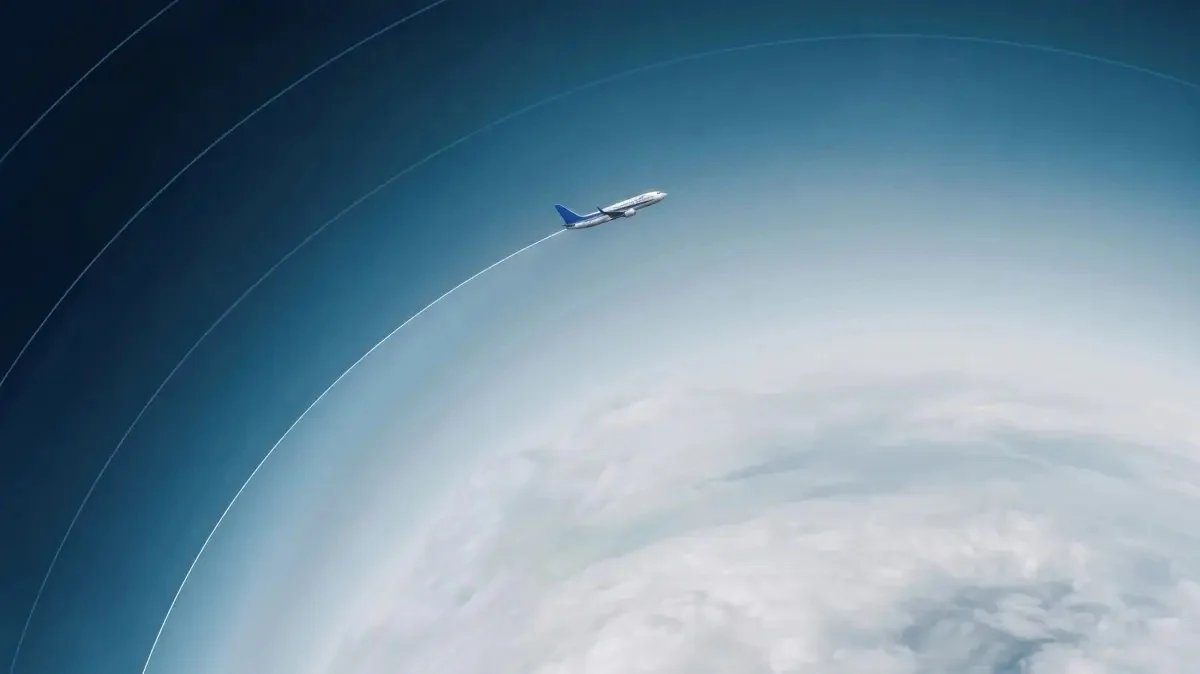
Google recently announced a major collaboration with the UK government. They partnered with various leading aviation and meteorological institutions. Together, they launched a massive experiment called Operation Blue Skies. This initiative uses artificial intelligence to predict atmospheric conditions. Consequently, it adjusts flight altitudes to reduce aircraft contrails. Ultimately, this effort aims to mitigate the severe global warming effects caused by aviation.
The Climate Impact of Aircraft Contrails
Aircraft frequently fly through cold, humid high-altitude environments. Engine exhaust mixes with water vapor during these flights. Instantly, this mixture condenses into tiny ice crystals. This process leaves long white trails across the open sky. We commonly know these formations as aircraft contrails. Sometimes, conspiracy theorists mistakenly identify them as “chemtrails.” However, scientists have proven a much harsher reality regarding these clouds.
The Greenhouse Effect Problem
These artificial high-altitude clouds trap radiant heat effectively. They reflect heat from the Earth’s surface back down to the ground. As a result, they create a potent and damaging greenhouse effect. Currently, aircraft contrails create a massive environmental footprint globally. Researchers estimate they account for approximately one-third of the total climate impact from the aviation industry. Therefore, reducing them is a top priority for environmentalists.
AI Predicts Atmospheric Conditions
Google proposed Operation Blue Skies to combat this persistent issue. The project aims to calculate atmospheric regions prone to forming lasting contrails. Furthermore, it will safely guide aircraft to avoid these specific zones. This 30-month project will conduct extensive tests within the Shanwick airspace. This vital region covers the busy eastern North Atlantic flight corridor.
Implementing Altitude Adjustments
Field operations will take place during two upcoming winters. Specifically, tests will run from 2026 to 2027 and 2027 to 2028. During this period, UK National Air Traffic Services controllers will guide specific flights. They will instruct pilots to adjust their cruising altitude based on AI predictive models. The maximum vertical adjustment will be exactly 2,000 feet.
Minor Changes Yield Major Results
Previous preliminary studies show highly promising results for this method. Aircraft can effectively avoid contrail-prone layers with very minor altitude changes. Approximately 10,000 flights will pass through this test region each winter. Yet, controllers will ask only one to five percent of these flights to alter their routes. This small sample size provides statistically significant data sets for researchers. Importantly, it achieves this crucial data collection without disrupting major aviation operations.
Integrating Global Resources
Google will provide its AI prediction models completely for free. These advanced models rely heavily on satellite imagery and machine learning technologies. Additionally, Google invested roughly 1.9 million dollars in engineering resources and computing power. The UK government also supports this green initiative strongly. They provided over half of the 6.8 million dollar total budget through the Aerospace Technology Institute.
A Coalition of Academic Powerhouses
Operation Blue Skies successfully unites numerous academic and meteorological institutions. Partners include the UK Met Office and Imperial College London. The University of Cambridge and the organization Contrails.org also joined this powerful coalition. Together, these groups will conduct rigorous data analysis. Subsequently, they will scientifically verify the true climate impacts of these altitude adjustments.
A Fast Track to Aviation Carbon Reduction
The aviation industry desperately needs to reduce carbon emissions quickly. Developing more efficient engines is the most direct approach. Utilizing sustainable aviation fuel presents another highly viable option. However, these technologies require massive financial investments and incredibly long development cycles. In contrast, Google’s AI-predicted routing offers a highly appealing alternative solution. This method boasts extremely low implementation costs. Furthermore, it allows for immediate real-world testing and deployment.
The Future of Eco-Friendly Flights
Adjusting flight altitudes does slightly increase aircraft fuel consumption and carbon dioxide emissions. Yet, previous simulation data indicates a massive net positive for the environment. The greenhouse effect reduction from avoiding contrails vastly outweighs the extra fuel penalty. Operation Blue Skies must prove its effectiveness and economic viability over the next two years. If successful, this AI-based air traffic control system could revolutionize the industry. Ultimately, it might become a standard environmental operating procedure for global aviation.
Support Our Threat Intelligence
If you find our technology report and cybersecurity news helpful, consider supporting our work.
 Buy Me a Coffee
PayPal
Buy Me a Coffee
PayPal