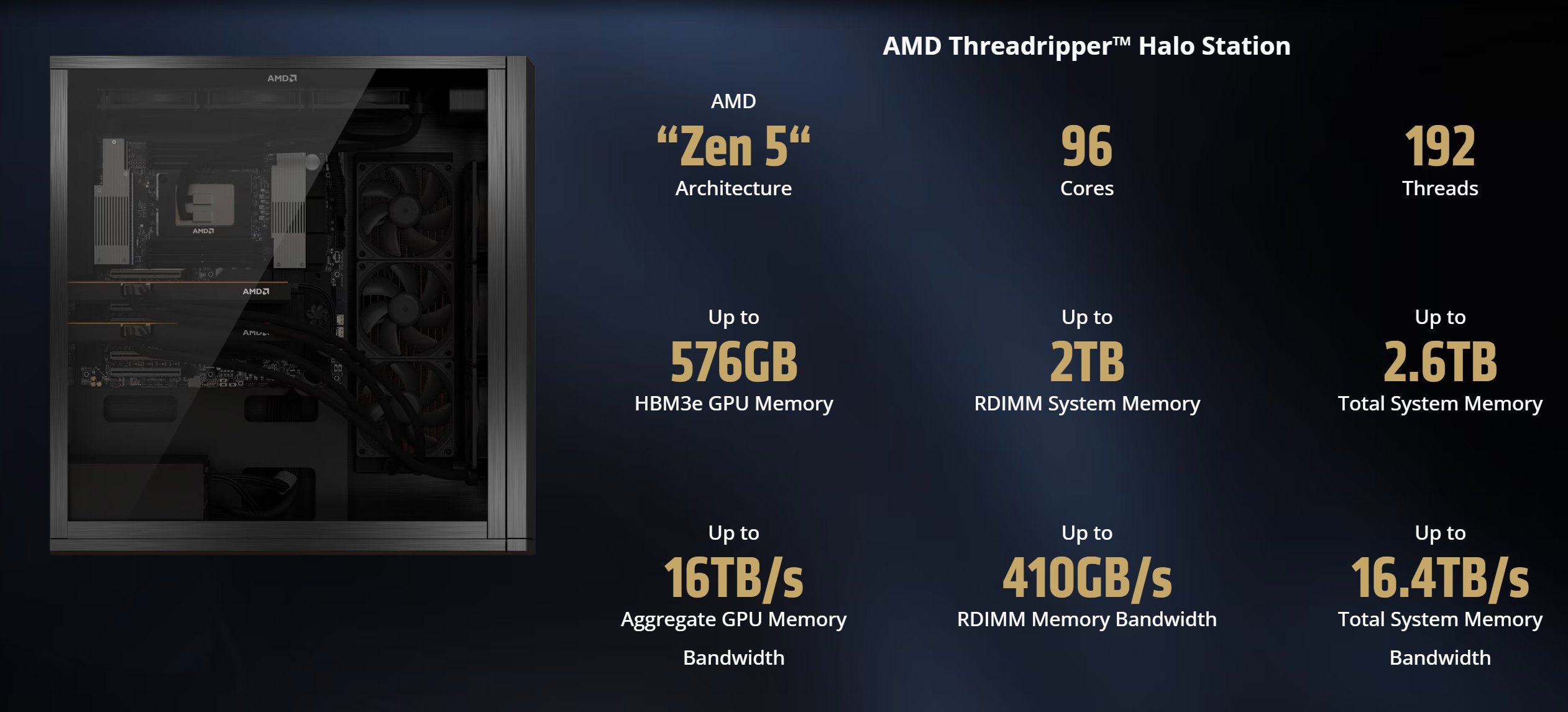
AMD unveiled the Threadripper Halo Station at the IFA 2026 exhibition. This remarkable machine effectively relocates a massive artificial intelligence server. It moves the hardware from a standard rack directly into a desktop chassis. The maximum configuration boasts 576 gigabytes of HBM3e memory for its accelerators. Furthermore, it supports up to two terabytes of conventional RAM. Consequently, users can execute trillion-parameter models entirely locally. They no longer need to transmit sensitive data to the cloud.
The Dawn of Personal AI Workstations
AMD designates this creation as a personal AI workstation. The manufacturer primarily targets researchers, model developers, and intimate engineering teams. They promise the capability to train and refine colossal models directly. Moreover, this system can simultaneously service hundreds of autonomous AI agents. Commercial availability for this innovative project should commence in 2027.
Formidable Hardware Specifications
Unprecedented Processing Power
The Threadripper PRO 9995WX forms the beating heart of this machine. It features 96 Zen 5 cores and 192 processing threads. This processor achieves clock speeds up to 5.4 GHz. Additionally, it contains 384 megabytes of L3 cache alongside a 350-watt thermal envelope. An eight-channel memory controller accommodates up to two terabytes of DDR5 RDIMM. This setup delivers a memory bandwidth reaching 410 gigabytes per second.
Revolutionary Graphics Integration
However, the most extraordinary attribute resides in the graphics department. AMD is finally porting its data-centric Instinct accelerators to a workstation format. The ultimate configuration houses four Instinct MI350P modules. Each individual unit possesses 144 gigabytes of HBM3e. This provides an astonishing 4 terabytes per second of memory bandwidth per card.
Four accelerators yield a cumulative 576 gigabytes of HBM3e. Together, they achieve up to 16 terabytes per second of total bandwidth. Combined with the system memory, the machine accesses up to 2.6 terabytes of RAM. AMD claims a staggering overall peak bandwidth of 16.4 terabytes per second. Of course, this 16 TB/s figure represents the sum of the individual accelerators. It does not reflect the speed of a single unified memory array.
Practical Applications and Privacy
The IFA prototype appeared somewhat more modest than the flagship version. It contained merely two MI350P cards with 288 gigabytes of HBM3e. Nevertheless, AMD specifically engineered the chassis to accommodate four full accelerators. Each module utilizes the advanced CDNA 4 architecture. They house 8,192 stream processors each. Ultimately, they generate up to 4.6 petaflops in MXFP4 calculations. The maximum power draw per card hits 600 watts, though users can restrict it to 450 watts.
This colossal HBM3e reservoir is absolutely crucial for large language models. It stores their massive weights directly within the accelerator memory. When developers quantize models to four bits, the weight volume decreases significantly. Therefore, a four-card configuration effortlessly holds models exceeding a trillion parameters. Users can offload auxiliary data into the slower system RAM. However, PCIe transfers are considerably more sluggish than native HBM3e access.
Naturally, AMD places a profound emphasis on absolute data privacy. Organizations can process sensitive corporate documents and proprietary code internally. They never have to surrender their intellectual property to a cloud vendor. Previously, running monumental models locally demanded multiple server-grade GPUs. Most standard workstations simply lacked the requisite video memory to function effectively.
Cost and Power Considerations
The astronomical price tag renders the “personal” moniker rather subjective. AMD has not yet disclosed the official retail price. According to estimates by The Register, a fully equipped system could cost between $100,000 and $150,000. Other experts appraise just the core components at well over six figures. Clearly, this behemoth will not compete with conventional gaming desktops.
Furthermore, the electrical requirements present a formidable challenge. Four flagship accelerators will consume up to 1.8 kilowatts of power alone. The 96-core processor adds another 350 watts to the equation. This excludes the memory, storage drives, cooling pumps, and auxiliary components. This configuration vastly exceeds the boundaries of a traditional desktop computer. It demands sophisticated electrical delivery and incredibly robust liquid cooling.
The Competitive Landscape
The primary challenger to this machine will undoubtedly be the NVIDIA DGX Station. The NVIDIA system offers 252 gigabytes of HBM3e at 7.1 TB/s. It includes an additional 496 gigabytes of LPDDR5X linked via NVLink C2C. In contrast, AMD provides significantly more HBM3e and 3.4 times the total memory. Yet, raw capacity does not solely dictate real-world model performance. Efficiency depends heavily on the PCIe interconnects and the maturity of the ROCm software stack.
The Threadripper Halo Station illustrates how rapidly the industry is evolving. The very definition of “local AI” is transforming before our eyes. Recently, this term implied running a tiny quantized model on a home PC. Now, AMD offers a desk-side computing leviathan. Its memory and consumption rival a small enterprise server. Still, it grants researchers data center capabilities without the relentless burden of cloud rental fees.
Support Our Threat Intelligence
If you find our technology report and cybersecurity news helpful, consider supporting our work.
 Buy Me a Coffee
PayPal
Buy Me a Coffee
PayPal