As the applications of generative and agentic artificial intelligence mature into highly intricate paradigms, the paramount logistical friction confronting software engineers has fundamentally shifted. Practitioners are no longer primarily bottlenecked by the synthesis of source code, but are instead financially and operationally paralyzed by exorbitant cloud API drawdowns and the labyrinthine initialization processes of localized runtime environments. To directly remediate this systemic friction, AMD has formally announced the impending launch of the Ryzen AI Halo Developer Platform, scheduled to open for commercial pre-orders this June, with a foundational retail nomenclature commencing at $3,999.
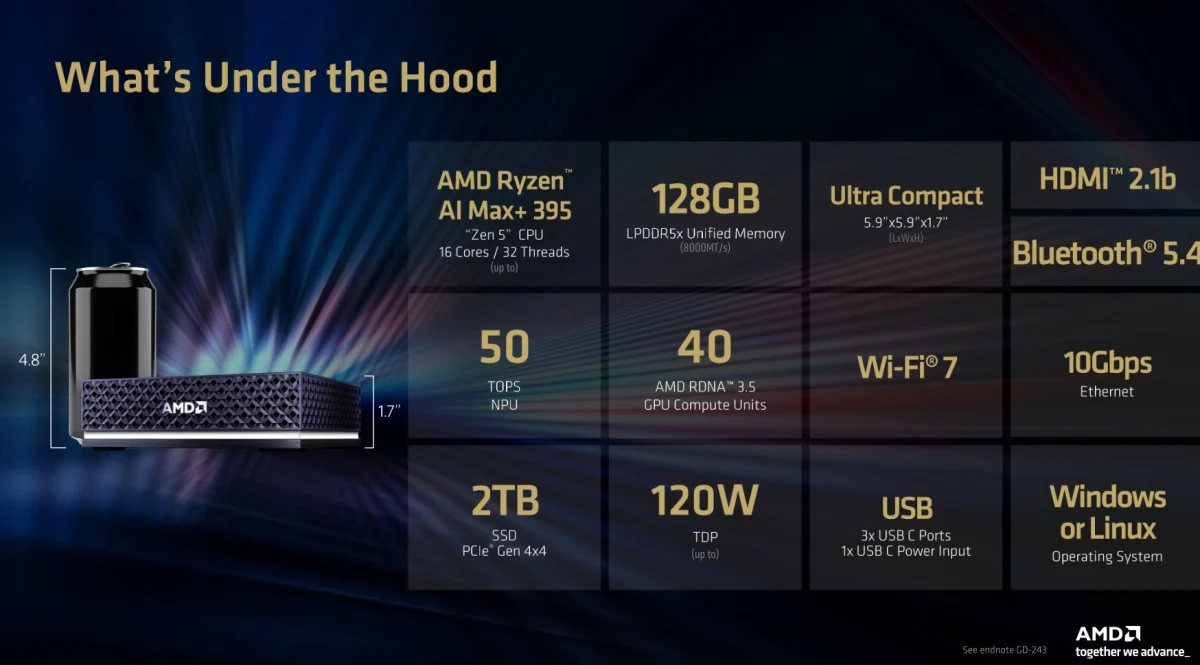
The Ryzen AI Halo materializes as an ultra-compact workstation chassis measuring a mere 5.9 x 5.9 x 1.7 inches. Its flagship SKU will be weaponized with the monolithic AMD Ryzen AI Max+ 395 processor—a compute engine boasting a 16-core, 32-thread CPU architecture derived from the Zen 5 instruction set, a dedicated Neural Processing Unit (NPU) yielding up to 50 TOPS of deterministic inference throughput, and a graphics subsystem leveraging 40 Compute Units (CUs) structured upon the RDNA 3.5 visual fabric.
The defining hardware advantage of this architecture resides in its dense provisioning of up to 128GB of high-speed LPDDR5x Unified Memory. This architectural consolidation empowers developers to orchestrate and execute frontier large language models scaling up to 200 billion parameters directly within local volatile memory buffers, completely bypassing off-chip communication bottlenecks.
On the software layer, AMD mitigates engineering friction via AMD AI Playbooks—a curated, turn-key software repository offering out-of-the-box software stacks that natively support both Windows and Linux target operating systems. This turnkey environment successfully recaptures days of lost engineering velocity traditionally squandered on driver harmonization and model compatibility triage.
Positioning the Ryzen AI Halo within the contemporary hardware macrocosm highlights the surgical precision of AMD’s competitive positioning:
-
In Juxtaposition with the NVIDIA DGX Spark: Although NVIDIA exercises absolute administrative hegemony over the enterprise landscape via its mature CUDA ecosystem, its $4,699 DGX Spark tier restricts developers strictly to Linux execution boundaries. Conversely, the Ryzen AI Halo offers a significantly suppressed capital expenditure entry point, introduces 50 TOPS of native, hardware-isolated NPU compute (an architecture entirely absent from the DGX Spark blueprint), and natively accommodates the Windows development pipeline, ultimately yielding an optimized, superior Tokens-Per-Second per dollar (TPS/$) matrix during dense LLM inference.
-
In Juxtaposition with the Apple Mac Mini M4 Pro: While Apple Silicon architecture has secured a significant market footprint within localized AI research loops due to its early monetization of unified memory fabrics, the Mac Mini M4 Pro is structurally capped at a maximum threshold of 64GB of memory. This physical constraint renders it incapable of instantiating frontier models exceeding 100 billion parameters and restricts its efficacy when executing state-of-the-art, high-fidelity video generation models—architectural barriers that the Ryzen AI Halo effortlessly obliterates with its 128GB allocation.
-
In Juxtaposition with Intel and Qualcomm Co-driven AI PCs: While the Intel Core Ultra and Qualcomm Snapdragon X portfolios exhibit highly optimized edge-inference metrics within standard “AI PC” form factors, their design philosophies are heavily tuned toward consumer-grade edge-compute workloads. For professional machine learning practitioners executing model fine-tuning arrays and parsing massive parameter structures, the desktop and workstation-tier unified memory strategies from Intel and Qualcomm remain considerably underdeveloped compared to the robust engineering of the AMD Halo platform.
Given that autonomous agentic architectures routinely consume in excess of one million tokens during a singular daily execution cycle, absolute dependency on cloud-hosted API fabrics introduces unsustainable operational overhead.
Per AMD’s forensic fiscal modeling, an enterprise development cell relying exclusively on the Claude Sonnet 4.5 cloud API during high-intensity, eight-hour daily development shifts will incur a staggering monthly recurring cloud expenditure approximating $773. Conversely, migrating that exact computational workload to a localized, $3,999 Ryzen AI Halo node—even when accounting for hardware depreciation alongside a calculated localized utility electricity draw of roughly $16.20 per month—allows the organization to achieve absolute financial amortization and break-even parity within a brief six-month operational window.
Projected across a standard three-year hardware lifecycle, the aggregate cost of ownership for the localized workstation plateaus at an estimated $4,582, whereas equivalent cloud-hosted API subscription fees skyrocket to a prohibitive $27,828. For agile startups and heavy artificial intelligence practitioners, migrating core compute structures back to localized hardware represents the single most effective methodology to preserve absolute data sovereignty while maintaining strict fiscal discipline.
Support Our Threat Intelligence
If you find our technology report and cybersecurity news helpful, consider supporting our work.
 Buy Me a Coffee
PayPal
Buy Me a Coffee
PayPal