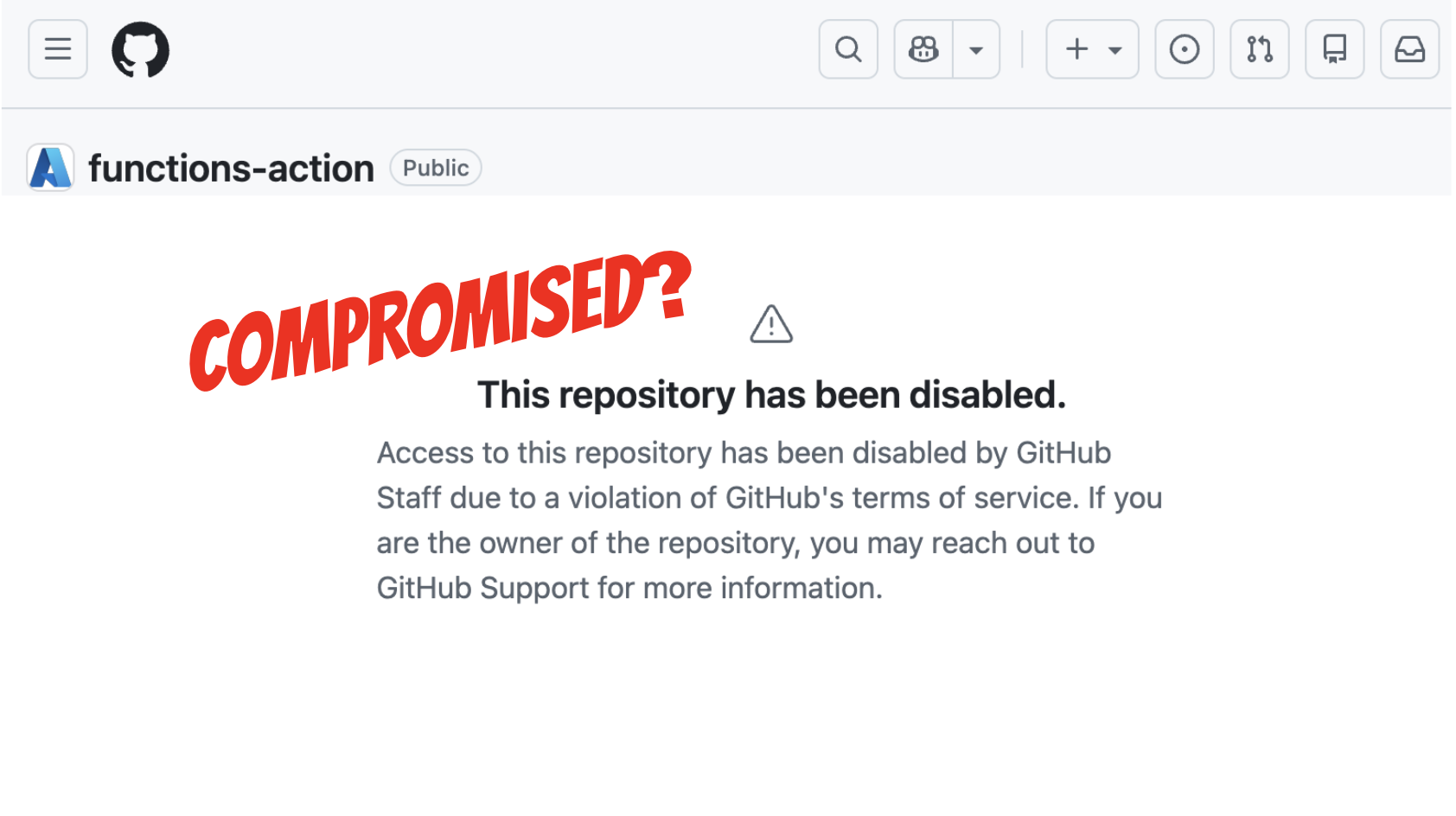
GitHub abruptly deactivated seventy-three institutional Microsoft repositories. This sudden intervention followed an aggressive resurgence of the self-propagating Miasma malware campaign. Consequently, the disruption fractured projects across four primary organizational domains: Azure, Azure-Samples, Microsoft, and MicrosoftDocs. The affected assets encompass critical cloud components, foundational code samples, engineering documentation, and the complete Durable Task ecosystem.
When attempting to access the Azure/azure-functions-host repository, developers encounter a generic Terms of Service violation notification. Therefore, GitHub advises repository owners to contact internal support for further classification. For external contributors, this administrative lock renders critical source code entirely inaccessible. Furthermore, engineers must treat recent historical revisions with profound skepticism until proper verification occurs.
Dissecting the Infection Matrix
According to telemetry from OpenSourceMalware, the compromised inventory includes high-profile distributions. Specifically, repositories like azure-search-openai-demo-purviewdatasecurity, Connectors-NET-SDK, and the language-specific variations of durabletask have vanished. This operational breach does not target inconsequential test scripts. Instead, the adversary systematically infiltrated vital infrastructure hubs, focusing on cloud functions, enterprise connectors, artificial intelligence demonstrations, and multi-language runtime components.
The Recurrence of the Durable Task Vulnerability
Notably, the current exploitation highlights the vulnerability of the Durable Task framework. During May 2026, threat actors poisoned the identical package within the PyPI registry via a compromised authentication token. In that instance, malicious iterations (versions 1.4.1 through 1.4.3) deployed a secondary module to harvest credentials across AWS, Azure, Google Cloud, and Kubernetes clusters. Researchers at SafeDep verified that the original GitHub repository escaped compromise during that phase. Instead, the perpetrator compiled the corrupted packages locally before uploading them directly using standard twine utilities.
The Evolution of the Worm Architecture
This latest administrative freeze alarms security analysts because the campaign returns to its primary target node. Beyond the core Azure/durabletask asset, the suppression engulfs sister projects spanning .NET, Go, Java, JavaScript, MSSQL, Netherite, and protobuf architectures. Security investigator Paul McCarthy, known online as 6mile, links this wave directly to the May incursions. He theorizes that the adversaries successfully retained valid access keys harvested during the prior breach.
Tracing the Lineage of Mini Shai-Hulud
Architecturally, analysts classify Miasma as a sophisticated variant of Mini Shai-Hulud. This self-replicating worm explicitly targets software supply chains. The TeamPCP collective disseminated the original prototype in mid-May 2026. Subsequently, rogue actors quickly weaponized and modified these core methodologies.
Miasma continuously refines its persistence mechanisms, propagating aggressively through novel packages and compromised maintainer accounts. Recently, the campaign persisted in hijacking repositories to construct public repositories designed to store exfiltrated secrets.
Cryptic Identifiers and Stolen Assets
To catalog these stolen assets, the threat group deployed specific repository descriptions. These strings included “Miasma: The Spreading Blight” and “Hades – The End for the Damned.” At the time of public disclosure, GitHub hosted thirteen environments labeled with the Hades signature. Concurrently, eighty-two repositories utilized variations of the Miasma nomenclature.
Bypassing Traditional Package Registries
Significantly, Miasma rejects exclusive reliance on classic registry poisoning techniques, such as corrupting the npm index. Instead, researchers observed instances where threat actors bypassed registries entirely to inject malicious payloads directly into root source repositories. A prominent casualty of this technique was icflorescu/mantine-datatable, alongside four associated ecosystems.
Infiltrating Intelligent Developer Workflows
Crucially, this specific malicious revision introduced no new external dependencies. The adversary merely embedded a large 4.3-megabyte binary module directly into the source architecture. They subsequently bound its execution to ubiquitous development applications. These utilities include Claude Code, Gemini CLI, Cursor, VS Code, and standard npm test routines.
Consequently, the exploit executes when a developer clones the repository and invokes an artificial intelligence coding companion. SafeDep characterizes this behavior as a multi-stage Bun bootloader adapted for direct source repository persistence.
This strategic maneuver poses a severe challenge for modern engineering teams. Typically, contemporary security audits focus heavily on inspecting package.json updates and lockfile modifications. If an incoming commit introduces no visible dependencies, standard automated scanners frequently fail to trigger alarms. Nevertheless, the compromised architecture secures an execution vector through trusted daily development environments. Ultimately, the coding assistant or the test engine transforms into a mechanism that launches the malicious loader.
The Structural Weakness of Open-Source Ecosystems
Fundamentally, this campaign exploits the inherent vulnerabilities of collaborative development. It systematically abuses trust in repository owners, cryptographic publishing keys, and maintainer identities. Because the platform witnesses actions originating from authenticated accounts, the malicious commit resembles a routine software update.
Therefore, traditional signature filters struggle to contain supply chain incursions. The Miasma worm does not exploit zero-day code defects within GitHub or npm infrastructure. Instead, it captures an administrative key or an automated workflow token to mimic an authentic maintainer. The package deploys via standard pathways, and dependent projects ingest the tainted code through previously verified channels.
Precedents in Automated Supply Chain Sabotage
The prior wave illustrated how rapidly these infections spread across massive digital landscapes. In early June 2026, Microsoft Threat Intelligence documented a parallel assault targeting @redhat-cloud-services within the npm registry. In that episode, adversaries compromised the core RedHatInsights continuous integration pipeline. This access enabled them to publish trojan horse modules via legitimate GitHub Actions workflows using OpenID Connect. That single breach compromised thirty-two distinct packages across ninety separate version releases. Miasma follows an identical operational logic by exploiting trusted automated pipelines rather than executing brute-force client hacks.
Critical Remediation and Post-Incident Auditing
Consequently, developers face exposures that extend far beyond Microsoft’s deactivated repositories. Following an administrative lockout, organizations must audit local clones, downstream forks, package caches, and continuous integration artifacts. If a team previously interacted with an affected repository, the mere restriction of the remote GitHub source fails to eliminate the systemic risk.
Miasma vividly illustrates the agility of modern self-propagating worms across package registries, source code repositories, and AI-driven development environments. Platforms have restricted seventy-three compromised Microsoft nodes, yet the underlying campaign continues to mutate. Therefore, engineers must validate the entire operational chain. Security teams must verify publishing tokens, inspect access keys, audit GitHub Actions workflows, and scrutinize localized AI programming utilities to guarantee absolute sanitation.
Support Our Threat Intelligence
If you find our technology report and cybersecurity news helpful, consider supporting our work.
 Buy Me a Coffee
PayPal
Buy Me a Coffee
PayPal