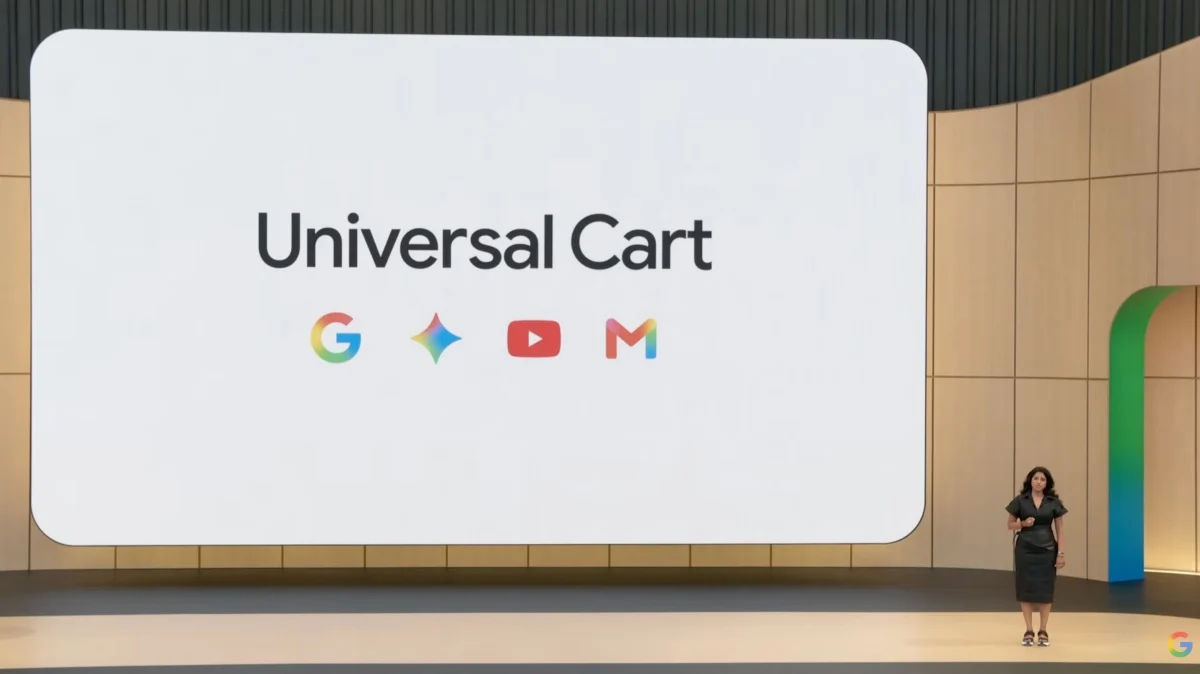
Every single day, upwards of one billion retail interactions transpire across the Google digital landscape. In a strategic maneuver to progressively consolidate and harmonize the modern consumer’s digital wallet, Google leveraged the stage of the Google I/O 2026 symposium to unfurl a grand paradigm shift designated as “Agentic Commerce,” simultaneously debuting its foundational framework, the “Universal Cart” platform.
Far from functioning as an elementary online checkout utility, the Universal Cart serves as an intelligent, decentralized nexus spanning Google’s entire ecosystem of flagship services, including Search, Gemini, YouTube, and Gmail. By mobilizing background artificial intelligence agents to autonomously cross-reference prices, harvest promotional codes, and rigorously evaluate product cross-compatibility, Google aims to transmute the traditional e-commerce methodology from an active search routine into an effortlessly delegated experience, establishing standardized transactional and semantic commerce layers alongside global retail conglomerates.
The core architecture of the Universal Cart is engineered to elegantly intertwine retail procurement with the organic flow of an individual’s digital existence:
- Ubiquitous Procurement Overlays: In the impending operational landscape, whether an individual is interrogating a product via Google Search, engaging in a stylistic consultation with Gemini, viewing a hardware exposition on YouTube, or parsing an editorial digest inside Gmail, they can consolidate desired merchandise into this cross-service, cross-merchant repository via a singular interface interaction.
- Autonomous Surveillance and Technical Validation: This capacity represents the crowning optimization of the Universal Cart framework. Once merchandise resides within the repository, specialized sub-agents powered by the Gemini 3.5 architecture operate persistently 24/7 to scan for localized price reductions, audit historical valuation fluctuations, dispatch stock restoration notices, and exercise structural logical reasoning. For example, if an engineer aggregates computer components from disparate vendors, the system will proactively emit a validation warning highlighting any component incompatibilities and programmatically suggest congruent algorithmic alternatives.
- Synergistic Google Wallet Financial Maximization: Benefiting from a deep-tier synchronization with Google Wallet, the cart programmatically interprets the user’s credit card reward structures, active loyalty points, and merchant-issued certificates. It then computes the most economically optimal transaction combination, definitively resolving the systemic friction of unapplied promotional tokens at the final step of purchase.
To ensure the fluid execution of transactions across highly fragmented software environments, Google partnered with elite retail empires earlier this year to author the Universal Commerce Protocol (UCP):
- Unified Inter-Merchant Checkout: Harnessing the UCP framework, consumers can deploy Google Pay within the Universal Cart interface to conclude multi-brand procurement pipelines within a minimal click stream. Alternatively, they retain the option to transfer the holistic inventory metadata straight to a merchant’s native web engine to finalise the purchase. This architecture prepares for imminent deployment within the United States, supporting an inaugural vanguard of brands and hyper-scalers including Nike, Sephora, Target, Ulta Beauty, Walmart, and Wayfair, alongside the vast network of independent merchants anchored to the Shopify infrastructure (such as Fenty and Steve Madden).
- Absolute Merchant Sovereignty: Google explicitly underscores that regardless of the digital canvas upon which the final execution command is triggered, the merchant of record remains strictly the brand entity itself, preserving Google’s role purely as an elegant, interconnecting conduit.
As humanity prepares to surrender financial authorization to autonomous computing agents, security boundaries and cryptographic trust naturally emerge as the paramount operational hurdles. In response, Google introduced the Agent Payments Protocol (AP2):
- Algorithmic Budgetary Safeguards: Under the AP2 framework, operators can enforce strict conditional logic boundaries upon their agentic proxies. For instance, a directive can mandate: “Monitor this specific iteration of Nike footwear; execute the transaction exclusively if the valuation descends below 3,000 units.” The protocol strictly prohibits the disbursement of capital unless all predefined conditional parameters are met with absolute precision.
- Immutable Forensic Ledgers: The AP2 architecture leverages advanced privacy-preserving cryptography to cultivate a verifiable, cryptographic tether binding the consumer, the merchant, and the payment broker. Each agent-orchestrated transaction generates an untamperable digital authorization token, ensuring that if a logistical dispute or asset restitution process arises, both parties possess clear, mathematically verifiable evidence. This protective technology will undergo its introductory practical deployment within the impending months via the persistent personal companion, Gemini Spark.
The overarching strategic significance of the Universal Cart lies in its masterfully adroit evasion of the immense logistical and capital burdens characteristic of centralized hyper-retailers like Amazon. Google has chosen instead to fortify its position as the ubiquitous, inescapable gateway to global commerce.
By unifying premier global brands under the banners of the UCP framework, Google successfully extends its analytical reach into the sovereign digital architectures of independent corporate storefronts. For the consumer constituency, the system delivers an unexampled assistant that systematically automates financial savings and aggregates disparate shopping desires into a singular canvas. For enterprise merchants, the integration promises a drastic reduction in historical cart-abandonment metrics while preserving unhindered sovereignty over their proprietary consumer data.
Concurrently, for Google, this paradigm shift cements its absolute status as the premier gatekeeper of the digital frontier, intertwining its foundational advertising machinery directly with the actual moment of transaction. This summer, the vanguard of this commercial revolution will ignite across the United States.
Support Our Threat Intelligence
If you find our technology report and cybersecurity news helpful, consider supporting our work.
 Buy Me a Coffee
PayPal
Buy Me a Coffee
PayPal