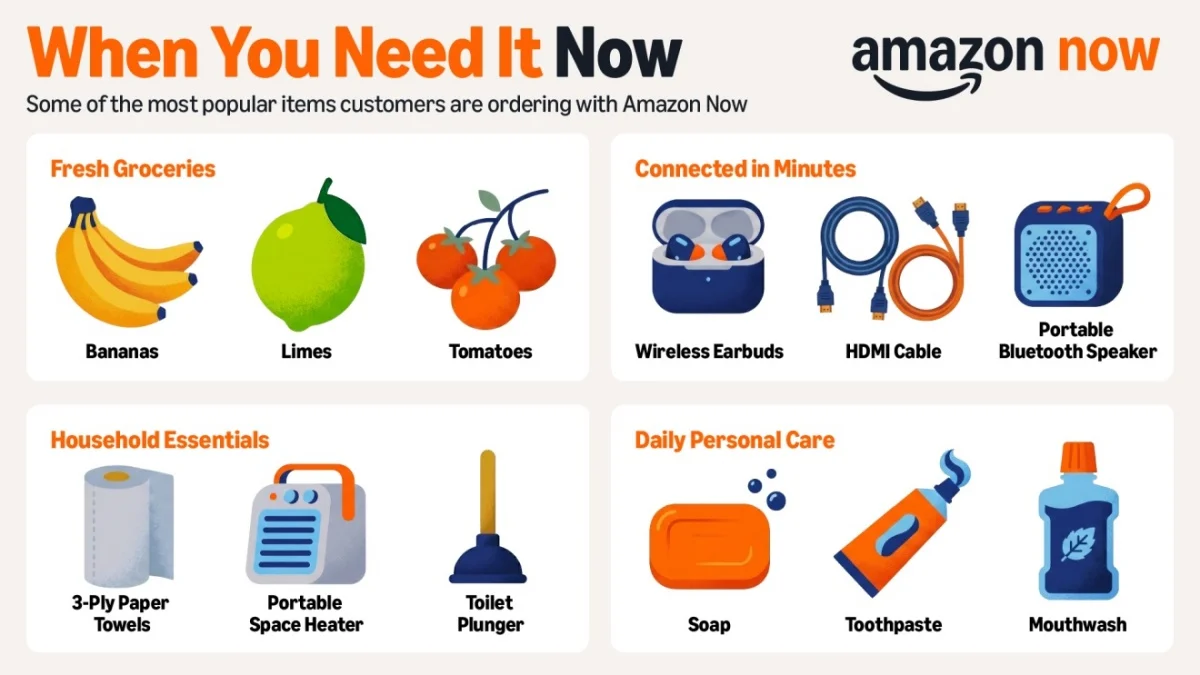
Amazon has recently proclaimed that Amazon Now, its flagship ultra-rapid delivery service, is officially expanding its deployment to dozens of major American metropolises, including Atlanta and Dallas, following triumphant pilot programs in Seattle and London. This service pledges to deliver fresh perishables, household essentials, and even select consumer electronics into the hands of users within a mere thirty minutes. Such an initiative not only threatens the viability of traditional brick-and-mortar retail but also underscores Amazon’s preeminence in the strategic orchestration of urban micro-fulfillment centers.
To achieve the ambitious target of a thirty-minute delivery window, reliance on conventional, sprawling suburban distribution hubs is inherently insufficient. The efficacy of Amazon Now is predicated upon a structural metamorphosis of its logistics network:
- Satellite Micro-Warehousing: Amazon has established a multitude of small-scale distribution nodes situated strategically within urban cores and adjacent to residential and commercial districts. This significantly curtails the transit distance for delivery partners and ensures that order fulfillment is executed within minutes.
- Perpetual 24/7 Operations: In the majority of participating cities, Amazon Now operates incessantly. Users need only navigate the Amazon application or official portal to identify items designated for “30-Minute Delivery”—a selection encompassing urgent daily necessities such as dairy products, eggs, and detergents.
- Tiered Remuneration Model: This expedited service mandates a fee structure: Prime members incur a $4 delivery charge per order, while non-members are assessed a fee of $14. Furthermore, orders falling below a $15 threshold are subject to a nominal processing surcharge.
Amazon Now currently represents the swiftest echelon of the Amazon logistics hierarchy. Beyond this, the company’s “last-mile” arsenal includes:
- Drone Delivery: Currently providing aerial delivery within one hour across nine distinct locations in the United States.
- Multimodal Speed Options: This encompasses one-hour and three-hour windows, alongside same-day delivery options spanning over 10,000 municipalities.
Nevertheless, the competition remains formidable. The retail titan Walmart is actively collaborating with Wing, the drone subsidiary of Google’s parent company, Alphabet, recently extending its autonomous aerial delivery services to the San Francisco Bay Area. The conflict over delivery celerity has ascended from terrestrial fleets into the low-altitude airspace.
The large-scale implementation of Amazon Now highlights the company’s endeavor to seize the final frontier not yet fully conquered by e-commerce: spontaneous, instantaneous consumption. Historically, the immediate need for a household staple necessitated a visit to a local convenience store or supermarket. However, as Amazon gains the capability to deliver these goods to one’s doorstep within thirty minutes at a relatively modest cost, the “immediacy” advantage of physical retail is profoundly diminished.
Conversely, the backbone of this service is rooted in sophisticated “predictive analytics.” Amazon must possess an exacting understanding of regional consumption patterns to maintain precise inventory within the constrained spatial confines of micro-fulfillment centers. As the service expands toward Austin, Phoenix, and Denver by the conclusion of 2026, Amazon is weaving its logistics network into an omnipresent “invisible convenience store web.” While this bolsters lifestyle convenience for the consumer, the resulting strain on logistical infrastructure and urban traffic remains a subject warranting close observation.
Support Our Threat Intelligence
If you find our technology report and cybersecurity news helpful, consider supporting our work.
 Buy Me a Coffee
PayPal
Buy Me a Coffee
PayPal