Following the conclusion of Red Hat Summit 2026, Daniel Aw (Vice President and General Manager, APJ), Vincent Caldeira (Chief Technology Officer, APJ), and Fytos Charalambidas (Vice President of Technical Sales, APJ) engaged in a comprehensive dialogue to elucidate how the open-source pioneer is leveraging hybrid cloud technology to stabilize its strategic trajectory in the Asia-Pacific market amidst the global surge of generative and agentic AI.
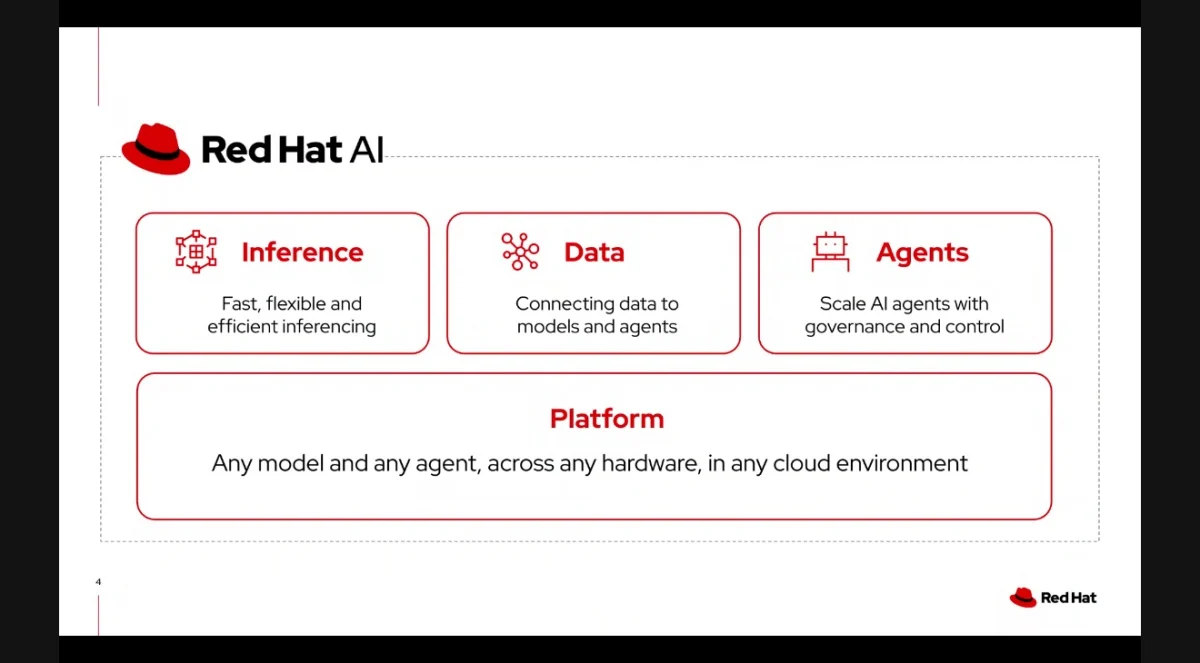
Addressing the rapid evolution of the AI landscape, Vincent Caldeira clarified that Red Hat’s focal point has expanded beyond mere foundational infrastructure to encompass the holistic management of the AI lifecycle. With the release of Red Hat AI 3.4, the company has not only fortified its agile inference frameworks—incorporating vLLM and robust inference servers—but has also formally ventured into the realm of Agentic AI.
Caldeira noted that corporate expectations have transcended rudimentary tasks like email drafting; enterprises now demand AI “agents” capable of autonomous tracking, observation, and the execution of intricate business workflows. To this end, Red Hat has introduced specialized tools for agent identity and lifecycle management, utilizing the Ansible Automation Platform to orchestrate a seamless union between AI recommendations and human oversight, thereby achieving secure, governed automated remediation.
Daniel Aw highlighted that the Financial Services Industry (FSI) exhibits the most fervent demand for AI adoption across the Asia-Pacific region. Institutions such as banks, brokerage firms, and exchanges are actively deploying models via Red Hat’s hybrid cloud platforms to refine customer experiences and risk mitigation strategies. This is followed closely by the public sector, where escalating geopolitical complexities have intensified the demand for AI innovation and sovereignty within the defense domain. Furthermore, Aw observed a spirited transition toward virtualization in Australia and Japan, with Red Hat OpenShift Virtualization achieving record-breaking revenue in the first quarter of 2026—a testament to the market’s acceleration in merging legacy infrastructure into AI-oriented hybrid environments.
Regarding the burgeoning concept of “AI Sovereignty,” Caldeira emphasized that this imperative now transcends simple data localization, encompassing granular control over infrastructure, data, and operational layers. Fytos Charalambidas added that Red Hat’s profound collaboration with NVIDIA is a cornerstone of this movement, providing the Red Hat AI Factory blueprint and “Day 0” support for NVIDIA’s latest architectures, including Blackwell. By leveraging the inherent transparency of open-source technology, Red Hat assists regional governmental and corporate entities in architecting “Zero Trust AI” frameworks, ensuring that both training and inference align with local regulatory and security benchmarks.
Charalambidas remarked that while the Asia-Pacific market was trailing North America a decade ago, it is now a vanguard of innovation. He noted a distinct bifurcation in market needs: one segment pursues rapid innovation at the “speed of the market,” requiring daily updates and a Zero CVE (Zero Vulnerability) environment; the other demands enduring stability. This necessity prompted the launch of the “RHEL Forever” extended maintenance service, which supports critical systems for cycles spanning ten to thirty years.
The strategic essence of Red Hat Summit 2026 underscores a conviction that the future of AI is irrevocably open-source. Whether through the provision of hardened container images via RHEL or achieving the $2 billion milestone in OpenShift recurring revenue, Red Hat is utilizing the hybrid cloud as a bedrock to ensure that Asia-Pacific enterprises can pursue the AI race with both velocity and unwavering resilience.
Support Our Threat Intelligence
If you find our technology report and cybersecurity news helpful, consider supporting our work.
 Buy Me a Coffee
PayPal
Buy Me a Coffee
PayPal