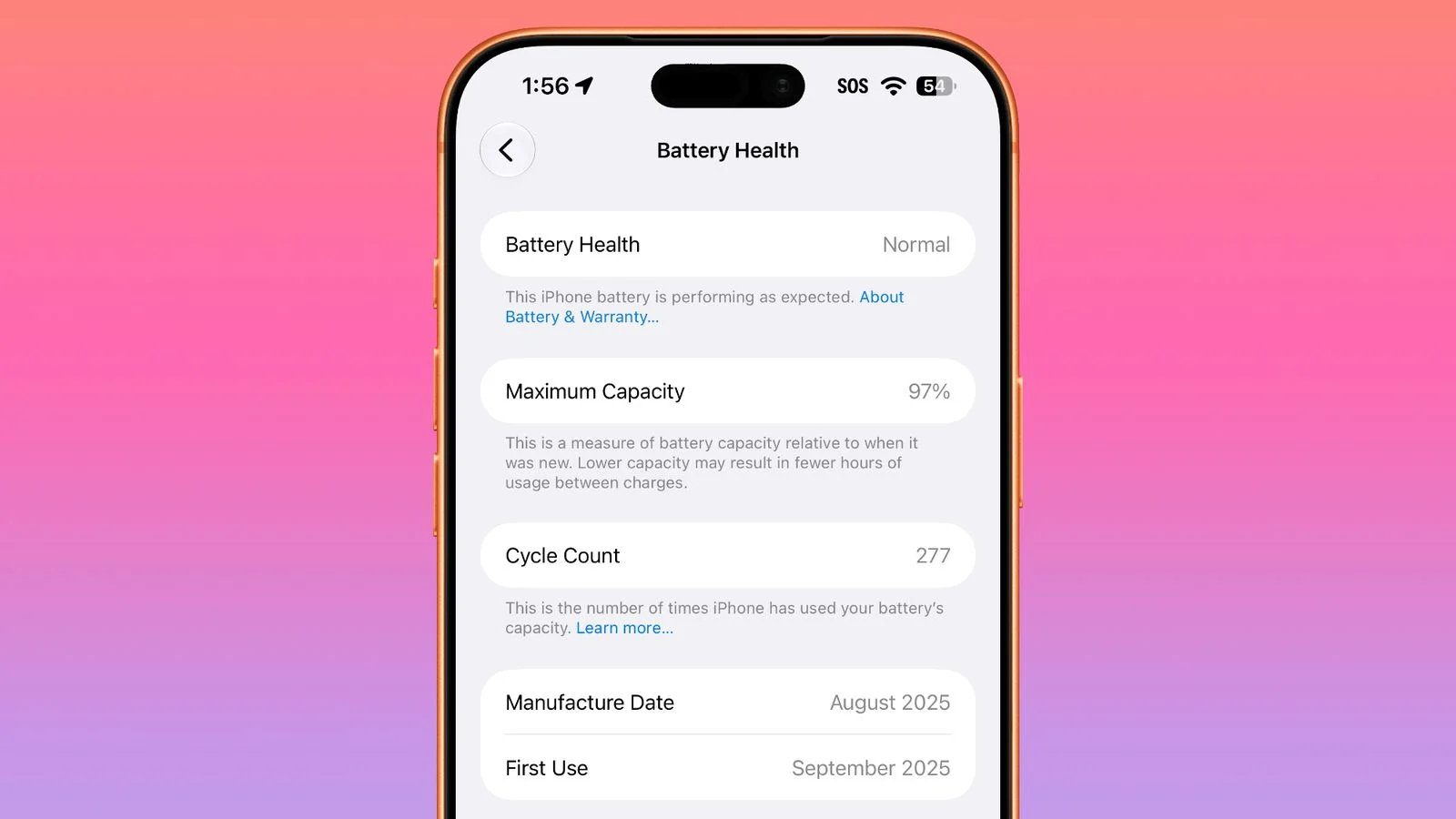
Recently, MacRumors published an observational usage report spanning three consecutive iPhone generations. The author maintained an 80% charge threshold on an iPhone 17 Pro Max for a full year. Consequently, the maximum battery capacity remained at an impressive 97% across 277 charge cycles.
In comparison, previous flagship generations exhibited steeper declines. Both the iPhone 15 Pro Max and iPhone 16 Pro Max dropped to 94% after their inaugural year. Furthermore, after three years of service, the iPhone 15 Pro Max retained 88% capacity across 369 cycles. Meanwhile, the iPhone 16 Pro Max concluded its second year with 93% health after 343 cycles.
Nuances of Anecdotal Battery Performance
MacRumors emphasized that these individual findings do not constitute a controlled laboratory study. Indeed, multiple external elements influence chemical degradation. Battery chemistry varies subtly among production units. Moreover, daily workload intensity, recharging frequency, and ambient temperatures profoundly shape real-world battery longevity.
Apple notes that restricting the peak charge to 80% noticeably slows chemical aging. Conversely, when battery capacity dips below 80%, the system may throttle peak processing speeds to prevent unexpected shutdowns. This performance mitigation recalls previous controversies regarding vintage iPhone devices. Therefore, sustaining battery longevity preserves fluid operating speeds.
Wired Versus Wireless Thermal Impact
In addition, the author predominantly utilized wired USB-C cables rather than wireless charging pads. Admittedly, measuring the exact impact of this charging choice remains challenging. Wireless chargers typically transmit power at lower wattages. However, wireless charging coils generate elevated thermal heat, which can quietly accelerate battery degradation over time.
Practical Charging Thresholds for Mobile Users
Starting with the iPhone 15 lineup, Apple introduced adjustable charging ceilings within system settings. Users can conveniently select upper limits of 80%, 85%, 90%, 95%, or 100%. Specifically, capping the charge limits the duration a lithium cell spends at maximum chemical voltage. The operating system will occasionally top up to 100% to recalibrate measurement accuracy.
Nevertheless, frequent travelers might prefer charging to full capacity. That extra 20% provides crucial endurance during demanding commutes. Ultimately, every lithium-ion cell deteriorates with relentless passage of time. Users must eventually replace their aging batteries regardless of software limits.
Balancing Mobility and Cell Preservation
For individuals who regularly carry portable power banks, the 80% ceiling remains an exceptional choice. This proactive habit curbs battery wear while relieving daily battery anxiety on busy afternoons.
Support Our Threat Intelligence
If you find our technology report and cybersecurity news helpful, consider supporting our work.
 Buy Me a Coffee
PayPal
Buy Me a Coffee
PayPal