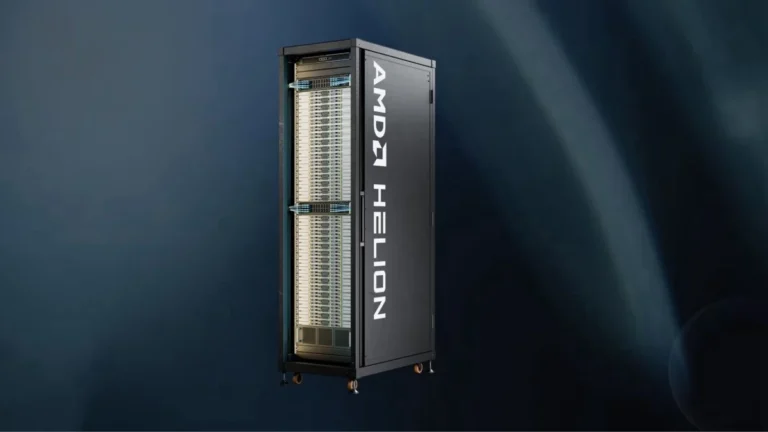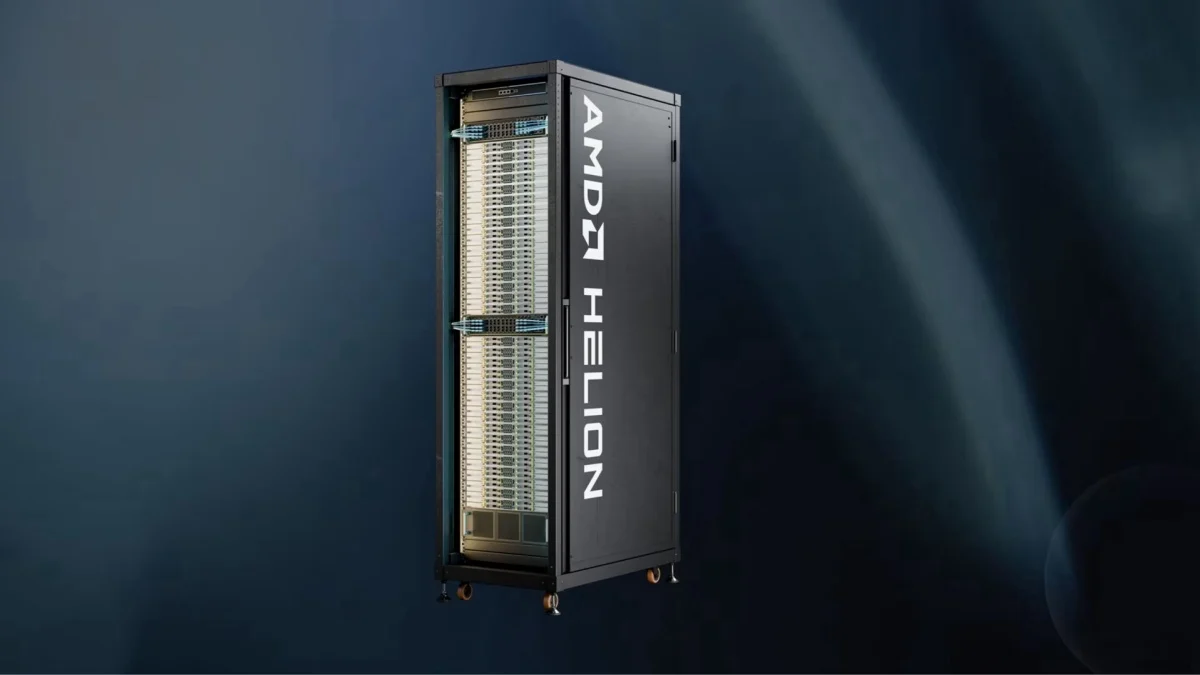
As generative AI progressively evolves from rudimentary conversational interfaces into autonomous “Agentic AI” capable of executing tasks, scripting code, and managing workflows, the fundamental computing architecture required by data centers is undergoing a profound metamorphosis. To seize this emerging wave, AMD has officially unveiled a revolutionary rack-scale, open infrastructure blueprint: AMD Helion.
Engineered for Agentic AI: A Dynamic Equilibrium of CPU and GPU
“Agentic AI is not a monolithic workload,” articulated Dan McNamara, AMD Senior Vice President of Server Business, astutely pinpointing the current industry bottleneck during the product launch. When AI agents execute enterprise applications or navigate complex workflows, they rely not only upon GPUs for model inference and generation but also demand formidable CPUs to handle logical deduction, code execution, and systemic orchestration.
Consequently, the AMD Helion architecture introduces an exceptionally resilient design, inherently featuring an “integrated token router.” This innovative mechanism, synthesizing hardware and software, autonomously and dynamically directs AI agent model invocations between open-source and frontier models. This guarantees the most efficient allocation of computational resources.
Dual-Track Configuration Strategy: Satisfying Hyperscale and Enterprise Demands
Predicated upon the Open Compute Project (OCP) design specifications, AMD Helion offers flexible configurations supporting both air and liquid cooling. Furthermore, it introduces two distinct yet highly practical demonstrative architectures tailored for disparate client demographics:
- Hyperscale-Dedicated CPU Rack: This is an aggressively processor-dominated configuration. A single rack, populated with the latest sixth-generation AMD EPYC processors, can accommodate an astonishing maximum of 32,768 CPU cores. This deliberate design decouples AI agent execution and logical computation from model inference. This architectural separation empowers cloud behemoths to possess dedicated agentic AI execution capacity, subsequently connecting to independent GPU inference clusters via high-speed networks.
- Enterprise-Grade All-in-One Rack: Targeting enterprise clients seeking comprehensive solutions within a singular platform, AMD provides a hybrid rack. This configuration seamlessly amalgamates EPYC CPU nodes, AMD Instinct MI350P GPU nodes, and general-purpose computing, flawlessly integrating agentic AI execution and model inference within a solitary physical framework.
Open Ecosystem versus Closed Ecosystem: Resounding Support from Tech Titans
AMD anticipates contributing the Helion design specifications to the OCP open-source community, with related rack configurations slated for an official collaborative launch with ecosystem partners this November.
Upon its announcement, this initiative immediately garnered the endorsement of a veritable all-star lineup within the server industry. Industry heavyweights, including Cisco, Dell, Foxconn, HPE, Lenovo, Quanta Cloud Technology (QCT), Supermicro, and Wiwynn, have already declared their intentions to launch customized rack solutions predicated upon the AMD Helion blueprint.
AMD’s Counter-Encirclement Strategy: Challenging NVIDIA’s Systemic Hegemony
Analyzing the open-source design of AMD Helion in contrast to the GB200 NVL72 rack system aggressively promoted by NVIDIA illuminates fundamentally divergent philosophies. NVIDIA’s strategy is undeniably “the system is the chip.” Through NVLink and proprietary network architectures, they tightly bind the entire rack into a closed, profoundly efficient, yet exorbitantly expensive super-brain.
Conversely, AMD Helion plays two formidable trump cards: an open blueprint and OCP compliance. While Jensen Huang seeks absolute imperial dominion, Lisa Su is systematically uniting a formidable coalition of server brands and prominent Taiwanese ODMs to mount a collective resistance. AMD grants its partners an extraordinary degree of customization flexibility – such as the liquid cooling and rack integration prowess mastered by Wiwynn and Supermicro – employing this alliance to combat NVIDIA’s increasingly autocratic control over system architectures.
Furthermore, Helion’s pronounced emphasis on CPU core density in the era of agentic AI represents a stroke of strategic brilliance by AMD. During the initial generative AI epoch, NVIDIA convinced the industry that the GPU was absolute. However, in the imminent agentic AI era, agents must execute code, invoke APIs, manage memory, and orchestrate complex scheduling – disciplines that remain the undeniable forte of traditional CPUs. Through Helion, AMD is unequivocally reminding the entire industry that in the impending second half of the AI revolution, the master of the most powerful x86 server CPUs undoubtedly wields a voice that cannot be ignored.
Support Our Threat Intelligence
If you find our technology report and cybersecurity news helpful, consider supporting our work.
 Buy Me a Coffee
PayPal
Buy Me a Coffee
PayPal