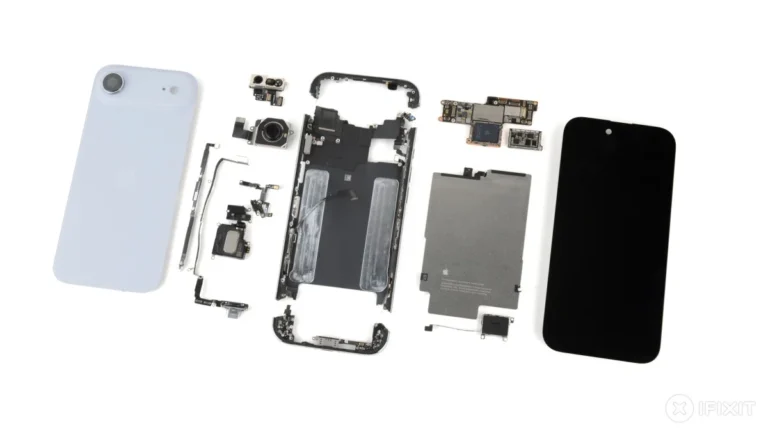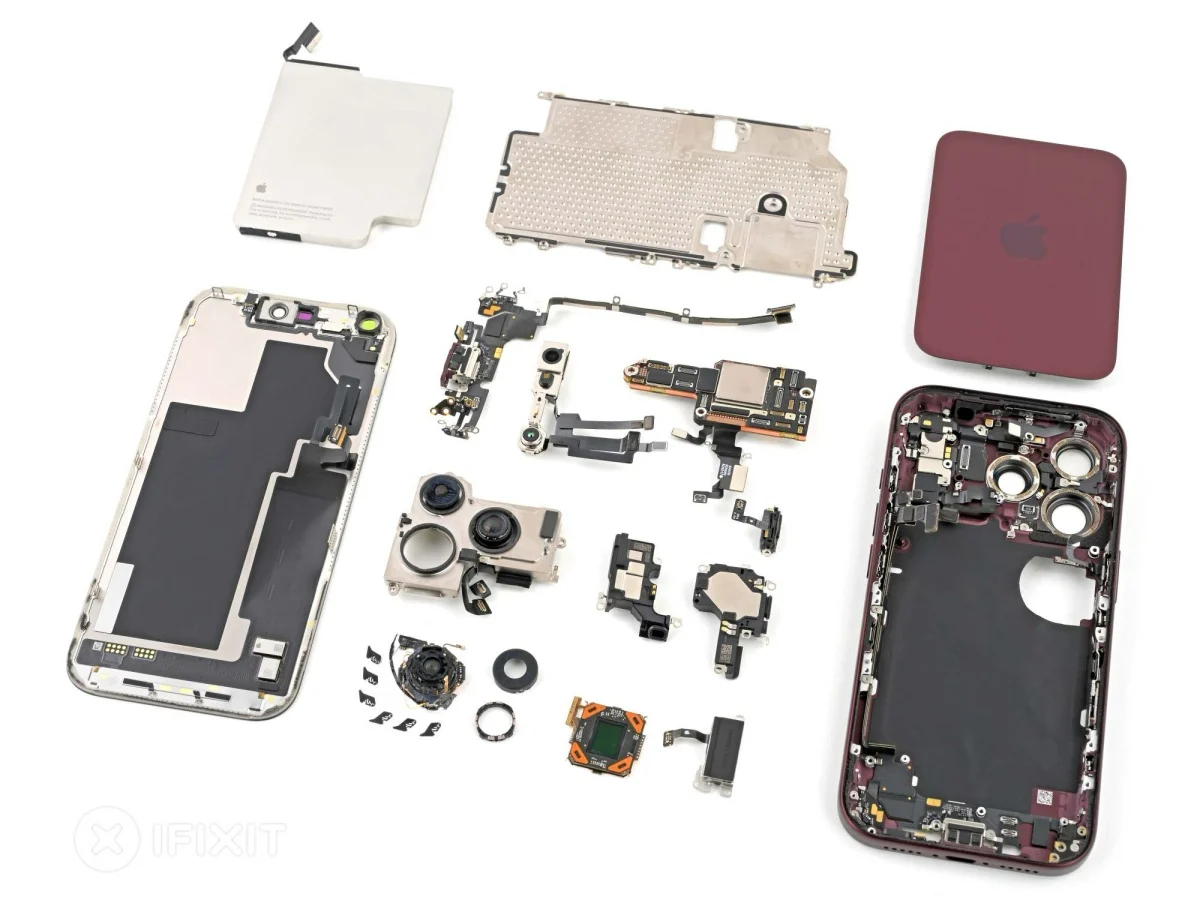
Each year, as a new iPhone arrives, iFixit’s dissection affords the world a glimpse of the craftsmanship trade-offs Apple makes within its limits of internal space. This year’s iPhone 18 Pro and iPhone 18 Pro Max not only add a variable-aperture lens operating like a mechanical pupil, but also introduce sweeping changes to cooling, mainboard layout, and under-display sensing components.
Yet accompanying this exquisitely precise structure is a shift in repair difficulty and risk. Of the four phones iFixit tested and dismantled, three suffered a tearing and detachment of the plastic frame around the display upon opening. iFixit documented it all in its full teardown video.
Mechanical Variable Aperture: Exquisite Craft, Almost No Standalone Repair
The iPhone 18 Pro series main camera introduces a variable-aperture mechanism (offering four presets: f/1.48, f/1.8, f/2.8, and f/4.0). Under the microscope, this structure resembles a miniature precision mechanical watch:
- Hair-thin blades: It employs six magnetically driven “polymer composite” blades, each merely as thick as a human hair, with tiny locating holes and sliding grooves along the edges, overlapping and gliding against one another before a sensor less than half an inch across.
- Physical optical limits: Although f/1.48 sets a record for the largest aperture in iPhone history (letting in 7.3 times the light of f/4.0), the small 6.8mm physical focal length and compact sensor limit its maximum physical opening to about 4.6mm. Testing shows that stopping the aperture down does sharpen edge quality, yet at maximum aperture the bokeh still cannot rival that of a full-frame camera.
- Costly repairs: This tightly bonded, tiny-tolerance aperture module is essentially “unrepairable on its own.” If a blade jams or oil adheres, the only repair route is to replace the entire camera module (the previous iPhone 17 Pro’s camera module was quoted at $249, and this generation’s replacement cost is expected to be higher). Fortunately, the camera module itself retains an independent modular design.
Face ID Components Move Under the Display, Shrinking the Dynamic Island
On the front, Apple has for the first time moved Face ID’s infrared camera beneath the upper-left corner of the display, while the TrueDepth camera (selfie lens) and dot projector remain in the central cutout.
Under a high-magnification microscope, the OLED display above the infrared lens adopts an “interlaced pixel-culling” arrangement, letting light pass through the panel to reach the infrared filter below, a principle akin to the under-display camera (UDC) of Samsung’s Galaxy Z Fold series. Since the infrared camera need only capture biometric contours rather than full-color images, the interference from the pixel grid can be easily overcome by algorithms, while the central Dynamic Island shrinks further in area.
Doubled Cooling, but an Enclosed SoC Complicates Data Recovery
In mainboard and cooling architecture, the iPhone 18 Pro shows important adjustments:
- A20 Pro moved outward for better heat conduction: The A20 Pro processor moves from its former “sandwich inner layer” to the outer side, and the memory shifts from the previous PoP packaging to a side-by-side configuration, pressing more directly against the newly designed vapor chamber, whose surface area is three times larger than the previous generation’s, greatly improving the old heat-buildup problem.
- NAND sealed inside raises the data-recovery bar: The price of improved cooling is that the NAND flash memory chip is enclosed within the mainboard’s interlayer. Should the mainboard suffer water ingress or a short circuit, a repair engineer must first use high-temperature desoldering to separate the double-layer board before reaching the storage chip, greatly increasing the labor and risk of chip transplantation and data recovery.
- A clever modem configuration: Most versions across the lineup use Apple’s in-house C2 modem, and only the US eSIM version of the iPhone 18 Pro Max still uses a Qualcomm modem, which observers speculate relates to the two companies’ patent agreement running through the end of 2026.
A Boon for Battery Swaps, With a Catch: Great Metal Tray, but Opening the Screen May Crack the Frame
The screwed-in metal battery tray, much praised since last year, continues in the iPhone 18 Pro. Removing 13 screws lets one lift out the battery together with the tray, with no stubborn adhesive to fight; to replace the cell alone, applying 12V for about 90 seconds cleanly releases the electronically controlled adhesive.
Entering the interior, however, is fraught with pitfalls. Although the rear glass is easy to remove, all key internal components (including the battery) must be reached “by removing the display from the front.” In iFixit’s teardown test, even after heating for as long as 25 minutes, three of the four phones suffered breakage and peeling of the white plastic frame around the display. Once the plastic frame is damaged, re-gluing cannot restore the original waterproof airtight seal.
Ultimately, iFixit gave the iPhone 18 Pro and iPhone 18 Pro Max a provisional repairability score of 7 out of 10.
Further Observation: How Does a 5,000mAh+ Battery Fly? Apple’s Factory Software Lock Sidesteps the 20Wh Air-Travel Ban
On battery specifications, the pure-eSIM iPhone 18 Pro has a battery capacity of 4,288 mAh (16.76 Wh), while the top-tier iPhone 18 Pro Max crosses the 5,000 mAh mark in a single stride, reaching 5,567 mAh in the pure-eSIM version and 5,391 mAh in the physical-SIM version.
Notably, converted, both iPhone 18 Pro Max models slightly exceed the 21 Wh mark, directly touching the air-transport restriction laws of many countries that bar small personal electronic devices from exceeding 20 Wh without special declaration.
To resolve this regulatory threshold in global logistics, Apple adopted an ingenious strategy: at the factory, it locks the battery’s charge ceiling below 20Wh via software, so the boxed device meets aviation and customs transport standards worldwide. Once the consumer first powers on and connects to the network to activate the device after purchase, the system automatically “breaks the seal,” releasing the full rated capacity. Should the user later need to ship the device back for repair, they can even manually re-enable this 20Wh limit mode in the system menu.
Miniature Mechanics and Software Hedging: Apple’s Mature (and Calculating) Engineering Aesthetic
From this internal structure and its peripheral regulatory countermeasures, one can clearly see two extreme faces of Apple as the world’s leading consumer-electronics company.
On one hand, its hardware craftsmanship displays breathtaking engineering prowess. Cramming six mechanical aperture blades under 5mm in diameter into a tiny lens module, and even reallocating the double-layer mainboard’s component layout for cooling, all demand extreme precision in supply-chain integration. The price, however, is a higher “modular replacement cost” and a steeper barrier to independent repair.
On the other hand, faced with the outdated but still-effective international 20Wh air-transport regulation, Apple chose not, like other Android makers, to offer regional reduced-capacity batteries or a complex dual-cell architecture. Instead, it opted to sail through with a “factory software lock, unlocked upon network activation.” This software-minded approach to dissolving a regulatory barrier cannot but command admiration for Apple’s deep calculation in supply-chain management and compliance maneuvering.
Support Our Threat Intelligence
If you find our technology report and cybersecurity news helpful, consider supporting our work.
 Buy Me a Coffee
PayPal
Buy Me a Coffee
PayPal