In a single day, Apple refreshed nearly its entire software ecosystem. On September 14, the company released iOS 27, iPadOS 27, macOS 27, watchOS 27, visionOS 27, and tvOS 27. The headline novelty is Siri AI, the long-awaited overhaul of the voice assistant built on Apple Intelligence, capable of taking on-screen content into account, searching personal information within apps, and performing actions at the user’s request. Apple confirmed the rollout in its developer releases notes.
A Rebuilt Siri, Launching in Beta
Siri AI launches in a beta version and at first works only on devices set to English. In October, Apple plans to add French, Japanese, Korean, Portuguese, and Spanish. Russian is not yet among the announced options.
As The Verge detailed at launch, the new Siri differs markedly from the former assistant. It can sustain a conversation with clarifying questions, search for information among messages, email, and photos, analyze text or an image open on screen, and retrieve current information from the internet. Siri can, for instance, find a restaurant recommendation a friend sent, locate a hotel booking number in an old email, or gather photos from a particular trip.
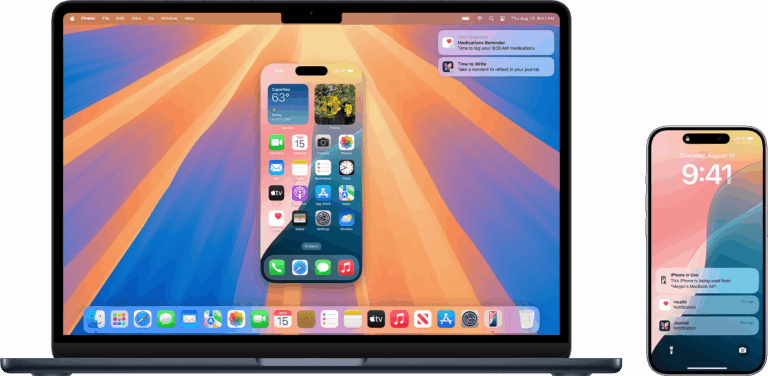
Apple has also expanded Siri’s ability to work with apps. The assistant can compose an email from scratch, edit text, process photographs, and pass the result to another app. On iPhone, a conversation can begin by voice, the side button, or a swipe down from the Dynamic Island. On iPad and Mac, Siri AI is built into Spotlight and system context menus, so a question can be posed directly about an open image, document, or selected text.
Privacy and Device Support
Conversation history is now stored in a separate Siri app and syncs via iCloud across compatible devices. To process requests, Apple uses local models and the Private Cloud Compute server infrastructure. The company asserts that personal data is neither retained during server processing nor made accessible to Apple employees.
Support for Siri AI is noticeably narrower than that of iOS 27 itself. The new system can be installed from the iPhone 11 and second-generation iPhone SE onward, but Apple Intelligence features require at least an iPhone 15 Pro or 15 Pro Max, or an iPhone 16-family model and newer. On iPad, a model with an M1 or newer processor, or an iPad mini with A17 Pro, is required. On Mac, most Apple Silicon computers from the M1 onward qualify.
iOS 27: Refined Liquid Glass and Smarter Apps
In iOS 27, Apple refined the Liquid Glass interface after the previous design’s contentious debut. A transparency slider now appears in settings, letting users make elements more translucent or more opaque. System apps received updated icons, especially large widgets appeared, and the volume of calls, alarms, timers, notifications, and system sounds can now be adjusted separately.
Apple Intelligence has reached the built-in apps too. Safari can automatically group numerous tabs by topic and monitor changes on selected pages. The Passwords app gained a feature especially interesting for security: upon detecting a weak or compromised password, the system can open the relevant site, sign in to the account, and replace the password with a stronger one. The user need only confirm the operation.
Photos gained expanded image-editing tools. The system can change cropping while generating the missing areas, extend a shot, and remove extraneous objects more neatly. Image Playground gained the ability to create photorealistic images, and Apple marks generated material with a hidden SynthID watermark.
iPadOS 27: A Focus on Performance
iPadOS 27 concentrated in part on performance. Apple claims work with external drives is accelerated up to fivefold, along with faster app launches and AirDrop file transfers. The system should also switch more smoothly between Wi-Fi and cellular networks. Visual Intelligence now works with screenshots and lets one ask questions about on-screen content.
macOS 27 Golden Gate: A Line in the Sand for Older Macs
macOS 27 received the name Golden Gate and became an important boundary for older Apple computers. The new version runs only on Macs with Apple Silicon processors. macOS 26 remained the last major release with support for Intel Macs and Rosetta. Beyond Siri AI, Apple reworked toolbars, sidebars, and other Liquid Glass elements.
watchOS, visionOS, and tvOS
watchOS 27 gained a dedicated Siri app with conversation history, a dynamic app grid with recommendations, new Smart Stack hints, and a single-tap finger gesture for opening widgets one-handed. Workout Buddy uses training data for personalized prompts, and cycle tracking in the Health app now accounts for perimenopause and menopause.
visionOS 27 brought Siri AI to the Apple Vision Pro. A user can look at a physical object, or an object in an app window, and pose voice questions. Panoramic photos can now be turned into spatial environments, and Apple also updated Control Center, notification behavior, and Wi-Fi connectivity.
tvOS 27 stands somewhat apart from the general AI update. Apple does not include Apple TV in the list of devices with Siri AI, yet the system received other changes. The company completely reworked the Podcasts app, adding support for video podcasts, subscriptions to paid programs, and a new interface for viewing episodes on the television.
A Long Overhaul, Not Yet Complete
The arrival of Siri AI concludes a protracted phase of reworking the assistant, whose new capabilities Apple began promising alongside the first generation of Apple Intelligence. The full launch cannot yet be called complete: Siri AI remains a beta, works not on all devices and languages, and in the European Union its availability depends on the platform. On Mac and Apple Vision Pro the features are available with a supported language, whereas on iPhone, iPad, and Apple Watch the EU launch is so far restricted. In China, the new Apple Intelligence and Siri AI capabilities remain unavailable for now, owing to regulatory requirements.
Support Our Threat Intelligence
If you find our technology report and cybersecurity news helpful, consider supporting our work.
 Buy Me a Coffee
PayPal
Buy Me a Coffee
PayPal