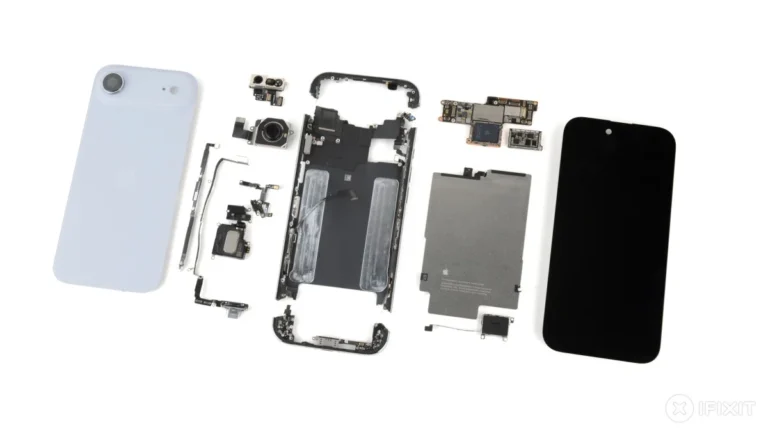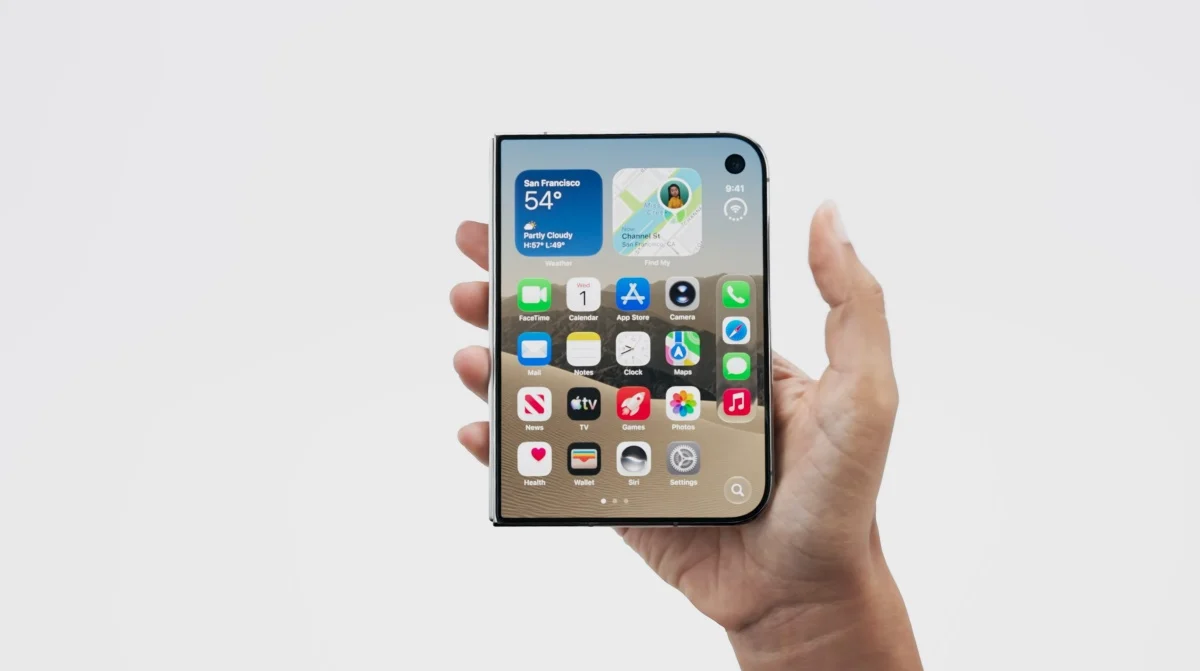
Apple’s foldable model, the iPhone Duo, made its debut at the recent autumn event. In pursuit of an exquisitely thin chassis, Apple was compelled to revert to Touch ID fingerprint recognition integrated into the power button, the most conspicuous compromise in the device’s industrial design. Yet according to a recent Bloomberg report, Apple has already begun devising a solution, planning to welcome Face ID back in later generations of the iPhone Duo. The most pivotal force behind this ambition is the ever-evolving generative and image-computation architecture of Apple Intelligence.
Compromise Under Spatial Constraints: Algorithms in Place of Bulky Optics
Most foldable phones on the market today, seeking to avoid an overly thick single-side body when unfolded, adopt almost uniformly side-mounted fingerprint recognition or simple 2D camera facial unlocking. Apple, however, has always held its biometric security standards, such as payment-grade verification, to an exceedingly strict measure.
The traditional TrueDepth camera module contains precise optical structures including a dot projector, an infrared camera, and a flood illuminator. Their physical thickness simply cannot be crammed into the extraordinarily slender body of the iPhone Duo. To break through this physical barrier, supply-chain sources reveal, Apple plans to extend the computational power of Apple Intelligence into low-level image processing and depth reconstruction.
The logic of this concept runs thus: on a future iPhone Duo, Apple could adopt a secondary depth-sensing camera system that is smaller in volume, thinner in structure, and relatively lower in hardware complexity. It would then rely on the device’s Neural Processing Engine (NPE) and Apple Intelligence models to perform high-precision 3D spatial geometry computation and depth-map restoration. By using algorithms to compensate for optical hardware tolerances, Apple can drastically reduce the physical thickness of the Face ID sensing module while preserving anti-spoofing biometric security that meets the Apple Pay standard.
Arriving by the Third Generation at the Earliest, With a Telephoto Lens in the Plans
This technology, however, may still require several years to mature. As Bloomberg’s Mark Gurman details in his newsletter on the iPhone Duo making foldables the new normal, the AI-empowered lightweight Face ID system may not arrive until the third-generation iPhone Duo. By then, as internal mechanical stacking matures and processor efficiency improves, the third-generation model is also expected to add the periscope telephoto lens absent from the first generation due to thickness concerns.
Wielding Deep Hardware-Software Integration, Apple Seeks to Reshape the Foldable Standard
In an era when the Android camp has already released several generations of book-style foldables, the industry broadly regards abandoning complex 3D structured light in favor of side fingerprint recognition as a necessary evil, one made to preserve feel and portability.
Apple’s insistence on Face ID, however, springs fundamentally from its devotion to a consistent interactive experience across the iOS ecosystem. From unlocking and password autofill to Apple Pay, the seamless verification that Face ID brings has long become muscle memory that iPhone users find hard to relinquish. For Apple, reverting to Touch ID is merely a transitional measure to seize the market with its first-generation product.
By letting Apple Intelligence intervene in low-level depth inference, Apple neatly highlights its most disruptive core strength: unrivaled vertical integration. While competitors are confined to general-purpose sensors and third-party algorithms, Apple can simultaneously command the neural cores of its A-series chips, custom ultra-thin CMOS sensors, and on-device large machine-learning models. Should Apple truly manage, without adding to the body’s thickness, to achieve flawless 3D Face ID on a wafer-thin foldable through computational models, it would once again prove that when hardware hits its physical limits, self-developed chips and system-level AI are the only solution to break the bottleneck.
The iPhone Duo’s Arrival Has Actually Rattled Samsung
From my perspective, after Apple formally launched the iPhone Duo, Samsung repeatedly mocked it through marketing, emphasizing that it had invested more than eight years developing the foldable market. Even so, Samsung is expected to find a way to bring the S Pen back to the Galaxy Z Fold line, especially since Apple added USB-C Apple Pencil writing support to the iPhone Duo.
Furthermore, should Apple continue refining its camera lens design, Samsung may again adopt an under-display camera in its foldables, or even restore the telephoto lens that the Galaxy Z Fold8 lacked.
As for hinge design, Apple’s precise hinge on the iPhone Duo lets its screen hover freely at multiple folding angles. Samsung, in seeking to further reduce the body weight of the Galaxy Z Fold8, could only maintain the hover effect at specific angles. Therefore, even though the iPhone Duo’s inner display panel is chiefly supplied by Samsung, it may still prompt Samsung to reinvest effort in the hinge design of its future foldables.
Support Our Threat Intelligence
If you find our technology report and cybersecurity news helpful, consider supporting our work.
 Buy Me a Coffee
PayPal
Buy Me a Coffee
PayPal