A simple link traversal could allow an adversary to plunder private GitHub repositories. This vulnerability nested within the keyboard event handling architecture of Visual Studio Code webviews. Consequently, the exploit vector becomes exceptionally dangerous when targeting github.dev. In this scenario, the victim merely needs to open a meticulously crafted URL.
The Mechanics of the Browser-Based Editor
The github.dev environment allows users to launch any accessible repository natively within a lightweight browser instance of VS Code. Through this interface, developers can seamlessly inspect files, modify source code, manage pull requests, and commit changes. To facilitate these operations, GitHub transmits an OAuth authentication token directly to the web editor. This token empowers the application to execute commands on behalf of the authenticated operator.
Unfortunately, the system fails to restrict this authentication token to the isolated active repository. Additionally, if the victim possesses administrative privileges on alternative collateral projects, the token exposes those private domains as well. During a successful exploitation cycle, an adversary intercepts this secret token. Afterward, the threat actor queries the GitHub API to enumerate the victim’s entire private infrastructure.
Flaws Within the Webview Architecture
The architectural vulnerability resides specifically within the Visual Studio Code webview implementation framework. For instance, developers frequently leverage these webviews to render Markdown previews or orchestrate interactive Jupyter Notebooks. To preserve security boundaries, the system initializes the webview content inside an isolated browser context. This containment strategy intends to separate untrusted code from the primary editor window.
However, Visual Studio Code selectively relays certain user inputs from the webview back to the primary environment. Without this conduit, standard keyboard shortcuts like the command palette would fail whenever a cursor focuses inside an embedded frame. Regrettably, this integration creates a hazardous side effect. A script executing within untrusted content can artificially mimic keystrokes. Consequently, it forces the editor to perform unauthorized administrative actions.
Exploiting Extensions via Jupyter Notebooks
While the exploit cannot directly inject arbitrary text strings, the native keyboard shortcuts provide ample operational capability. The proof-of-concept exploit initially triggered a benign-looking notification recommending a specific workspace extension. Subsequently, the routine leveraged a local workspace utility. Through this mechanism, the attacker injected a custom keybinding sequence. This maneuver successfully forced the installation of a secondary extension while entirely bypassing publisher trust verifications.
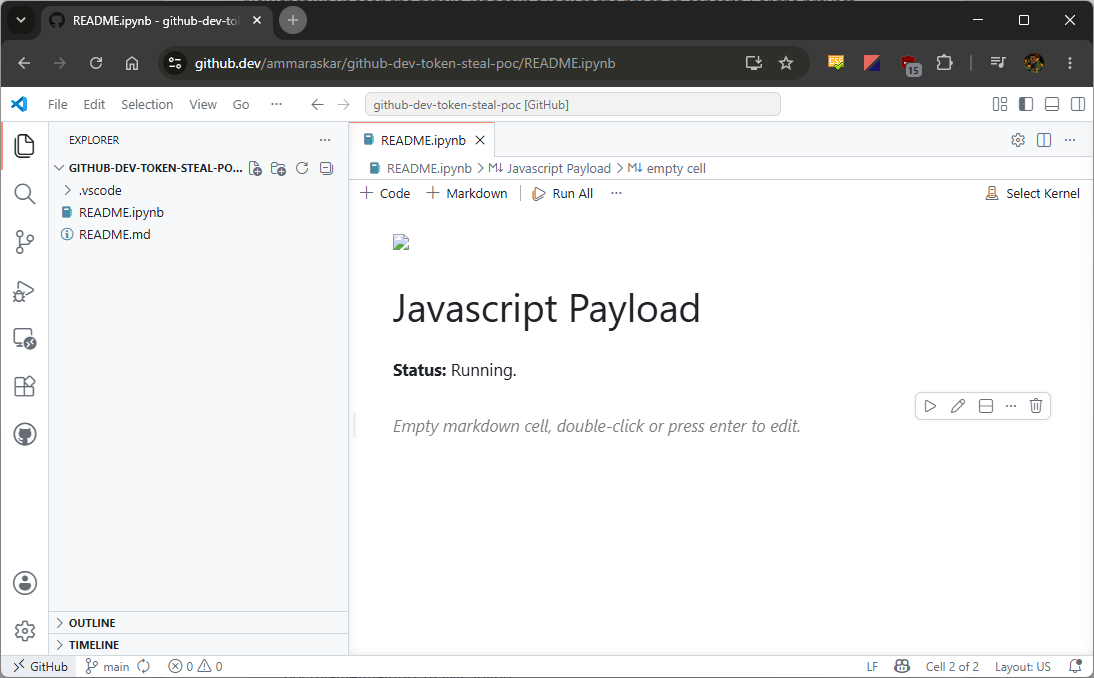
The empirical demonstration utilized a malicious repository containing a Jupyter Notebook alongside a local extension payload inside .vscode/extensions. Upon opening the compromised file, the script monitored the editor for the target notification window. Next, it simulated a keyboard event to accept the primary prompt action. Immediately afterward, the macro triggered the custom shortcut to install the rogue extension. Ultimately, this payload exfiltrated the sensitive GitHub authentication token.
Following successful deployment, the rogue module queried the GitHub API to harvest a complete directory of the user’s private projects. Simultaneously, the extension broadcasted the stolen OAuth credentials to an external destination. Moreover, this demonstration confirms a viable exploitation chain initiated via a digital hyperlink click.
Impact on Desktop Architectures and Mitigation
Crucially, this security exposure jeopardized the native desktop installation of Visual Studio Code as well. For the desktop variant, however, the adversary must convince the victim to clone the malicious repository locally. The target must then manually open the corrupted Jupyter Notebook. Furthermore, a secondary webview flaw could elevate this threat to full remote code execution on the host machine.
Users can mitigate these immediate perimeter risks by thoroughly purging local storage data and browser cookies for github.dev. If an unauthenticated user encounters a malicious link without an active session, the platform displays an explicit initialization prompt. Consequently, the operator can safely terminate the webpage before any data exposure occurs. Conversely, if cached site tokens remain valid, the interface launches automatically without displaying any defensive warnings.
Evaluation of Active Controls and Disclosure
Nevertheless, the researcher noted that certain core Visual Studio Code defenses successfully restricted the exploit’s propagation. Rigid Content Security Policies alongside strict HTML sanitization routines effectively neutralized alternative scripting vectors. Nonetheless, the flaw proves that relaying keyboard events from isolated frames creates a dangerous control channel.
Ultimately, the discoverer disclosed this security vulnerability publicly on June 2, 2026. Approximately one hour prior to publication, he alerted an established point of contact within the GitHub security collective. Immediately afterward, he disseminated the comprehensive brief and initialized a formal ticket inside the Visual Studio Code issue tracker.
Support Our Threat Intelligence
If you find our technology report and cybersecurity news helpful, consider supporting our work.
 Buy Me a Coffee
PayPal
Buy Me a Coffee
PayPal