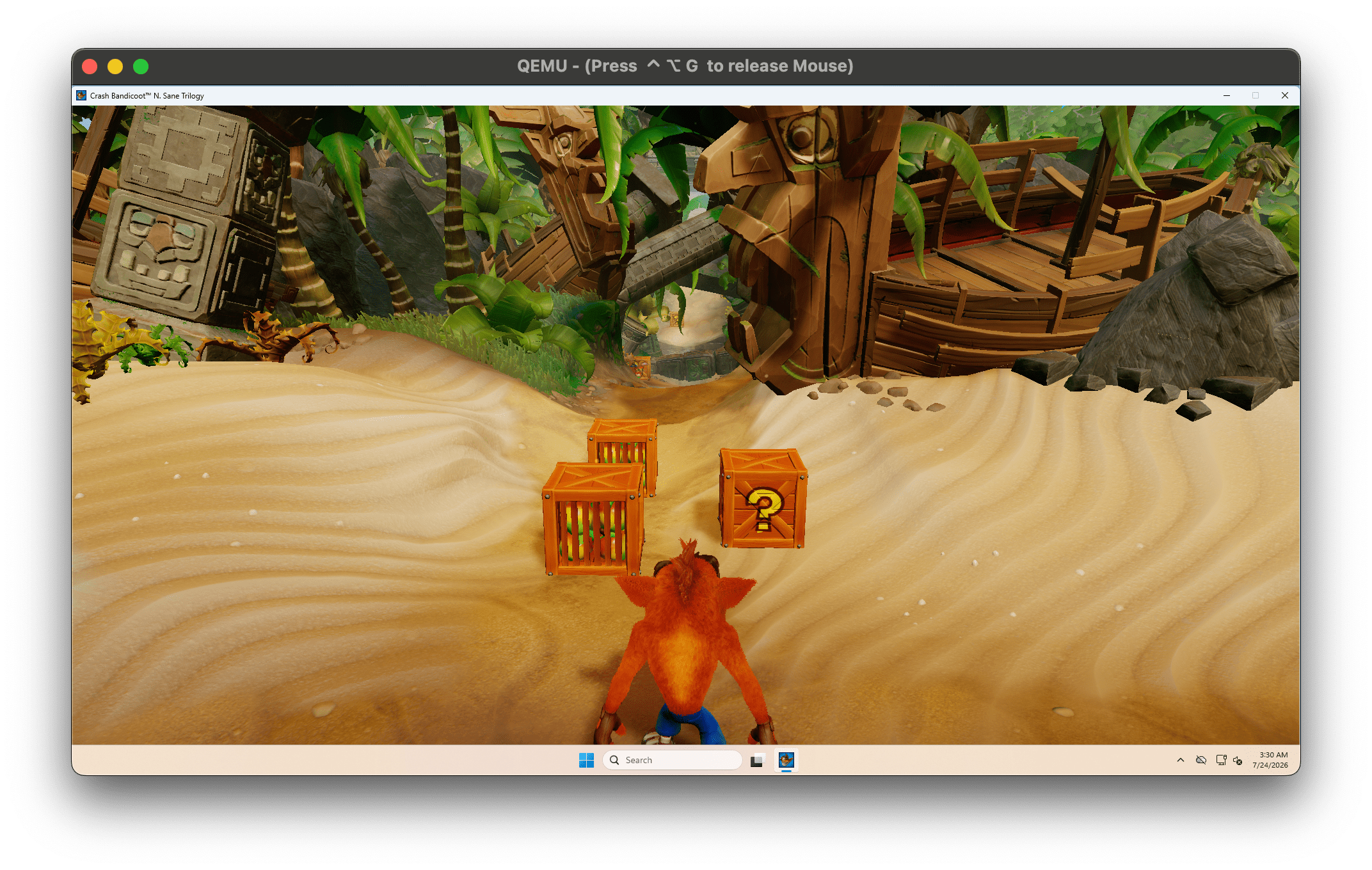
A Leap Forward in Virtualized Graphics
The UTM development team recently unveiled Triton, a revolutionary Windows DirectX 11 graphics driver engineered specifically for QEMU virtual machines. Working in tandem with the previously released D3D forwarding protocol, QEMU virtual machines can now achieve comprehensive DX11 support. You can read the technical deep dive regarding introducing Triton DirectX 11 driver for QEMU. The developers impressively demonstrated a Windows 11 Arm64 virtual machine, running flawlessly via UTM on macOS, successfully launching demanding games like the Crash Bandicoot N. Sane Trilogy.
UTM serves as a profoundly popular open-source virtualization tool across macOS and iOS platforms. Architecturally, it builds upon the robust QEMU foundation. Essentially, QEMU handles the raw virtualization execution, while UTM provides the intuitive graphical interface, configuration management, and seamless system integration. Therefore, the profound significance of Triton extends far beyond UTM alone. This driver fundamentally revolutionizes the graphical acceleration capabilities of all QEMU Windows virtual machines.
Resolving Virtual Machine Graphics Bottlenecks
Previously, the UTM team introduced Neptune, a mechanism designed to forward D3D API calls directly to the host machine via VirtIO. Initially, Neptune catered primarily to Wine environments within Linux virtual machines. It effectively allowed Windows applications operating inside Linux VMs to export D3D calls for external rendering.
However, the architecture of a true Windows virtual machine presents significantly greater complexity. One cannot simply drop d3d11.dll and dxgi.dll into a game directory and expect perfection. If attempted, the Windows Desktop Window Manager (DWM) remains incapable of genuinely recognizing the underlying GPU capabilities. This inevitably causes severe CPU-based copying, devastating performance degradation, and a remarkably sluggish desktop experience. Furthermore, intrusive anti-cheat systems frequently detect and flag these DLL replacements as malicious.
Triton, conversely, adopts a deeply integrated approach that closely mimics native hardware drivers. It actively implements the Windows DX Device Driver Interface (DDI). Consequently, applications continue utilizing the authentic, system-provided D3D and DXGI components. Windows then seamlessly delegates the underlying graphical commands directly to the Triton user-mode and kernel-mode drivers.
Triton and Neptune: Achieving Seamless DX11 Forwarding
According to detailed technical documentation provided by the UTM team, Triton ingeniously translates Windows DDI calls back into standard DX11 API calls. It then passes these calls to Neptune for rigorous serialization. Neptune transmits this serialized data via QEMU/VirtIO directly to the host machine. Finally, the host machine executes the rendering utilizing virglrenderer and the appropriate local graphics backend.
This elegant architecture significantly minimizes intermediate translation layers. The developers highlighted that legacy solutions, such as those employed by VirtualBox, translate DDI calls into an intermediate bytecode. The host machine must then painstakingly interpret and execute this bytecode. Triton, however, strives to directly remap graphical commands back into pure DX11 calls. Theoretically, this direct approach enhances efficiency and substantially boosts overall compatibility.
Nevertheless, this sophisticated strategy encounters formidable challenges, particularly concerning the DXBC Shader bytecode utilized by DX11. While Triton avoids fully decompiling and translating DXBC, it must meticulously reconstruct specific metadata. This crucial step ensures the host machine renderer can accurately identify and process these complex shaders. The developers candidly acknowledge that this specific translation phase currently represents the most fragile and error-prone component of the architecture.
Navigating macOS Licensing Restrictions
The UTM team revealed that D3DMetal delivers superior performance. Even when specific rendering processes necessitate execution via Rosetta translation, it consistently outperforms native ARM64 DXMT. However, severe licensing restrictions pose a critical obstacle. Apple stringent software license terms strictly limit this component’s usage to the development, testing, and evaluation of games via Apple platforms. Furthermore, it forbids any commercial distribution.
Consequently, UTM cannot legally bundle D3DMetal directly into its public application at this time. This limitation will persist unless they negotiate a specialized licensing arrangement similar to that secured by CrossOver.
Current Status: Highly Experimental
The UTM team stated that they have open-sourced all relevant user-mode and kernel-mode driver code. Advanced power users possess the ability to compile and test the software independently. Concurrently, the team is actively attempting to merge numerous modifications into the upstream QEMU project repositories. They also plan to introduce significantly more user-friendly support in upcoming official UTM releases.
For the average consumer, rushing to experiment with this driver remains unnecessary at this early stage. However, for macOS enthusiasts, dedicated QEMU users, and virtual machine developers, Triton commands immense attention. While the driver has not yet fully replicated a native Windows gaming environment, it undeniably represents a monumental leap forward for QEMU Windows graphics acceleration.
Support Our Threat Intelligence
If you find our technology report and cybersecurity news helpful, consider supporting our work.
 Buy Me a Coffee
PayPal
Buy Me a Coffee
PayPal