AMD is orchestrating a subtle yet consequential refinement for its Ryzen processors: a mechanism enabling Windows and Linux to discern with greater precision which CPU core possesses the superior overclocking potential. Presently, operating systems often rely on indirect metrics to estimate frequencies; however, the nascent CPPC HighestFreq protocol aims to eliminate such conjecture, furnishing the task scheduler with more authentic data regarding the chip’s capabilities.
According to Wccftech, CPPC HighestFreq will allow the processor to transmit its actual peak boost frequencies to the operating system via the firmware. By utilizing a dedicated register, Windows and Linux will be liberated from calculating core behavior based on abstract performance indices or approximate mathematical models. While this adjustment may seem imperceptible to the average user, its systemic significance is profound: the task scheduler will be empowered to expeditiously assign demanding workloads—such as gaming or intensive professional applications—to the most capable cores, optimizing responsiveness through superior thread distribution.
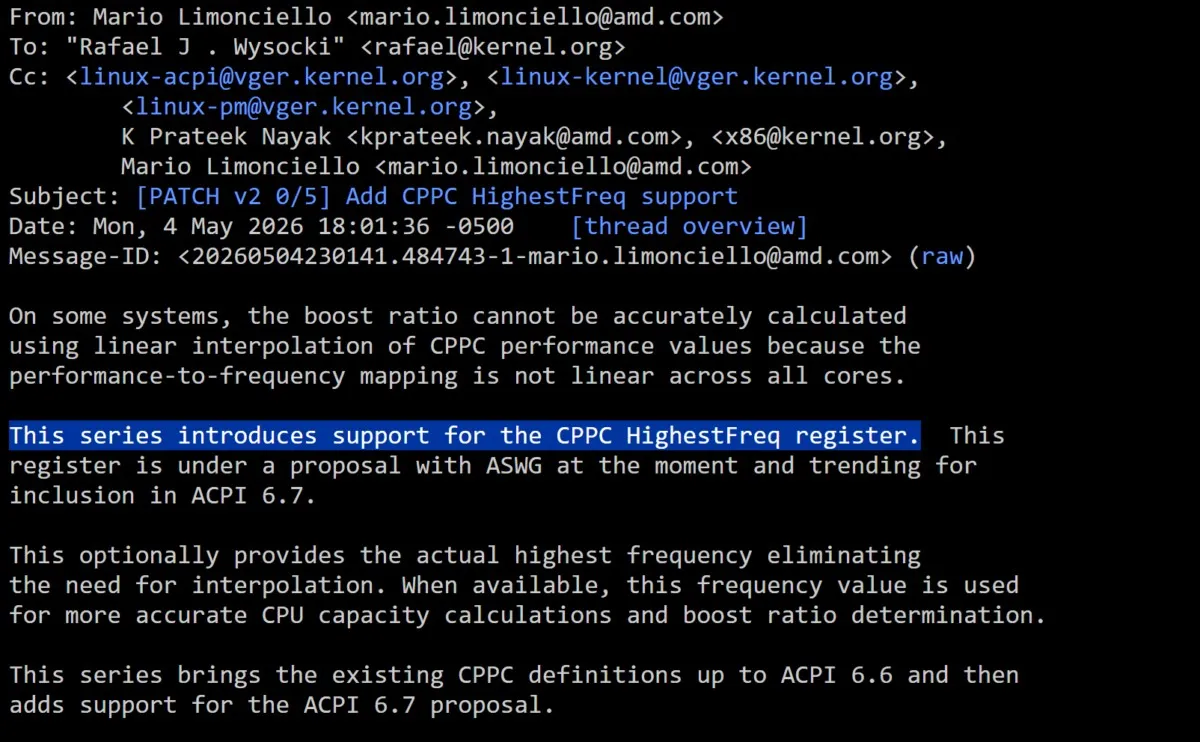
Support is currently being integrated into the AMD P-State driver for Linux, with the mechanism anticipated to debut in the ACPI 6.7 specification. ACPI facilitates the dialogue between the operating system and the hardware firmware, while CPPC (Collaborative Processor Performance Control) allows modern processors to manage performance with far greater fluidity than antiquated fixed-frequency states.
AMD’s patch notes for the Linux kernel indicate that the CPPC HighestFreq register is essential for scenarios where maximum boost frequencies cannot be accurately derived through linear interpolation of standard CPPC values. The legacy approach is prone to inaccuracies, as the correlation between a nominal performance metric and actual frequency is not uniform across all cores.
Contemporary Ryzen architectures are particularly sensitive to these discrepancies. One core might sustain elevated frequencies with greater stability, while another encounters thermal or power constraints more rapidly; boost algorithms must account for temperature, voltage, and the silicon quality of specific dies. Without precise data, the scheduler might inadvertently dispatch a heavy task to a suboptimal core, even when the processor is capable of suggesting a superior alternative.
For gaming and interactive software, such errors do not necessarily manifest as a catastrophic drop in frame rates, but they can diminish responsiveness, exacerbate latency, or prevent the processor from fully utilizing its “prime” cores at critical moments. CPPC HighestFreq provides the system with a direct reference point: identifying which cores can achieve the highest peaks and which should be reserved for less rigorous tasks.
This mechanism appears exceptionally advantageous for Ryzen processors featuring preferred core technology and intricate boost algorithms. While modern AMD chips can already identify the most robust cores within the silicon, the operating system does not always perceive the comprehensive picture. With the implementation of HighestFreq, the firmware can convey more precise telemetry, allowing the AMD P-State driver to incorporate this intelligence into its frequency and power management strategies.
At present, this refinement remains in the developmental phase and does not guarantee an immediate performance surge across all configurations. The eventual impact will be contingent upon the specific processor, firmware version, Linux kernel iteration, and the implementation of ACPI 6.7. Nevertheless, the trajectory is clear: AMD seeks to bridge the chasm between the processor’s latent capabilities and the operating system’s perception of them.
Support Our Threat Intelligence
If you find our technology report and cybersecurity news helpful, consider supporting our work.
 Buy Me a Coffee
PayPal
Buy Me a Coffee
PayPal