The Evolution of Agent Discovery
AI agents will soon locate one another using the traditional Domain Name System. Consequently, they can bypass specialized registries, manual configurations, and random network address searches. To facilitate this, the Linux Foundation introduced an open-source project called DNS for AI Discovery, or DNS-AID. This initiative seamlessly integrates the discovery of autonomous software into existing internet infrastructure.
Overcoming Structural Bottlenecks
Fundamentally, DNS-AID assists intelligent agents in discovering one another by name, function, and domain. Currently, communication between these agents relies heavily on hardcoded settings and predefined addresses. Furthermore, developers frequently depend on fragmented search mechanisms. Project architects believe that such a rigid model scales poorly. Therefore, it creates an unnecessary reliance on isolated platforms.
Leveraging Existing Internet Foundations
The project intentionally utilizes DNS to avoid building another centralized registry. Indeed, a proprietary registry could quickly become a competitive bottleneck. This issue would intensify as traffic passes between agents from diverse enterprises. In contrast, DNS has gracefully resolved similar challenges for websites over several decades. It effortlessly maps intelligible names to resources across almost any network environment.
Expanding Beyond Name Resolution
Modern DNS extends far beyond translating domain names into IP addresses. For instance, administrators regularly publish SPF, DKIM, and DMARC records to secure electronic mail. Additionally, newer mechanisms like SVCB and HTTPS Resource Records enhance this ecosystem. These protocols allow clients to locate services and retrieve connection parameters directly.
Technical Architecture and Frameworks
Architecturally, DNS-AID builds upon SVCB while retaining TXT records as a fallback option. Moreover, the project leverages DNSSEC, DANE, and TLSA records. These tools effectively verify data provenance and establish secure connection policies. Consequently, this framework empowers agents to connect without intermediary platforms. They can operate without dedicated infrastructure or binding to a single protocol.
Streamlining Developer Workflows
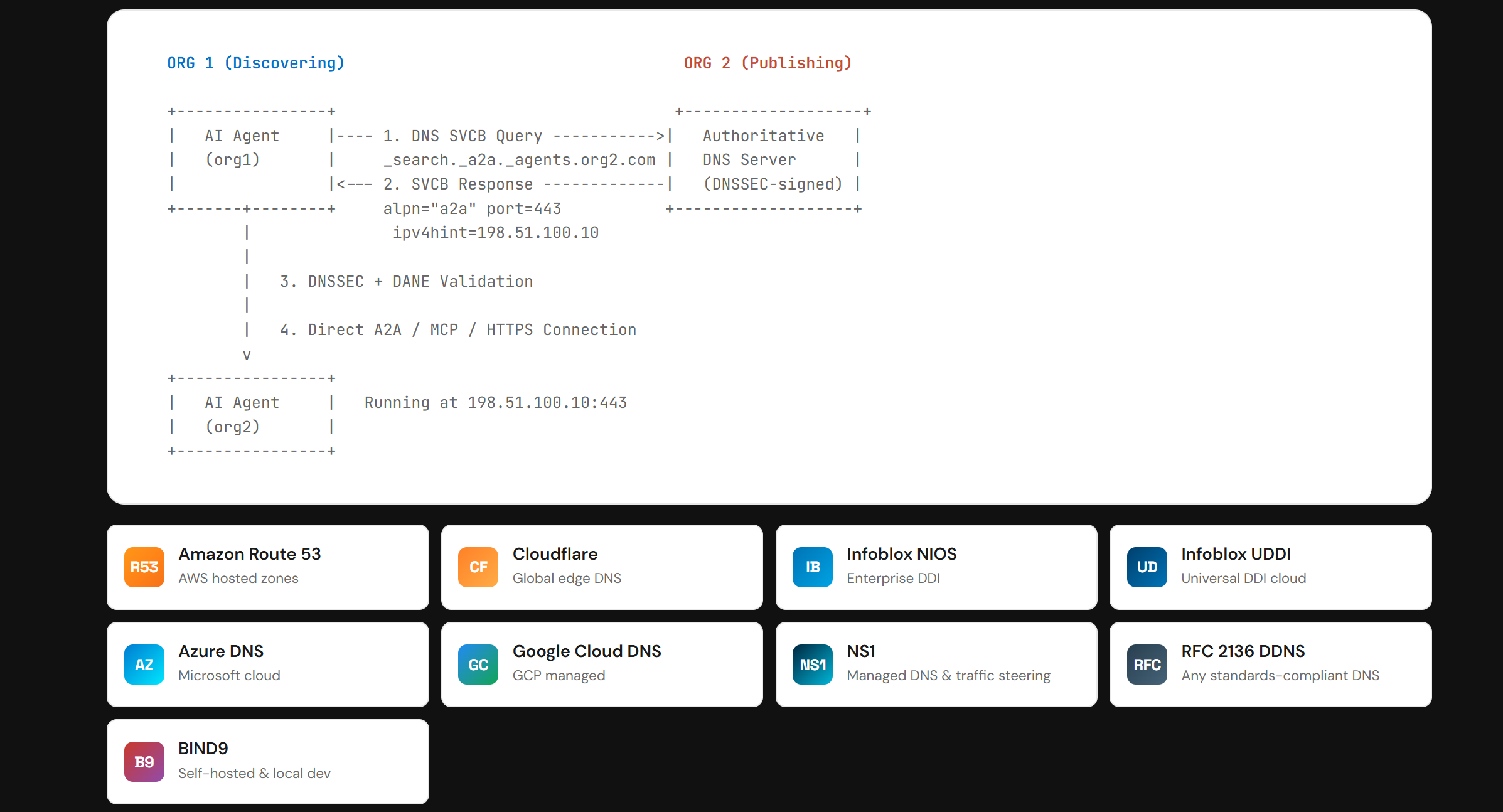
Specifically, the architecture supports MCP, A2A, HTTPS, and other flexible configurations. These options are easily defined via SVCB and ALPN. For developers, the operational logic remains delightfully straightforward. First, a service provider publishes a DNS record within their domain zone. Subsequently, an external system discovers the record and validates the cryptographic data. Finally, the inquiring agent determines exactly how to establish the connection.
Cryptographic Verification Layout
The typical record structure follows a precise format:
_{agent-name}._{protocol}._agents.{domain}
Following a query, the DNS system returns the exact connection parameters. Then, the client can meticulously validate the response using DNSSEC. They can also employ supplementary JWS signatures and DANE policies. This rigorous verification effectively mitigates the risk of spoofing attacks. Ultimately, it clarifies record provenance for the receiving party.
Ecosystem Adoption and Global Deployment
The Linux Foundation guarantees vendor-neutral governance for the initiative. Although Infoblox engineered the initial iteration of DNS-AID, industry adoption is expanding rapidly. Several prominent DNS providers and cloud platforms already pledge full support. This cohort includes AWS Route 53, Azure DNS, and Cloudflare. It also encompasses Google Cloud DNS, Infoblox NIOS, and NS1. Furthermore, any service compatible with RFC 2136 DDNS can participate. For local experimentation, engineers can deploy a BIND9 test environment using Docker.
Getting Started with the Utility
Developers can immediately initialize DNS-AID via the specialized dns-aid utility. After a swift installation, executing the dns-aid init command activates the system. The official documentation offers comprehensive onboarding instructions. Currently, a dedicated Python SDK is available for immediate deployment. Meanwhile, alternative language implementations will undoubtedly emerge as the project matures.
Market Implications and Real-World Value
Industrial enthusiasm for this architecture extends far beyond mere technical utility. For context, McKinsey projects that the emergent agent-to-agent commerce market will reach trillions of dollars. However, analysts must approach such grandiose forecasts with healthy skepticism. During the 1980s, the firm famously miscalculated the growth of the mobile telephony market. Therefore, the true value of DNS-AID relies entirely on authentic developer adoption. Success depends on whether engineers genuinely publish and discover agents via DNS.
Support Our Threat Intelligence
If you find our technology report and cybersecurity news helpful, consider supporting our work.
 Buy Me a Coffee
PayPal
Buy Me a Coffee
PayPal