Yesterday, Nvidia announced the groundbreaking RTX Spark Superchip tailored specifically for Windows on Arm devices. The processing unit features a custom CPU architecture co-developed alongside MediaTek. Initially, Nvidia will introduce two distinct tiers, designated as the N1 and N1X series. The N1 silicon targets mainstream consumer computing platforms. Conversely, the elite N1X variant boasts a 20-core matrix to establish itself as a flagship powerhouse. Hardware incorporating these advanced superchips will debut progressively throughout the autumn.
Preliminary Benchmark Telemetry Emerges
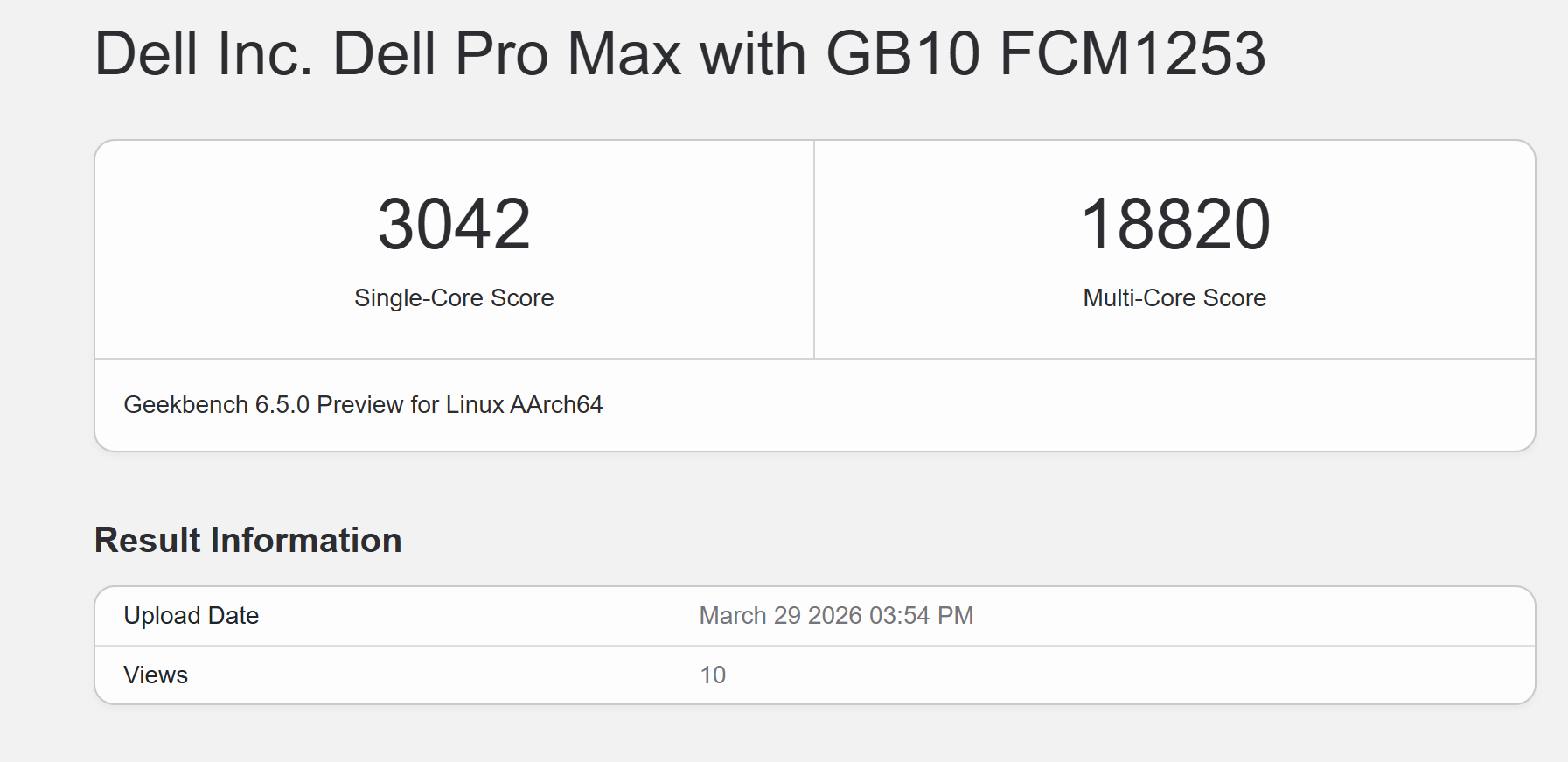
Data submitted to the Geekbench repository on March 29, 2026, reveals promising performance metrics. The N1X achieved an exceptional single-core score of 3,096. Furthermore, it secured a formidable multi-core computation metric of 18,837. Consequently, this performance directly rivals Apple’s premier M3 Max silicon from October 2023. That legacy Apple chip achieved a single-core score of 3,124 and a multi-core score of 18,920.
However, the M3 Max achieves these metrics utilizing 14 cores instead of a 20-core architecture. Therefore, purely from empirical data, Apple’s legacy silicon remains remarkably potent despite its age. Unquestionably, Apple has cultivated its proprietary Arm ecosystem for several years. In contrast, Nvidia is currently navigating its inaugural steps within this specific consumer domain. As the silicon iterations mature, the N-series may eventually secure performance parity with contemporary M-series hardware.
Decoding the GB10 Nomenclature
Observers noticed that the early benchmark logs explicitly utilize the “GB10” technical designation. This nomenclature arises because Nvidia deploys the identical GB10 silicon within its DGX Spark AI workstations. CEO Jensen Huang clarified that the N1X represents a heavily refined iteration of that core architecture. Accordingly, the graphical processing capabilities of the N1X should perfectly mirror the baseline workstation chip. This underlying graphical performance roughly equates to a discrete desktop RTX 5070 graphics card.
Evaluative Constraints and Unoptimized Prototypes
The earliest database entries regarding these engineering samples originally materialized in June 2025. Crucially, these preliminary prototypes entirely lack the sophisticated software and firmware optimizations of retail merchandise. As Nvidia collaborates with hardware partners to refine the platform, real-world metrics will likely improve. Regrettably, existing data streams remain strictly confined to Linux-based testing environments. Analysts have yet to observe verified performance telemetry utilizing a native Windows 11 framework.
Given the historical optimization hurdles of Windows 11, the definitive on-device experience requires post-launch valuation. Meanwhile, Microsoft is aggressively polishing its operating system layer to ensure seamless execution. This coordinated effort aims to prevent any catastrophic software stumbles during the retail premiere. Ultimately, consumers must await hands-on reviews to determine the true efficacy of Windows on Arm.
Support Our Threat Intelligence
If you find our technology report and cybersecurity news helpful, consider supporting our work.
 Buy Me a Coffee
PayPal
Buy Me a Coffee
PayPal