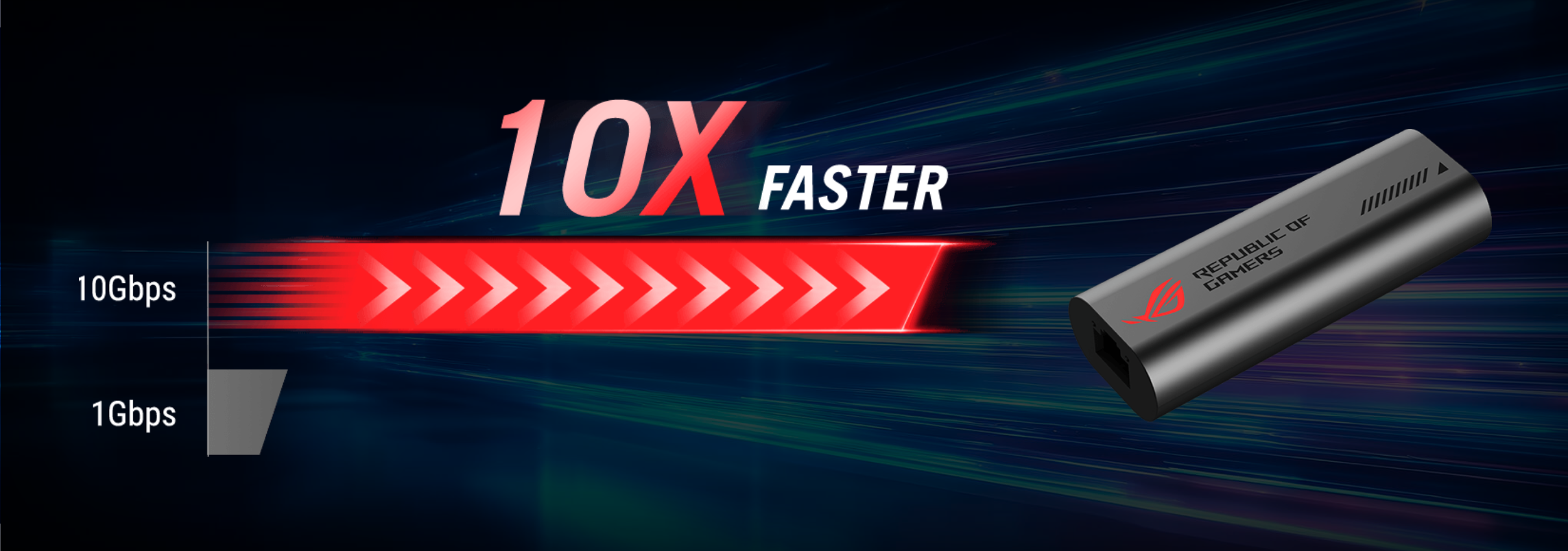
Asus recently launched a 10GbE USB network adapter under its esteemed Republic of Gamers (ROG) brand. This sophisticated network adapter relies on the USB 3.2 Gen 2×2 protocol and features a versatile USB-C interface, complete with a supplementary USB-A adapter. It primarily supports devices operating on Windows 10 and 11. Although Asus has not yet announced the final retail price for this peripheral, a Norwegian retailer recently listed it at $139, a figure that includes a 25% value-added tax.
Likely Powered by the Realtek RTL8159 Chip
According to the manufacturer’s official specifications, the ROG USB-C 10G USB ethernet adapter measures 85x32x19 millimeters and weighs a mere 38 grams without the cable. Asus generously provides a USB-C cable in the box. If a user’s device lacks a dedicated USB-C port, they can easily utilize the included USB-A adapter. However, employing this physical adapter might compromise the final transfer speeds, potentially failing to reach the theoretical 10Gbps threshold.
While Asus has not explicitly confirmed the internal hardware, industry experts strongly suspect this USB network adapter utilizes the Realtek RTL8159 chip. Many 10GbE USB network adapters currently on the market employ this exact silicon. Comparatively, similar domestically produced 10GbE adapters retail for roughly 200 to 250 RMB. This price disparity makes generic alternatives significantly more affordable than the premium Asus offering.
Incompatible with Apple Silicon Mac Devices
It is crucial to note that this category of 10GbE USB network adapters uniformly adopts the USB 3.2 Gen 2×2 protocol. This standard boasts a theoretical transmission rate of 20Gbps, thoroughly satisfying the 10Gbps requirement of the adapter itself. Nevertheless, Apple’s M-series Mac computers fundamentally lack support for the USB 3.2 Gen 2×2 protocol. Consequently, these network adapters remain entirely unsupported on any Mac powered by Apple Silicon.
The USB-C ports on modern Macs and MacBooks utilize the Thunderbolt 4 protocol, capable of reaching an impressive 40Gbps. However, when interfacing with standard USB 3.x peripherals, they can only negotiate down to the USB 3.2 Gen 2 standard, which provides a single-channel speed of 10Gbps. Because Apple hardware refuses to activate the dual-channel mode inherent to USB 3.2 Gen 2×2, these 10GbE adapters inevitably fail to meet full-duplex technical requirements. As a result, users will likely experience severely bottlenecked speeds hovering between 5Gbps and 6.5Gbps.
Therefore, if you intend to purchase a 10GbE USB network adapter for a Mac device, you must proactively verify the supported protocols. If the adapter utilizes the Thunderbolt protocol, it should achieve its maximum advertised speeds flawlessly. Conversely, if it relies on the USB 3.2 Gen 2×2 protocol, the absolute peak performance will plateau around 5 to 6.5Gbps.
Support Our Threat Intelligence
If you find our technology report and cybersecurity news helpful, consider supporting our work.
 Buy Me a Coffee
PayPal
Buy Me a Coffee
PayPal