The Vulnerability of Centralized Consensus
Cross-chain bridges have once again exposed their structural vulnerability. Assets can vanish not from a software flaw, but from the subversion of those who validate transactions. This vulnerability plagued Gravity Bridge. Consequently, an adversary exfiltrated approximately 5.4 million dollars after usurping control of the Ethereum validator cohort.
The Mechanism of Majority Endorsement
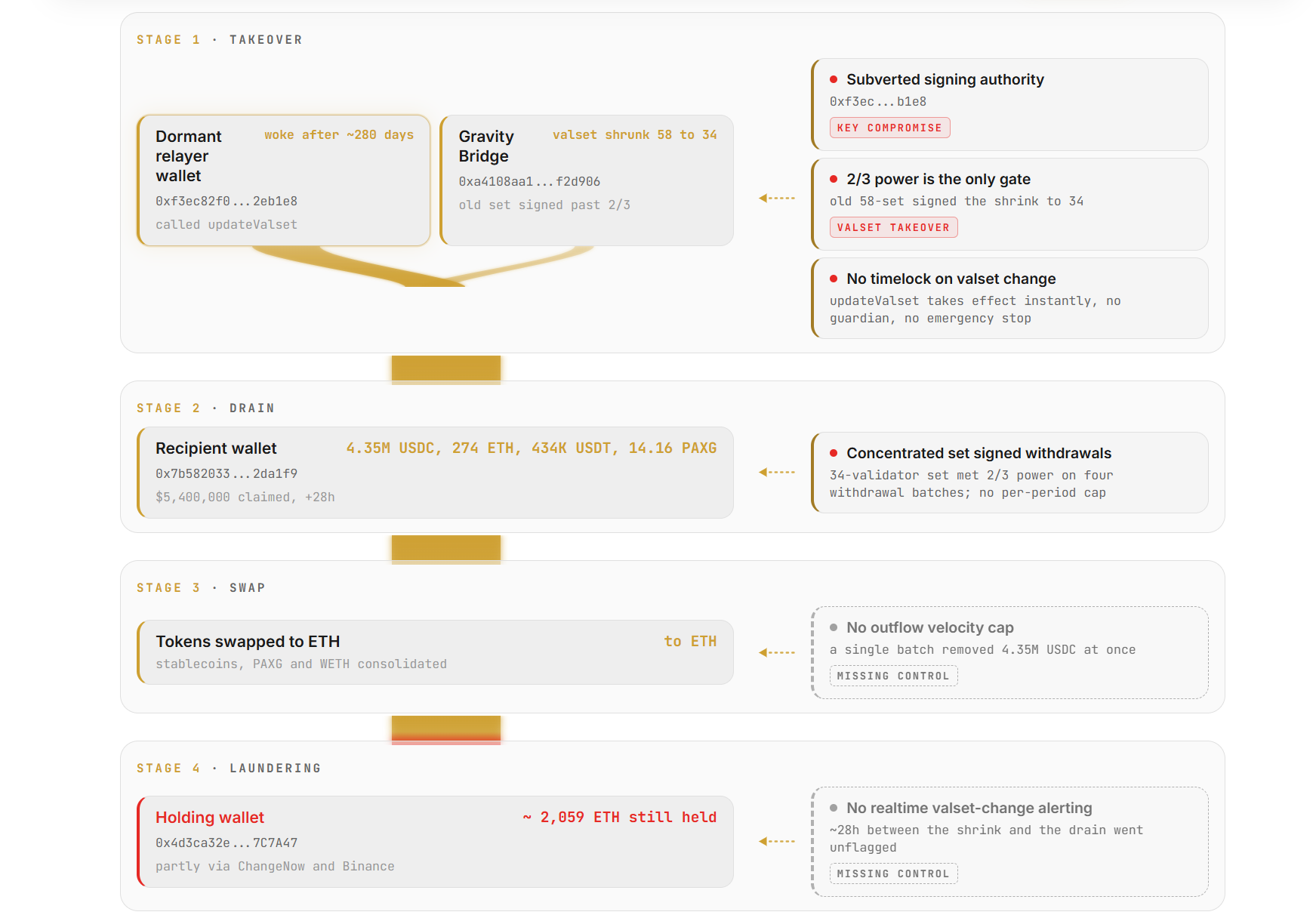
Gravity Bridge links Ethereum with the Cosmos-based Gravity chain. Crucially, the Ethereum smart contract releases funds only when validators holding a two-thirds voting majority endorse the transaction. According to data from BlackHart, the attacker successfully coerced signatures from authentic validators. Therefore, the adversary altered the composition of the active registry, reducing the participants from 58 to 34. This tactical maneuver concentrated authority. Subsequently, it permitted the malicious endorsement of unauthorized asset withdrawals.
Quantifying the Exfiltrated Capital
The malicious actor drained diverse tokens from the bridge architecture. Ultimately, the cumulative financial damage totaled approximately 5.4 million dollars.
| Asset Type | Amount Stolen |
| USDC | 4.35 Million |
| ETH | 274 |
| USDT | 434,000 |
| PAXG (Gold-Backed) | 14.16 |
Following the theft, the perpetrator converted these assets into ETH and transferred them to an isolated repository. Meanwhile, a portion of the funds routed through ChangeNow and Binance. At the time of publication, the attacker retained roughly 2,059 ETH.
Smart Contract Execution vs. Systemic Logic
Interestingly, BlackHart assesses that the core Gravity Bridge smart contract architecture remained completely uncompromised. The contract executed precisely as designed. It verified the cryptographic signatures and accepted the modified state seamlessly.
The Deficit of Protective Guardrails
However, the true failure lay in relying on signatures as the solitary line of defense. Unfortunately, the ecosystem lacked any time-lock mechanism before modifying the validator registry. Furthermore, it possessed no emergency pause protocol or volume-based extraction thresholds.
Chronology of the Exploitation Chain
Reactivating the Dormant Relayer
The intrusion initiated from a wallet that previously served as an authorized Gravity relayer in early 2025. Afterward, this account remained entirely dormant for approximately 280 days. On May 28, 2026, the compromised wallet invoked the updateValset function. This action abruptly condensed the validator group from 58 down to 34 members. Regrettably, the legacy cohort authenticated this change by providing signatures that satisfied the required voting threshold.
Compromising the Automated Pipeline
Approximately twenty-eight hours later, the newly concentrated validator set endorsed four extraction batches. All assets migrated swiftly to a singular address. Then, the perpetrator converted the tokens into ETH and consolidated them into a holding wallet.
Rather than assuming the accidental compliance of dozens of human operators, BlackHart posits a more plausible theory. The adversaries likely compromised the automated infrastructure responsible for cryptographic signing.
Current Status and Historic Parallels
Fortunately, alternative cross-chain protocols and bridges remained entirely unaffected. Nevertheless, the heist completely drained the funds resting within the Ethereum Gravity Bridge contract. Currently, authorities have been unable to recover the purloined digital assets.
Echoes of Legacy Perimeter Exploits
This security incident closely mirrors the historic Ronin Bridge and Harmony Horizon exploits of 2022. During those campaigns, adversaries similarly acquired sufficient cryptographic keys to drain repositories without subverting contract logic. In these scenarios, the primary hazard extends far beyond software code. It encompasses key management protocols and transactional verification architectures. Furthermore, defensive teams often lack adequate time to intercept anomalous modifications.
Prescribed Remediation and Strategic Defenses
Immediate Operational Recoveries
BlackHart strongly advises the Gravity collective and its validators to rotate all cryptographic keys immediately. Furthermore, engineers must thoroughly audit the automated signing pipeline. They should reinstate the legitimate validator composition only after rigorous manual verification.
Long-Term Architectural Safeguards
For cross-chain architectures generally, specialists recommend implementing a strict time-lock before modifying validator configurations. They must also integrate emergency suspension mechanisms and rate-limiting thresholds. This safeguard prevents a single key compromise from instantly exhausting a contract’s treasury.
Support Our Threat Intelligence
If you find our technology report and cybersecurity news helpful, consider supporting our work.
 Buy Me a Coffee
PayPal
Buy Me a Coffee
PayPal