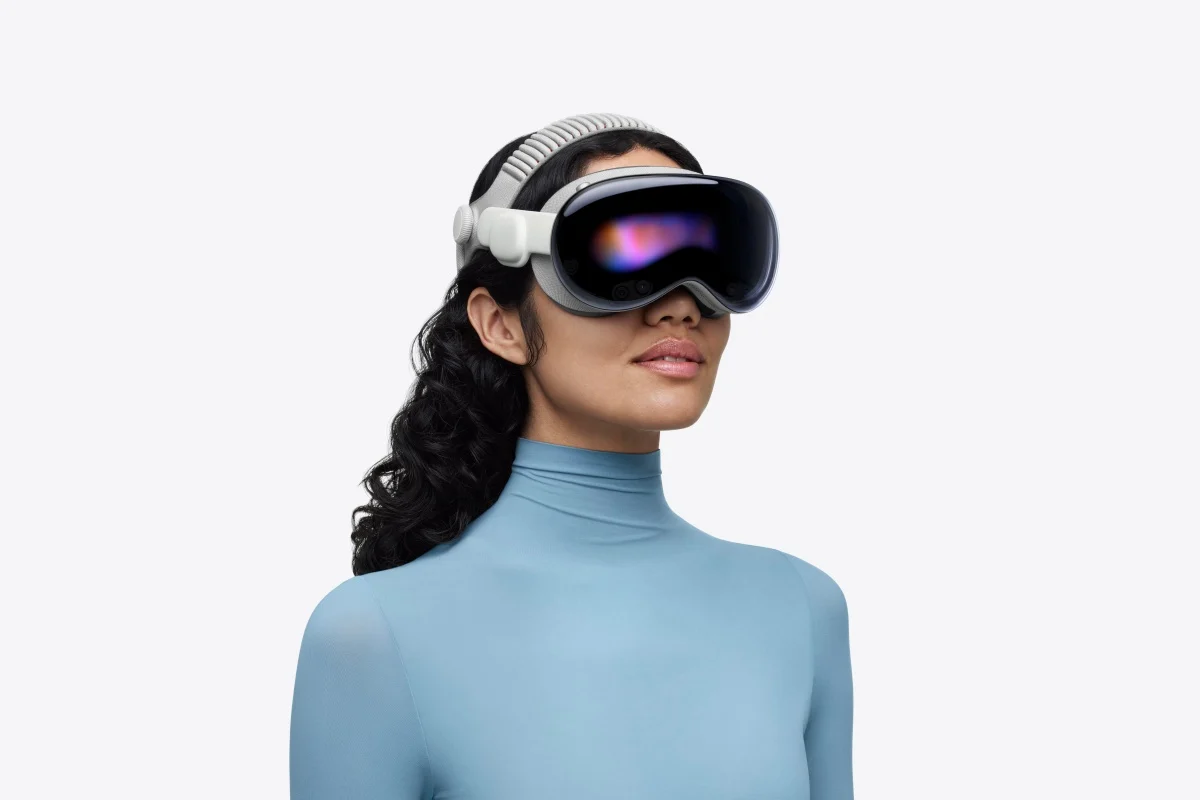
Notwithstanding persistent conjecture that Apple has surreptitiously abandoned its Vision Pro endeavor, recent insights from Bloomberg correspondent Mark Gurman suggest that the tech giant has not entirely forsaken the product line’s evolution. However, those anticipating a direct successor must steel themselves for a protracted interlude, as the next iteration of the Vision Pro is unlikely to manifest for at least another two years.
Following the internal cancellation of the rumored, more affordable “Vision Air,” Apple has pivoted its research and development trajectory within the Mixed Reality (MR) and wearable hardware sectors. The corporation is now wagering heavily on diaphanous smart glasses, AI-augmented AirPods equipped with visual capabilities, and a nascent, AI-driven wearable pin—rumored to be comparable in dimension to an AirTag.
Gurman reports that while Apple continues to refine underlying technologies and lightweight materials behind the scenes, there are currently no “active development” programs for a more economical, less encumbering enclosed headset. This strategic reallocation of resources is the primary catalyst for the Vision Pro’s impending developmental stagnation; a significant portion of the hardware talent formerly dedicated to the Vision department has reportedly been redeployed to the “Smart Glasses” initiative.
Furthermore, Apple’s paramount directive is now the comprehensive advancement of Artificial Intelligence. This mandate necessitates that teams dedicate substantial energy to the maturation of the next-generation Siri and the expedited launch of AI-centric endpoints, such as the camera-equipped AirPods and the aforementioned AI wearable pin.
Reflecting upon the Vision Pro’s transition from a highly anticipated marvel to a tepidly received commodity, analysts suggest its difficult retail debut—burdened by a staggering $3,499 price point—is largely a byproduct of the decade-long erosion of Apple’s physical retail infrastructure. The current, streamlined Apple Store model is ill-equipped to provide the profound, customized experiences and educational outreach required for such revolutionary hardware.
While Apple did unveil a refreshed Vision Pro in October 2025 featuring the M5 chip, seeking to extend the product’s lifespan through a quantum leap in computational power, this internal upgrade has failed to resonate with the mainstream market. In the absence of a “killer app” and burdened by its persistent weight and prohibitive cost, a mere silicon enhancement was insufficient to stir the consumer consciousness.
The Vision Pro stands as a testament to Apple’s exquisite craftsmanship in spatial computing; however, its heavy, expensive, and physically isolating “enclosed” design ultimately conflicts with the public’s expectations for daily technology. Conversely, the resounding success of Meta’s Ray-Ban smart glasses has illuminated a different path for Apple: the future of wearables lies in “imperceptible” devices that synthesize AI-assisted vision and voice—a paradigm far more palatable and marketable to the masses.
By shifting its primary resources toward lightweight glasses and AI pins, Apple is transitioning its wearable strategy from a science-fiction endeavor to “supplant reality” to a more pragmatic effort to “augment reality” through AI. While the Vision Pro has not been formally declared defunct, it will inevitably recede into the background over the next two years, serving primarily as a prestigious, albeit niche, exhibition of technical prowess for developers and specialized industrial or medical sectors.
Ultimately, Apple’s next “iPhone moment” in innovation may not be an apparatus worn upon the face, but rather a subtle instrument resting by the ear or pinned to the chest.
Support Our Threat Intelligence
If you find our technology report and cybersecurity news helpful, consider supporting our work.
 Buy Me a Coffee
PayPal
Buy Me a Coffee
PayPal