Apple recently exposed one of its most classified security paradigms to extensive public auditing. Specifically, the enterprise published its post-quantum cryptographic source code alongside its proprietary mathematical verification tools. Consequently, this unprecedented transparency will fortify the broader technology sector against the impending era of quantum computation.
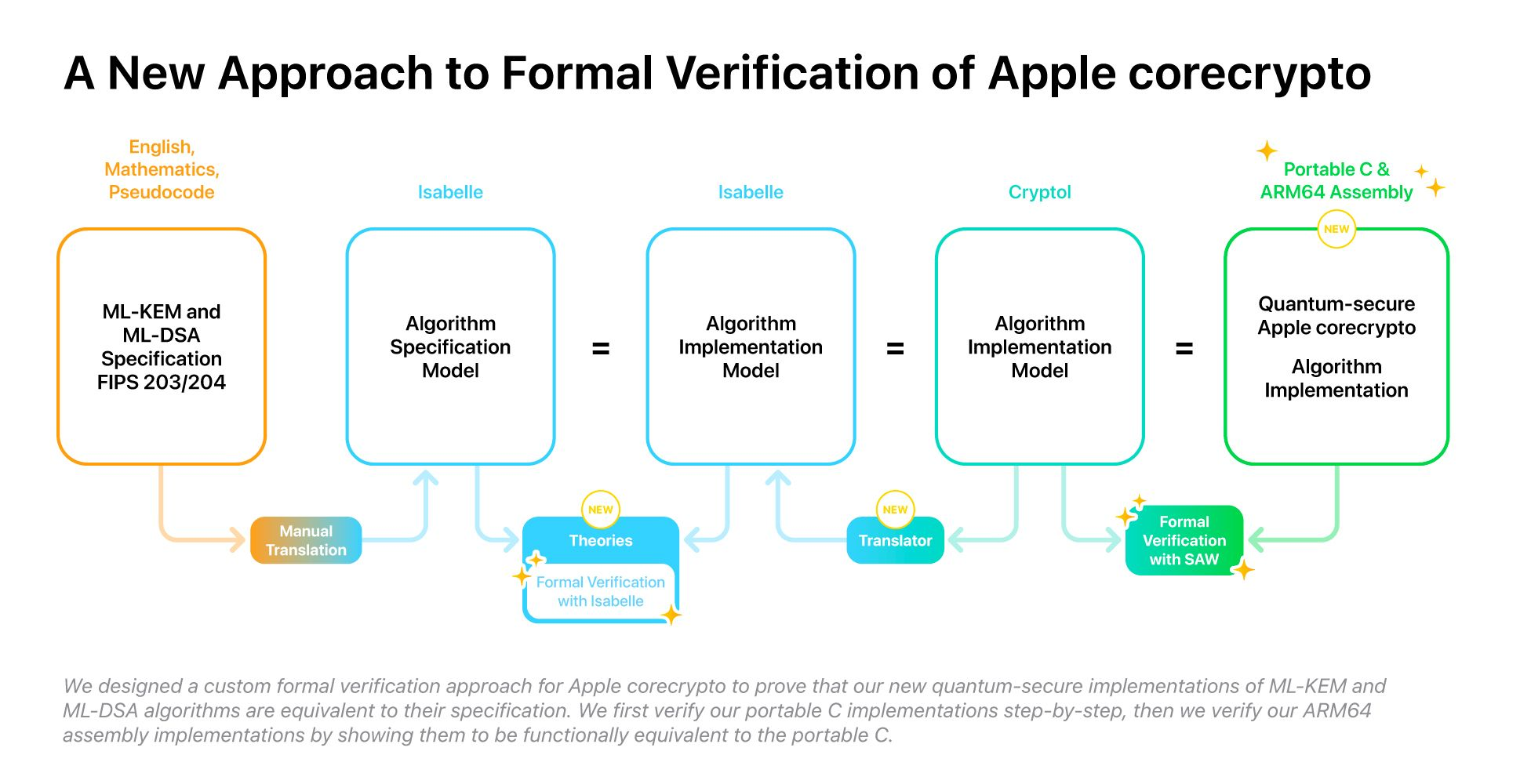
The public repository comprises production-ready implementations of two primary algorithms, namely ML-KEM and ML-DSA. Furthermore, Apple released its supporting libraries and formal verification frameworks into the open-source domain. Thus, the corporation claims to have established an exceptionally rigorous validation methodology for operational cryptographic models.
Universal Deployment and the Corecrypto Infrastructure
Engineers have already integrated these robust algorithms directly into Apple’s foundational corecrypto library. This critical cryptographic module natively powers all corporate operating systems across 2.5 billion active devices. Initially, Apple deployed this post-quantum defensive architecture within its iMessage platform in 2024. Subsequently, the engineering teams expanded this avant-garde protection to encompass enterprise VPN utilities and TLS network protocols.
The Cryptol-to-Isabelle Orchestration Framework
Notably, the released toolkit highlights an innovative Cryptol-to-Isabelle translation mechanism. This utility seamlessly transposes cryptographic models across disparate formal languages to ensure absolute compliance with global standards. To achieve this rigorous validation, Apple leveraged Galois’s Cryptol suite alongside the Isabelle framework. For context, elite academic bodies including Cambridge University and the Technical University of Munich co-developed Isabelle.
Isolating the Computational Omission
Remarkably, formal verification protocols successfully isolated a critical anomaly that traditional testing paradigms completely overlooked. Within the ML-DSA codebase, security architects discovered a singular, omitted computational step. This hidden bug could have silently compromised the operational integrity of native digital signatures. As a result, impacted iMessage transmissions would appear entirely authentic despite an underlying, catastrophic failure of the encryption layer.
The Hybrid Validation Methodology
Nevertheless, Apple readily concedes that pure mathematical proofs cannot guarantee absolute system immunity. Therefore, software engineers must still subject core subroutines to empirical testing within full system architectures. Ultimately, the enterprise advocates for a hybrid defensive strategy to achieve optimal operational assurance. In this model, formal verification guarantees core algorithmic precision while empirical testing mitigates auxiliary integration risks.
Algorithmic Equilibrium and Quantum Defenses
Principally, regulators selected ML-KEM and ML-DSA due to their masterful equilibrium of velocity, safety, and parameter density. These specialized frameworks will resolutely insulate sensitive telemetry from future quantum adversaries. Unchecked, those advanced computing platforms possess the raw theoretical power to shatter traditional asymmetric encryption schemes.
Support Our Threat Intelligence
If you find our technology report and cybersecurity news helpful, consider supporting our work.
 Buy Me a Coffee
PayPal
Buy Me a Coffee
PayPal