Synergy Across the Musk Empire
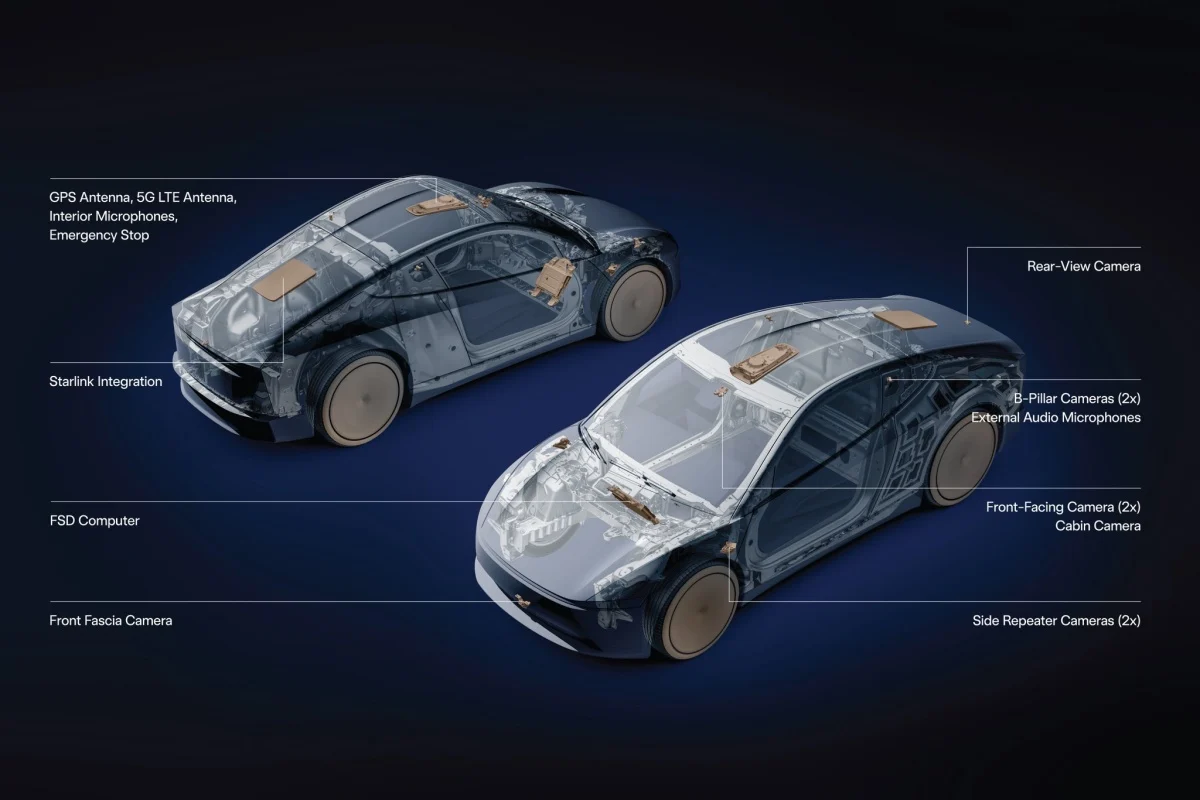
Technological resource integration across various companies is no longer a novelty within the business empire steered by Elon Musk. Earlier today, Tesla released an internal x-ray image of its autonomous Cybercab on the social platform X. This highly anticipated futuristic vehicle will directly integrate a Starlink V5 satellite antenna provided by SpaceX.
Tesla explicitly stated in the post that the Cybercab’s network communication architecture will feature a highly redundant mechanism. Alongside traditional GPS antennas and 5G LTE networks, it will integrate high-speed internet from space. Consequently, this robust foundation paves the way for fully autonomous vehicles.
Adopting the Starlink V5 Specification
According to official statements, the Cybercab features the newly unveiled Starlink V5 dish antenna design. Compared to the previous V4 specification, the V5 antenna is substantially smaller. Furthermore, it boasts superior energy efficiency. Although download speeds slightly decreased from 400 Mbps to 375 Mbps, this bandwidth remains more than sufficient for vehicular communications.
However, this hardware configuration presents a slightly contradictory detail to industry experts. Officially, Starlink positions the V5 product for home internet rather than mobile usage like the Starlink Mini. Integrating a stationary home device directly into a constantly moving Cybercab suggests something important. Specifically, Tesla has likely executed specialized custom engineering for this hardware integration.
The Necessity of Satellite Internet in Urban Areas
Analyzing the usage scenarios reveals an interesting contrast. The few operational Cybercab test vehicles operate primarily within urban areas possessing extensive 5G infrastructure. For instance, average 5G speeds in American cities can reach 175 Mbps. Therefore, deploying dual 5G and satellite configurations seems somewhat excessive for short-distance urban shuttle services.
Nevertheless, from a strict safety perspective, this excess provides essential redundancy for autonomous driving services. In fully driverless scenarios without human intervention, vehicles cannot afford to lose connection with control centers. They must not fail due to temporary 5G dead zones. The Starlink satellite network guarantees that the Cybercab maintains stable V2X communication. Additionally, it ensures real-time map updates and remote operational support under extreme conditions.
Naturally, from a broader commercial viewpoint, this represents a classic Elon Musk ecosystem maneuver. He effectively transforms Tesla’s massive future fleet requirements into stable enterprise-level orders for SpaceX. Consequently, this internal synergy maximizes overall corporate resource efficiency.
Commercial Rollout Timeline Remains a Mystery
Despite revealing an exciting hardware integration vision, Tesla has not announced an exact production timeline for the Cybercab. Currently, Tesla’s robotaxi fleet remains exceptionally small. Globally, only about 39 vehicles operate in an unsupervised testing state. If we include supervised test vehicles, the actual total reaches merely 770 units. Clearly, Tesla faces a long regulatory and production journey before realizing a seamless robotaxi empire powered by Starlink.
Support Our Threat Intelligence
If you find our technology report and cybersecurity news helpful, consider supporting our work.
 Buy Me a Coffee
PayPal
Buy Me a Coffee
PayPal