While OpenAI, Anthropic, Google, and Microsoft are aggressively injecting autonomous AI agent architectures into the software development theater, the Elon Musk-led xAI has no intention of ceding ground. The enterprise recently unveiled the early preview of Grok Build, a pioneering AI engineering agent crafted explicitly for professional software architects.
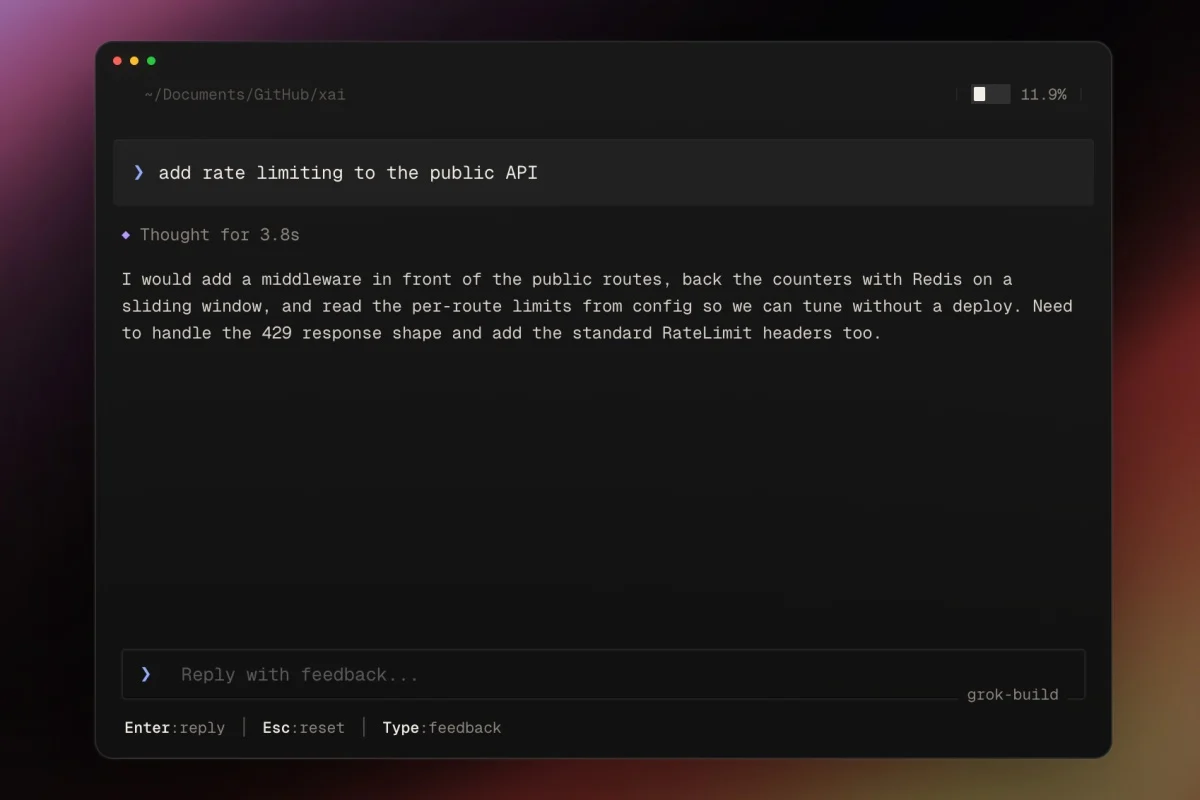
Operating directly within the terminal, this potent orchestrator assists developers in navigating intricate engineering workflows, spanning code composition, debugging, and documentation maintenance. Presently, the service has been deployed exclusively to the premier tier of SuperGrok Heavy subscribers.
Diverging from contemporaries that favor visual Integrated Development Environment (IDE) extensions, Grok Build honors the tradition of seasoned engineers by adopting a native Command Line Interface (CLI) paradigm. Developers can initialize installation via a singular directive and authenticate utilizing their SuperGrok Heavy credentials. Once invoked within an active codebase, Grok Build stands ready to accept delegated objectives, ranging from structural code refactoring and technical manual synthesis to deep-tier performance optimization.
To mitigate the systemic hazards of an artificial intelligence unilaterally executing sweeping alterations across foundational codebases, Grok Build introduces an architectural guardrail designated as Plan Mode. When confronted with multi-faceted engineering requirements, the agent pre-formulates a comprehensive execution blueprint. Developers retain the prerogative to sanction this strategy, append granular annotations, or mandate a complete revision. Code generation commences exclusively upon explicit authorization, with all subsequent mutations distinctly enumerated to facilitate seamless code reviews and version control compliance.
Beyond its core synthetic capabilities, xAI emphasizes that Grok Build exhibits superb compatibility with existing engineering ecosystems and collaborative pipelines. The utility integrates effortlessly into bespoke workflows, honoring established coding standards, native plugins, Model Context Protocol (MCP) daemons, and automated CI/CD continuous integration infrastructure.
Furthermore, when confronted with monolithic or time-intensive engineering endeavors, Grok Build can spawn multiple sub-agents to process disparate work items in parallel. This methodology permits the concurrent execution of structural linting and runtime bottleneck diagnostics, drastically compressing the holistic development lifecycle.
The debut of Grok Build signifies that the competitive landscape for computational engineering utilities has officially transcended the rudimentary “Copilot” era, ascending into the vanguard of autonomous agency. Within the current market matrix, platforms such as Anthropic’s celebrated Claude Code, Google’s Gemini CLI, and Microsoft’s GitHub Copilot Coding Agent demonstrate that premier AI monoliths have collectively deemed autonomous command-line utilities as the ultimate weapon to capture the developer constituency.
Although Grok Build remains tethered to an early preview phase restricted to an elite subscription demographic, its signature Plan Mode safeguard and multi-agent parallel processing faculties accurately address the dual imperatives of risk mitigation and multi-tasking efficiency prized by veteran engineers. As xAI iteratively refines the platform based on contemporary user telemetry, Grok Build possesses unmistakable potential to emerge as a formidable dark horse in the grand theater of AI-driven code generation.
Support Our Threat Intelligence
If you find our technology report and cybersecurity news helpful, consider supporting our work.
 Buy Me a Coffee
PayPal
Buy Me a Coffee
PayPal