The cyberespionage collective known as Kimsuky has refined its operational toolkit to launch targeted offensives against public institutions, defense contractors, and private enterprises. While spear-phishing missives remain their primary vector for initial ingress, the adversaries increasingly cloak their remote access infrastructure behind legitimate service architectures, including Visual Studio Code, DWAgent, Cloudflare Quick Tunnels, and Ngrok, according to an intelligence dispatch from Kaspersky.
The intrusion lifecycle initiates with an engineered email masquerading as a legitimate business document, an administrative questionnaire, a commercial proposal, a state communique, or a personal archive. Nestled within the payload is a first-stage dropper formatted as a JSE, EXE, PIF, or SCR binary. Upon invocation, the loader renders a benign decoy document to assuage suspicion, while concurrently unpacking malicious artifacts to disk, abusing native Windows administrative utilities, and initializing a specific Kimsuky module.
Forensic investigators have mapped these contemporary campaigns to two dominant malware lineages: PebbleDash and AppleSeed. The PebbleDash framework is predominantly deployed against the defense industrial base, whereas AppleSeed exhibits a strong correlation with offensives targeting state ministries. Within nascent variations of PebbleDash, specialists have isolated the HelloDoor, httpMalice, MemLoad, and httpTroy sub-components.
HelloDoor represents the premiere instance of a Kimsuky backdoor authored in the Rust programming language. Given its currently circumscribed functional palette, researchers surmise the binary represents an early developmental iteration. Intriguingly, HelloDoor’s codebase exhibits structural hallmarks of Large Language Model (LLM) synthesis, characterized by debugging strings punctuated with emojis. However, the retention of typographical errors within the prose suggests a hybrid composition, where human operators modified the scripts before or after generating the programmatic logic via AI.
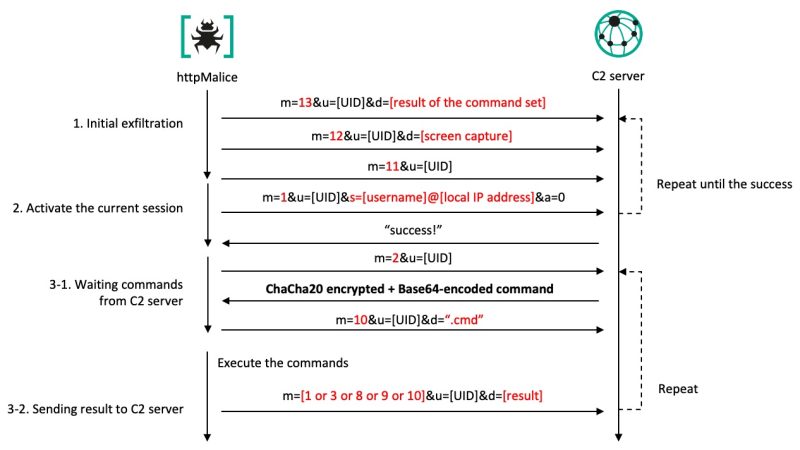
Conversely, httpMalice manifests as the most mature component dissected in the briefing. The implant executes a comprehensive environmental reconnaissance routine, evaluating privilege echelons, anchoring persistence via Windows services or registry run keys, transmitting periodic desktop screen captures, and polling its command-and-control server for secondary instructions. Through httpMalice, operators can remotely invoke shell commands, fetch arbitrary files, compress and exfiltrate entire directory structures, inject novel payloads directly into system memory, and orchestrate anti-forensic cleanup routines.
The tactical pairing of MemLoad and httpTroy facilitates low-observable persistence. MemLoad evaluates the underlying host environment, registers a scheduled task, and executes a secondary payload module into the memory space. Subsequently, httpTroy assume responsibility for long-term command connectivity and systematic data exfiltration from the compromised endpoint.
Concurrently, the AppleSeed ecosystem undergoes independent evolution. In its current configuration, the implant harvests local documents, screen captures, keystroke logs, connected cryptographic USB storage telemetry, and the entire contents of the C:\GPKI directory. Within the South Korean administrative apparatus, this specific pathway stores Government Public Key Infrastructure digital certificates utilized by officials to authenticate into state platforms. Consequently, the exfiltration of this repository yields not merely static files, but potentially reusable identities to compromise downstream targets.
Furthermore, investigators highlighted Kimsuky’s sophisticated exploitation of legitimate binaries to evade detection. The group weaponizes the native Remote Tunneling architecture of Visual Studio Code: a malicious dropper fetches an official VSCode binary, instantiates an outbound tunnel authenticated through a compromised GitHub profile, and dispatches the connection metadata back to the operator. To perimeter security defenses, this data flow appears indistinguishable from routine enterprise interaction with Microsoft’s public cloud infrastructure.
A corollary methodology was observed with DWAgent. The adversaries silent-install this legitimate remote administration software utilizing a pre-configured profile tethered to their own account. Upon initialization of the DWService background process, the operator instantaneously secures unhindered remote desktop access to the endpoint, routed entirely through the vendor’s legitimate relay infrastructure.
Kaspersky concludes with a high degree of confidence that both operational campaigns belong to the Kimsuky nexus. This attribution is reinforced by uniform delivery heuristics, overlapping target demographics, shared technical signatures, and disparate malware binaries signed with the identical stolen digital certificate. This campaign underscores that the collective is not abandoning its legacy frameworks, but is rather pursuing an incremental optimization of its codebase, adroitly blending custom implants with commercial administrative utilities to maximize its longevity within compromised environments.
Support Our Threat Intelligence
If you find our technology report and cybersecurity news helpful, consider supporting our work.
 Buy Me a Coffee
PayPal
Buy Me a Coffee
PayPal