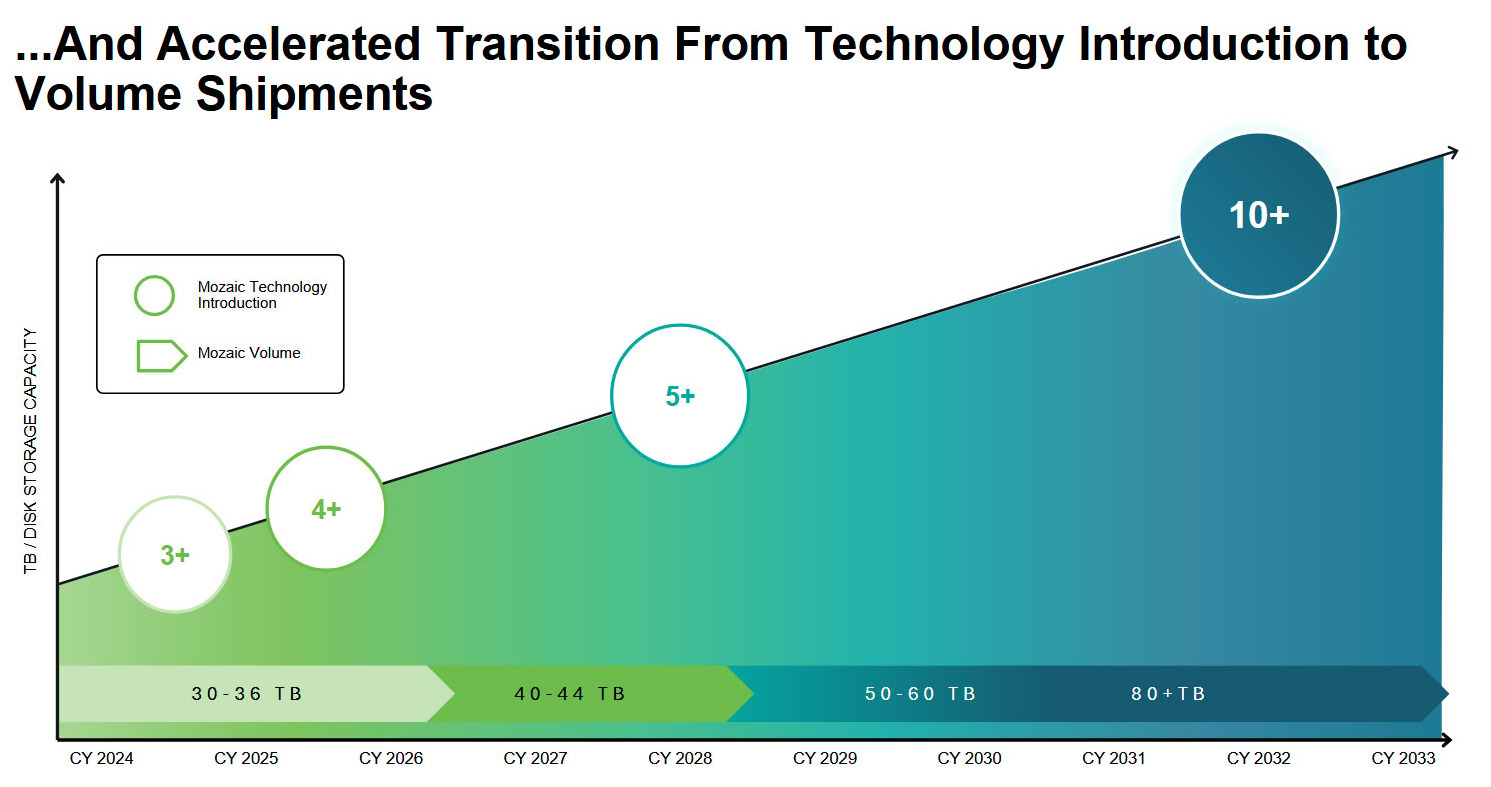
Seagate has unveiled bold ambitions during its Q4 fiscal year 2026 earnings call. The company confirmed it is actively advancing its HAMR – Heat-Assisted Magnetic Recording – technology roadmap. By late 2027, Seagate aims to achieve a storage density of 5TB per platter. Combining ten platters in a single drive, this milestone would yield a 50TB hard disk drive.
Why Areal Density Is the Central Challenge
Today’s high-capacity mechanical hard drives still occupy the familiar 3.5-inch form factor. Therefore, manufacturers cannot simply add physical bulk to increase capacity. Instead, they must continuously raise the areal density of each individual platter.
Under a ten-platter configuration, every gain in per-platter capacity translates directly into a proportional gain in total drive capacity. This constraint makes density improvements the single most important lever in the HDD industry.
Mozaic 5+ Technology Will Power the 50TB Generation
Seagate has confirmed that all future drives exceeding 5TB per platter will be built on its Mozaic 5+ platform. Moreover, the first products based on this architecture are scheduled to ship to select, priority customers for qualification in the latter half of 2027.
The Certification Pathway
The qualification process follows a structured sequence. First, Seagate completes its own internal testing and validation. Subsequently, the drives are handed off to OEM partners and hyperscale data center operators for final acceptance testing. Only after clearing this rigorous process will the 50TB drives be ready for broad commercial deployment.
According to TechSpot’s coverage of Seagate’s 50TB HAMR roadmap, the company’s trajectory reflects a deliberate, phased approach to market introduction.
Current Mozaic 4+ Drives Lead the Market Today
In the interim, Seagate’s existing Mozaic 4+ platform already supports capacities reaching 44TB. Furthermore, the company expects Mozaic 4+ drives to account for 50% of all HAMR HDD shipments to targeted customers by the end of 2026. Shipment volumes are projected to climb further as adoption accelerates.
AI Data Centers Are Fueling Unprecedented Demand
It is important to understand who is buying these drives. Seagate’s ultra-high-capacity HDDs are designed primarily for the AI industry – specifically for large technology companies and artificial intelligence firms operating at hyperscale.
Record Financial Performance Reflects the Trend
This surging demand is already visible in Seagate’s financial results. For the quarter ending June 2026, the company reported revenue of $3.6 billion. That figure represents a 17% increase over Q3 2026 and a striking 48% year-over-year gain compared to Q4 2025.
Capacity Booked Through 2028
Demand for cold storage – the category in which mechanical hard drives excel – has become so intense that Seagate’s exabyte-scale production capacity is already committed through 2028. The vast majority of current revenue flows from AI data centers and cloud computing operators.
Cold Storage Remains Critical for AI and Agentic Systems
Seagate argues that cold storage is not merely a peripheral component of AI infrastructure. On the contrary, it is foundational. AI model training, archival data lakes, and agentic systems all depend on reliable, high-density cold storage at scale.
This reality is what drives continued procurement of ultra-high-capacity drives. As a result, Seagate is positioning its Mozaic 5+ roadmap not as a distant aspiration, but as the direct commercial response to an already-committed customer base eager for the next density threshold.
Support Our Threat Intelligence
If you find our technology report and cybersecurity news helpful, consider supporting our work.
 Buy Me a Coffee
PayPal
Buy Me a Coffee
PayPal