Introduction to the Perimeter Breach
Software engineers traditionally place immense trust in verified namespaces. This trust is especially deep when handling components from prominent enterprise vendors. However, a recent incident within the npm registry exposes a critical perimeter vulnerability. This compromise proves that even verified dependencies can serve as conduits for credential theft.
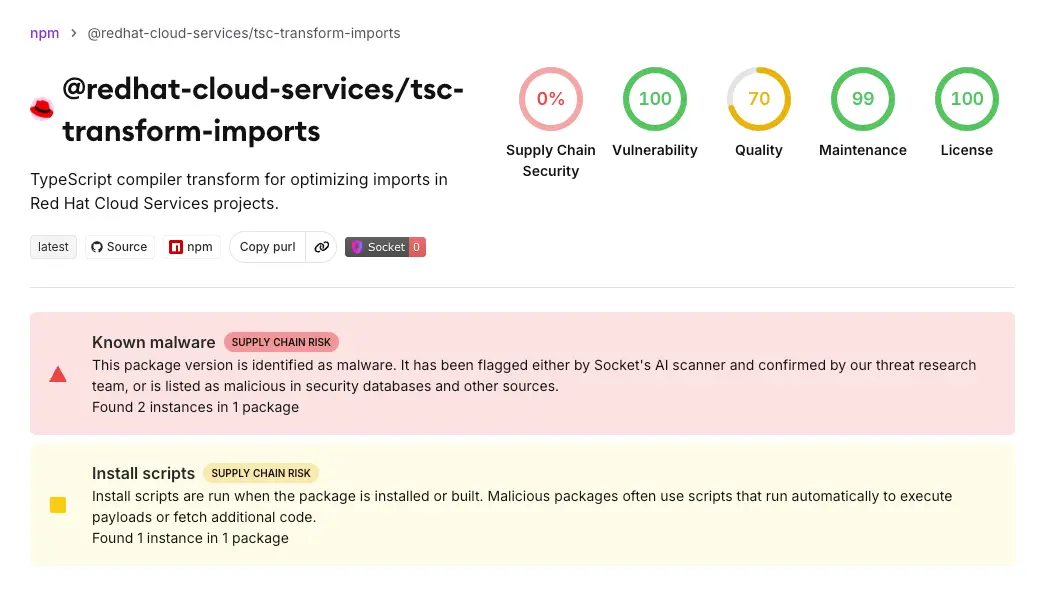
Consequently, malicious iterations surfaced directly within the Red Hat Cloud Services domain. This intrusion beautifully mirrors a miniature variant of the notorious Shai-Hulud campaign.
Deconstructing the Compromised Architecture
Security researchers at Socket initially detected this adversarial campaign targeting @redhat-cloud-services packages. According to their technical telemetry, the infected versions initialized a hidden payload via native preinstall hooks. Therefore, the underlying malicious script executed automatically during the dependency resolution phase. This orchestration triggered the threat vector right before module importation into the host project.
Extent of the Infiltration
This aggressive campaign compromised dozens of essential enterprise components. Specifically, Socket monitors ninety-five distinct corrupted artifacts published on June 1, 2026. The targeted assets notably include:
-
chromeandfrontend-components -
insights-clientandrbac-client -
host-inventory-client -
compliance-clientandnotifications-client
Execution Logic and Payload Obfuscation
Forensic analysis revealed that the index.js file deceptively masqueraded as a standard initialization entry point. In reality, the script functioned as an obfuscated loader mechanism. First, the code decrypted embedded components using advanced AES-GCM algorithms. Next, it transcribed the primary payload into a volatile temporary file.
Subsequently, the routine executed this binary using the Bun runtime before meticulously purging local forensic evidence. If the host system lacked the Bun environment, the malware autonomously fetched the runtime directly from GitHub repositories.
Secret Exfiltration and Lateral Propagation
The primary payload aggressively harvested a vast array of high-value authentication keys. For instance, it targeted GitHub Actions automation tokens, npm registry permissions, and private SSH keys. Concurrently, the malware extracted native Git configurations alongside cloud credentials for AWS, Azure, and Google Cloud Platform. It also scanned for Kubernetes cluster files, HashiCorp Vault secrets, and Docker telemetry. Furthermore, specialized modules specifically targeted the GitHub CLI memory spaces to seize ephemeral administrative tokens.
Additionally, Socket discovered that the malware encrypted the purloined telemetry before transmission. The exfiltration primarily utilized standard HTTPS channels. However, the architecture also maintained a fallback conduit leveraging the GitHub API.
Armed with an authorized token, the malware could silently write JSON data files back into public repositories. The codebase also contained explicit heuristics indicating potential lateral propagation. This capability allowed the threat to systematically alter remote repositories and continuous integration workflows.
Attribution and Open-Source Proliferation
Threat analysts heavily link these sophisticated tactics to the Shai-Hulud lineage. Nevertheless, they refrain from naming a definitive threat actor. The public availability of open-source frameworks from TeamPCP drastically lowers the barrier to entry. Consequently, diverse independent adversaries can effortlessly replicate these devastating supply chain intrusions.
Prescribed Remediation and Incident Response
Organizations exposed to these compromised versions must treat their systems as thoroughly breached. Merely deleting the local node_modules directory provides insufficient defense. This limitation exists because the malware operates persistently in the background. It alters configurations and captures credentials during the initial installation phase.
Therefore, security teams should immediately audit lockfiles and inspect CI/CD execution logs. They must also scrutinize package caches and developer workstations. Following this initial triage, practitioners must systematically rotate all potentially exposed keys. This emergency mandate encompasses credentials for GitHub, npm, primary cloud vendors, Kubernetes, HashiCorp Vault, Docker, PyPI, and private SSH pairs.
Support Our Threat Intelligence
If you find our technology report and cybersecurity news helpful, consider supporting our work.
 Buy Me a Coffee
PayPal
Buy Me a Coffee
PayPal