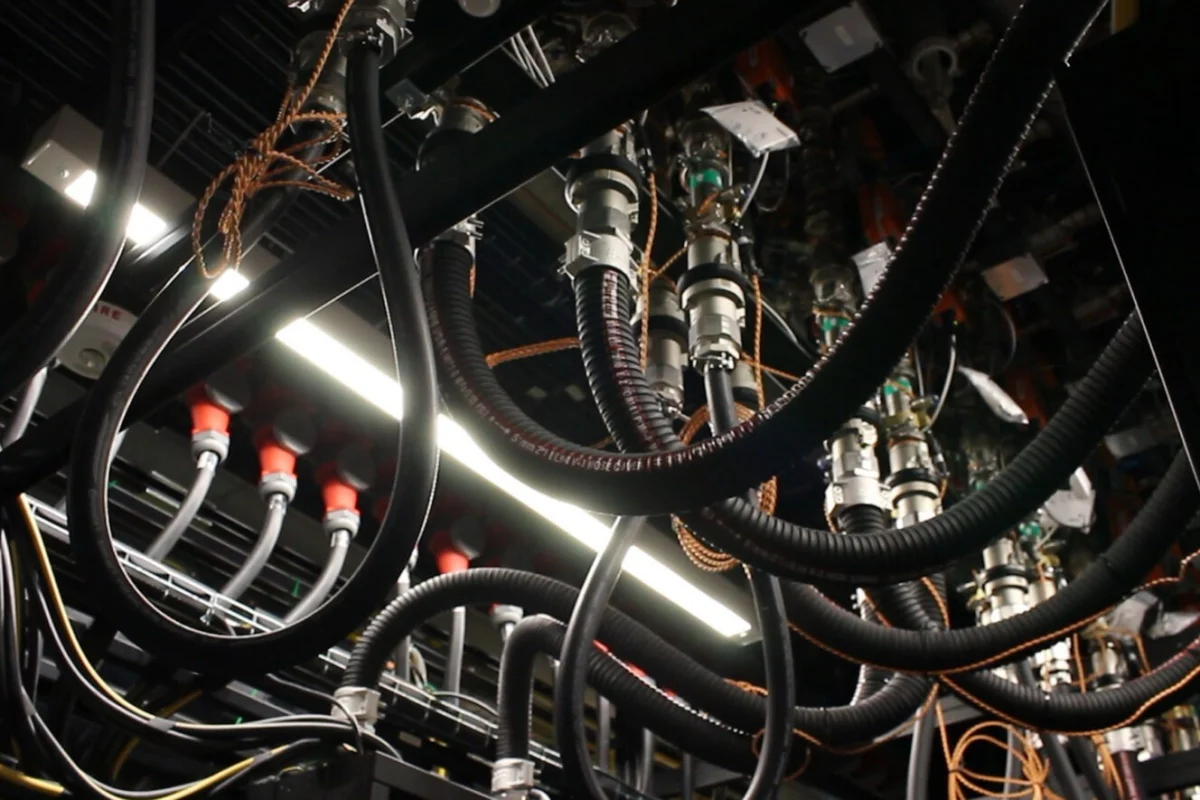
In the age of explosive AI compute, most people picture a data center as a “tech freezer” rows of giant fans, flickering blue light, and air conditioning so fierce that you need a jacket to step inside. Yet as NVIDIA’s next-generation Rubin infrastructure moves fully into the liquid-cooling era, that traditional design philosophy is being overturned.
According to the technical details NVIDIA recently published, the closed-loop liquid cooling system in its Rubin-generation servers actually injects coolant at 45°C (113°F). Remarkably, that runs hotter than the roughly 38°C to 40°C of a typical warm shower. Cooling the most powerful AI silicon on the planet with “warm water” seems counterintuitive, yet a brilliant piece of thermodynamic arithmetic hides behind the idea.
Why 45°C Warm Water Can Cool a Top-Tier Chip
In the past, data centers poured enormous amounts of electricity into chilling the air itself, then used powerful fans to blow that cold air across the chips. As compute density has soared, however, this approach has grown deeply inefficient and wasteful.
Silicon chips generate intense heat under heavy load. NVIDIA’s figures show that when 45°C coolant flows into the liquid cold plate and absorbs a chip’s waste heat, it leaves at roughly 55°C. In other words, as long as the cold plate’s heat-transfer design is excellent enough to keep the core within a safe range, that 10°C gap alone is enough to sustain full-speed operation.
The most crucial change, though, lies in simplifying the cooling path. Because the coolant baseline sits at 45°C, the facility no longer needs energy-hungry mechanical chillers to force the liquid cold. For most of the year, a data center can simply use outdoor dry coolers, relying on the temperature gap between ambient air and the 55°C return water to complete the heat exchange with remarkable efficiency.
Doing the Green and Economic Math: 40% Less Power, Near-Zero Water
This “warm-water liquid cooling” architecture directly tackles the two pain points critics raise most about AI data centers: grid load and water consumption.
Sharply Lower Operating Costs and Power Draw
Historically, cooling systems have swallowed up to 40% of a data center’s electricity bill. Industry estimates suggest that raising the cooling-source setpoint by just 1°C trims cooling energy costs by about 4%. Scale that up to a 50-megawatt mega facility, and the annual electricity savings alone reach roughly $4 million.
Erasing the Data Center’s “Water-Guzzler” Reputation
Traditional data centers rely on evaporative cooling towers, which consume up to 2.6 million gallons of water per megawatt each year. NVIDIA’s Rubin closed-loop design, by contrast, needs no evaporative cooling and no constant tower blowdown. As a result, it drives water consumption down to nearly zero.
Goodbye Noise and Space Anxiety, Hello Extreme Density
Beyond saving energy and water, this architectural shift also transforms the modern data center’s interior environment.
First, it creates a quiet workplace. Technicians once had to wear ear protection against the roar of thousands of high-speed fans. Rubin removes the fans and switches to silent coolant circulation, so that din simply disappears.
Second, it triples space efficiency. Thanks to liquid cooling’s superb heat-exchange performance, a server system that once occupied six rack slots (6U) under air cooling now shrinks to just 2U. Consequently, on the same footprint of land and infrastructure, operators can deploy up to three times the AI compute density.
Analysis: Geography Becomes the Decisive Factor for AI Deployment
Through Rubin, NVIDIA proves to the market that limitless AI compute need not spell environmental ruin. This low-energy, zero-water, warm-water cooling design looks set to become the standard for green data-center transformation over the coming years.
The technology is not without limits, however. As the reporting notes, geography will play a decisive role. In cooler, higher-latitude regions, 45°C warm-water cooling can drop chillers entirely and run perfectly on natural-air dry coolers.
Move the same architecture to the tropics or a desert, though, and outdoor temperatures above 40°C will severely squeeze heat-exchange efficiency. Therefore, how to fine-tune the architecture region by region becomes the next engineering challenge that cloud service providers (CSPs) must confront.
Support Our Threat Intelligence
If you find our technology report and cybersecurity news helpful, consider supporting our work.
 Buy Me a Coffee
PayPal
Buy Me a Coffee
PayPal