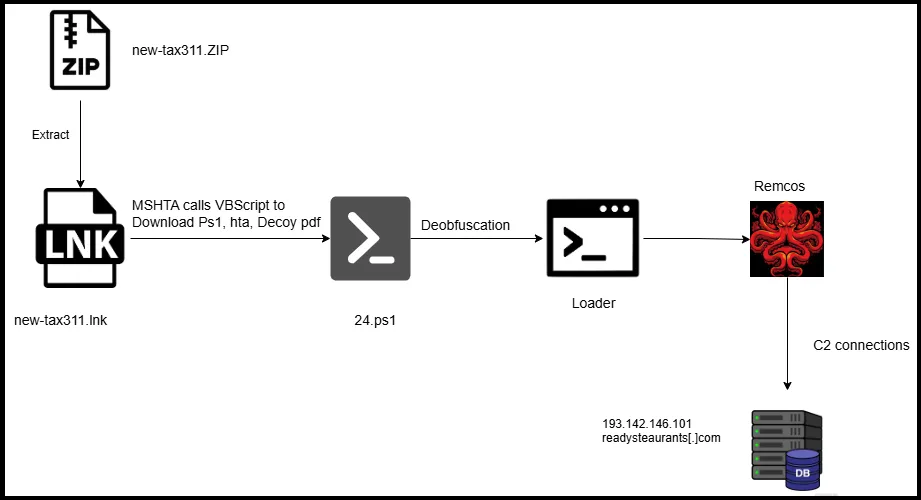
Researchers at Qualys have issued a warning about a new malicious campaign that leverages a PowerShell script to deploy the Remcos Remote Access Trojan (RAT). The infection vector relies on ZIP archives disguised as tax documents — within these archives lie LNK files masquerading as shortcuts to legitimate Office documents.
In the initial phase of the attack, a legitimate Windows system component — mshta.exe, used to execute HTML Applications (HTA) — is exploited. Through it, a remote HTA file named xlab22.hta is fetched, containing VBScript code. This script proceeds to download a PowerShell payload, a decoy PDF document, and another HTA file — 311.hta — which is subsequently registered in Windows startup via system registry modifications.
Upon execution, the PowerShell script unpacks and triggers a shellcode loader, which injects Remcos RAT directly into memory, thereby circumventing disk-based detection. This fileless approach allows the malware to evade the majority of antivirus solutions. Remcos RAT is a well-known surveillance tool capable of a broad range of remote control functions — from keylogging and screenshot capture to clipboard monitoring and process enumeration. Command and control is maintained via a secured TLS connection to the server readysteaurants[.]com.
The trend of deploying Remcos RAT through fileless methods is not new. As early as November 2024, researchers at Fortinet documented a similar campaign that used delivery-themed lures to entice victims into opening attachments that executed malicious code entirely in memory.
According to Qualys analysts, the combined use of PowerShell, LNK shortcuts, and mshta.exe signifies a shift toward “surgically precise” attacks designed to bypass both signature-based and behavioral detection mechanisms. Organizations lacking attachment control mechanisms and real-time PowerShell monitoring remain especially vulnerable.
Modern attack strategies increasingly rely on legitimate system utilities, repurposing standard Windows components as conduits for malware delivery. This underscores the critical need for a layered defense approach: filtering attachments at the email gateway, monitoring PowerShell activity, and restricting the execution of scripts via mshta.exe within enterprise environments.
Support Our Threat Intelligence
If you find our technology report and cybersecurity news helpful, consider supporting our work.
 Buy Me a Coffee
PayPal
Buy Me a Coffee
PayPal