With its antitrust settlement with Epic Games complete, Google’s app store ecosystem has reached a historic turning point. The company will open third-party payment options on the Google Play Store starting June 30. The change rolls out first in the United States, the United Kingdom, and the European Economic Area. At the same time, Google scraps its long-criticized flat 30% commission.
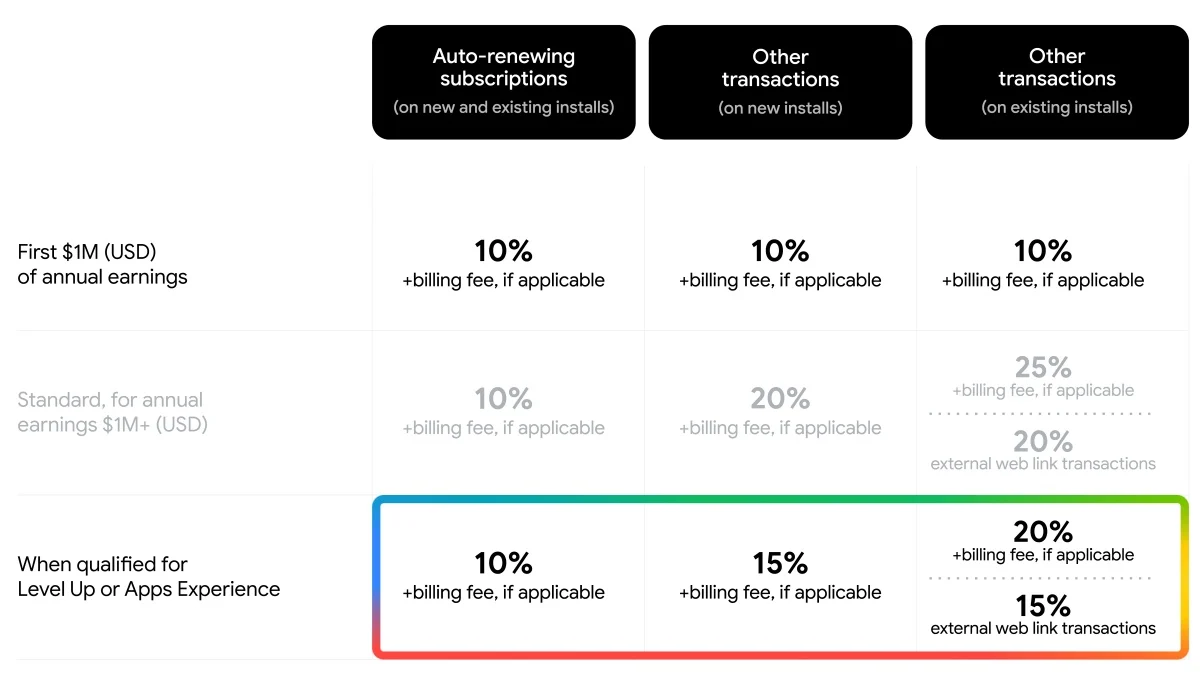
In its place, Google now splits the cost into a platform service fee and a billing fee. For small and mid-size developers earning under $1 million a year, the base service fee drops sharply to 10%.
Unbundling Payments: External Links and Custom Checkout
In the past, Android developers who sold digital content on Google Play had little choice. They were essentially forced to use Google’s official In-App Billing system. From June 30, however, Google will allow third-party payment options inside the app. Developers can even guide users to click a link and finish checkout on their own official website. You can read Google’s developer announcement for the full policy.
Under the new rules, developers can still keep the Google Play checkout option for shoppers. On top of that, they can design their own checkout screens, within Google’s user-experience rules. So consumers see their payment choices clearly and can pick the best deal.
A Rebuilt Fee Structure: Service Fee vs. Billing Fee
To support third-party payments, Google has fully restructured its commissions. The fees a developer owes now split into two parts.
Platform Service Fee
Every developer pays this fee, no matter which checkout method they use. It covers the value of the Android system, Play Store infrastructure, and traffic. For each developer’s first $1 million in annual revenue, the service fee falls to 10%. All auto-renewing subscriptions also carry a 10% service fee. Above the $1 million threshold, new non-subscription installs are charged 20%. Non-recurring transactions from existing installs can reach up to 25%.
Billing Fee
Developers pay an extra 5% billing fee only if they keep using Google Play’s official payment system. In short, a small developer who connects their own external payment pays just 10% to Google. If they stick with Google’s billing for convenience, the total comes to 15%.
The Apps Experience and Games Level Up Programs
To reassure large developers and lift app quality, Google also announced two new programs. They are called Apps Experience and Games Level Up. Both are set to launch on September 30 this year.
The programs target developers who invest in high-quality cross-screen experiences. That means apps and games built for large screens, smart TVs, and multiple devices. If they meet the high security and performance standards, they earn better rates even above $1 million in revenue. For example, new-install transactions drop to 15% and existing-install transactions to 20%.
The new policy starts on June 30 in the US, UK, and Europe. It then expands to Japan, South Korea, and Australia by the end of the year. Finally, Google plans a full global rollout, including Taiwan, by September 30, 2027.
The Wall Falls, but Is Google Still the Big Winner?
This sweeping move is a concrete concession to global regulators and to Epic’s long legal pressure. It marks a real, major change to the “commission tax” wall that long ruled the mobile app market.
Look closely, though, and Google’s math is shrewd. The change looks like open external payments on the surface. Yet Google created a brand-new “platform service fee” concept. So even if a developer uses no Google payment system and sends shoppers to their own site, they still owe Google a service fee of 10% to 20%.
For most small and mid-size developers, this is a good deal. A 10% service fee plus self-managed payment costs beats the old 15% or even 30%. For large game studios, however, the rules grow very complex. They involve new versus existing installs, auto-renewal status, and whether the developer joins the premium experience programs.
This app-store revolution, sparked by Epic Games, won developers a priceless thing: choice. Still, as the landlord of the operating system, Google clearly will not give up a profit pool worth tens of billions of dollars a year so easily.
Support Our Threat Intelligence
If you find our technology report and cybersecurity news helpful, consider supporting our work.
 Buy Me a Coffee
PayPal
Buy Me a Coffee
PayPal