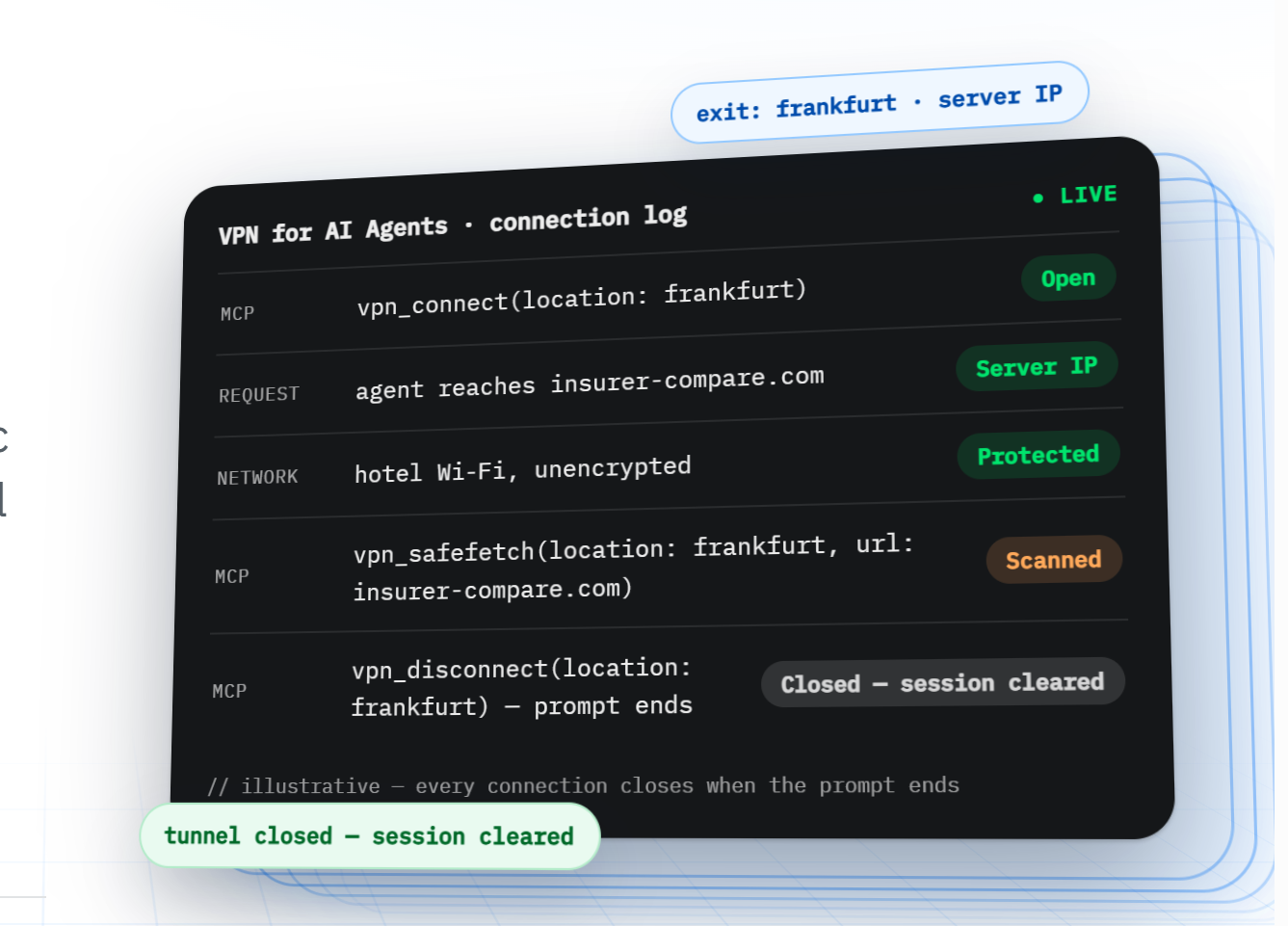
The veteran antivirus vendor Bitdefender has recently launched a dedicated VPN service for AI agents, aiming to resolve problems such as an agent exposing a user’s real IP address when going online, and residual network state lingering between separate tasks. The product serves AI agents through the Model Context Protocol (MCP) and, in principle, offers no support for direct use by a human being. Bitdefender introduced the service on its VPN for Agents product page.
Each Task Gets Its Own Isolated Connection
According to Bitdefender, once a user submits a task to an agent, the service establishes an isolated, temporary environment specifically for that prompt, then forwards the relevant requests through an encrypted tunnel to avoid directly exposing the user’s real IP address. Once the task concludes, the temporary environment is immediately destroyed, and any cache, cookies, or other session state are wiped clean as well.
This mechanism helps reduce data residue between tasks and can also be used to view web content from different regions or test localized pages. For developers who need to build websites or services, this VPN can therefore double as a connectivity test across different global endpoints.
Only Agent Traffic Is Routed, Not the User’s Own
A traditional VPN tool (the kind without split tunneling) takes over an entire device’s traffic once configured, meaning every action a user performs, whatever it may be, connects through the VPN’s exit node. This sometimes causes shifts in connection speed and localization problems when accessing content.
Bitdefender’s VPN, by contrast, is called upon exclusively by AI agents. Tools such as Claude Desktop, Cursor, Codex, and OpenCode, which can configure the MCP protocol, route their outgoing traffic through the MCP tool, so the browser or other applications on the computer continue to exit through the normal local network as usual.
Not an Anonymity Tool, and Not a Cure-All for Every Risk
Bitdefender stresses that this service chiefly changes a request’s network exit point and isolation method; it does not hide the prompts a user submits to a model provider, nor does it offer comprehensive security protection for the AI agent itself. Account logins and request content remain identifiable to the model and the destination website, so the service cannot be treated as a fully anonymizing solution.
At present, this VPN tool supports only macOS, is free during the testing period, and imposes no traffic limits. Should developer enthusiasm run high, a Windows version and a paid subscription plan will likely follow.
Support Our Threat Intelligence
If you find our technology report and cybersecurity news helpful, consider supporting our work.
 Buy Me a Coffee
PayPal
Buy Me a Coffee
PayPal