The Linux Vendor Firmware Service (LVFS) functions principally as a secure administrative portal engineered for original equipment manufacturers (OEMs), providing a centralized repository where hardware vendors can upload their latest firmware iterations, which end-users subsequently ingest and deploy via consumer-facing clients such as the GNOME Software Center or the fwupdmgr command-line utility.
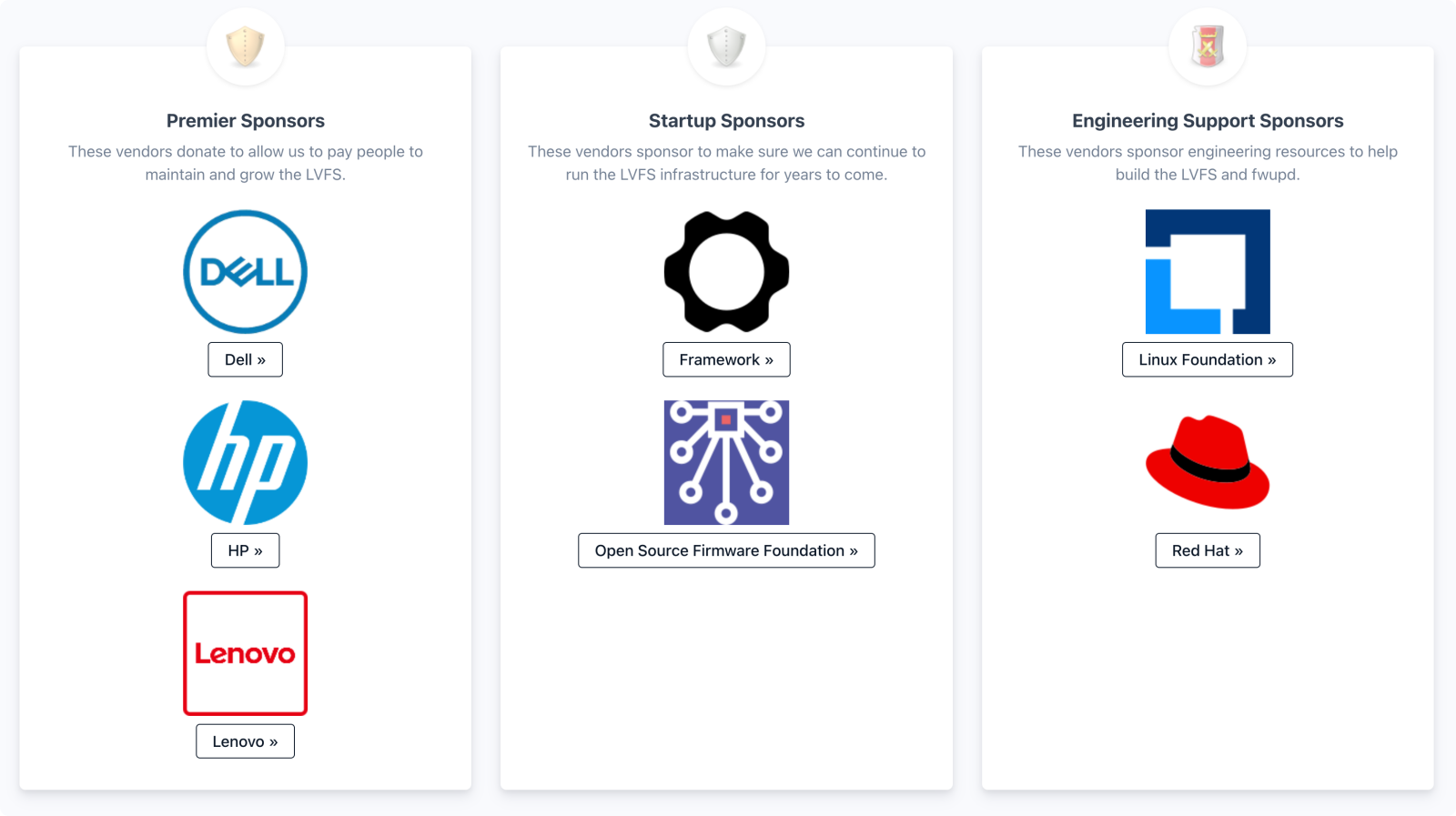
This critical infrastructure was initially architected in 2015 by prominent GNOME maintainer Richard Hughes. However, like many vital open-source repositories, the initiative historically suffered from a profound deficit of sustainable financial capitalization; historically, the operational viability of LVFS was subsidized primarily by Framework and the Open Source Firmware Foundation (OSFF) through modest annual grants of $10,000 to facilitate project development and infrastructure hosting. Encouragingly, a broader coalition of hardware manufacturing giants has formalized a commitment to subsidize the project’s ongoing lifecycle.
Lenovo and Dell have stepped forward as primary corporate underwriters for the LVFS ecosystem, with each enterprise committing an annual sponsorship of $10,0000. This influx of capital fundamentally shifts the project toward long-term institutional sustainability and structured governance, ensuring the continuous provisioning of secure, immutable, and resilient firmware distribution streams for the global Linux constituency.
Furthermore, HP is currently finalizing arrangements to join this elite underwriting tier, pledging a matching annual contribution of $10,0000. This collaborative alliance guarantees an aggregate, baseline fiscal runway of at least $30,0000 per annum for the LVFS enterprise, ensuring that subsequent development iterations and infrastructure management paradigms achieve unprecedented reliability.
Naturally, beyond the corporate triad of Lenovo, HP, and Dell, a sprawling assembly of international hardware fabricators—including ASUS, Acer, and MSI—relies continuously upon the transactional capabilities of LVFS to service their respective device portfolios. Consequently, the open-source community maintains an expectant posture, anticipating that adjacent hardware conglomerates will similarly transition to active fiscal sponsorship, thereby reinforcing the collective resilience and absolute continuity of this critical piece of the Linux ecosystem.
Support Our Threat Intelligence
If you find our technology report and cybersecurity news helpful, consider supporting our work.
 Buy Me a Coffee
PayPal
Buy Me a Coffee
PayPal