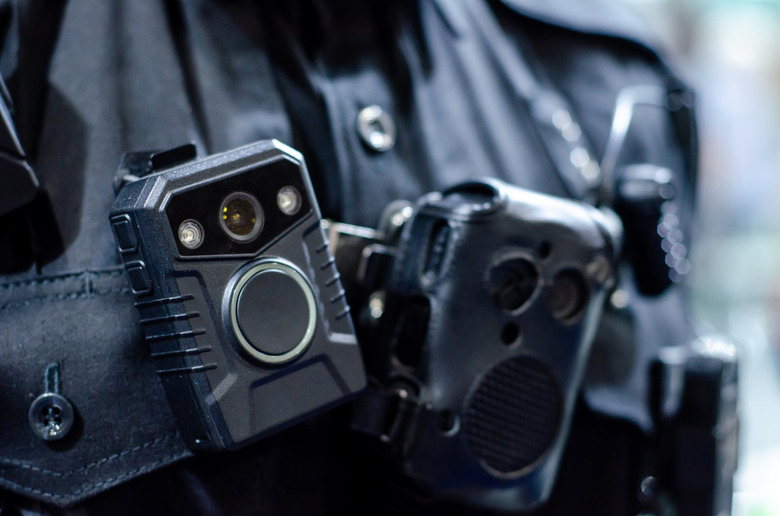
Close-up of police body camera
A law enforcement officer has not yet crossed the threshold of the precinct, yet an alien mobile device is already cataloging the surrounding personnel. One signal, then a second, and a third—the screen begins to populate with the precise coordinates of Axon service tasers and body-worn cameras utilized by thousands of Australian police officers. Such surveillance necessitates neither access to classified databases nor specialized hardware; a rudimentary Bluetooth scanning application suffices to orchestrate this tracking.
An investigation by ABC Four Corners has revealed that Axon body cameras and service tasers, when Bluetooth is engaged, are capable of broadcasting the wearer’s real-time location. The crux of the vulnerability lies in the utilization of persistent MAC addresses. While contemporary consumer electronics frequently rotate these identifiers to safeguard privacy, select Axon law enforcement equipment ostensibly transmits a fixed address, enabling the distinct identification of specific devices.
An anonymous researcher disclosed to Four Corners that he identified the flaw during routine monitoring of the Bluetooth spectrum. Upon observing Axon devices proliferating within the logs, the specialist developed a diagnostic program. This software identified Axon hardware, displayed the model and serial number, and provided the precise coordinates, issuing an immediate notification whenever police equipment was detected.
During a field test in Melbourne, the researcher utilized a publicly available Android Bluetooth scanning utility. As police officers approached, the application displayed the latitude, longitude, model, and serial number of their equipment. The film crew observed officers returning to a suburban precinct in marked patrol vehicles, followed by personnel departing in undercover cars; even after the vehicles vanished from visual range, the mobile device continued to receive alerts.
According to the researcher, the bespoke software remained operational at distances of up to 400 meters. The system is inherently scalable: by deploying inexpensive Bluetooth scanners throughout a district, one could generate a live map of police movements. In the hands of a criminal syndicate, such an instrument would facilitate the preemptive detection of raids, the evasion of arrest, or the orchestration of targeted assaults on officers.
The researcher endeavored to alert Australian authorities as early as 2024, dispatching missives to police departments, relevant ministers, the federal police, and national security agencies. In this correspondence, the specialist explicitly argued that the nascent Axon tasers effectively transformed officers into perambulating radio beacons, mandating that the manufacturer implement randomized MAC address rotation.
These warnings yielded no official response. Four Corners asserts that the Victoria Police received the correspondence in 2024 and conducted an internal assessment. Initially, the risk was deemed legitimate, prompting recommendations for urgent mitigation—particularly for surveillance and undercover units. Subsequently, however, Victoria Police leadership, following consultations with Axon, dismissed the concern as negligible.
Victoria Police informed journalists that they had encountered no instances of unauthorized access or tracking of tasers and body cameras via Bluetooth or Wi-Fi. A spokesperson cited internal testing that purportedly unmasked no such vulnerabilities, though the department declined to confirm whether frontline officers had been apprised of the potential for their equipment to betray their presence.
Four Corners also alerted police departments across other Australian states and territories, yet none disclosed the measures taken to fortify officer safety. The New South Wales Police merely remarked that criminal applications for tracking law enforcement have long existed, and that the authorities perpetually contend with such technological threats.
While Axon did not respond to inquiries from the ABC, the company’s website acknowledges a synonymous risk. Within its “Trust and Safety” section, the manufacturer notes that Bluetooth and Wi-Fi signals from Axon cameras are generally detectable, advising that clients should consider the potential for unwanted disclosure during high-risk operations. Critically, it specifies that “Stealth Mode” does not terminate the device’s radio emissions.
The researcher contends that this vulnerability cannot be rectified through a standard firmware update, asserting that the flaw is entrenched within the hardware architecture. Consequently, the manufacturer would be required to redesign the system or initiate a comprehensive recall. Although Axon discussed anti-tracking enhancements in 2023, the T7 and T10 models—widely utilized by Australian agencies—may remain without a definitive resolution.
The magnitude of this issue is amplified by Axon’s market dominance; the company provides tasers to over 18,000 law enforcement agencies globally, including every Australian state and territory. As the primary provider of body cameras, cloud storage, and software licenses, Axon maintains contracts with Australian authorities valued at hundreds of millions of dollars.
Criminologist Emma Ryan, a long-term scholar of electronic control devices, finds the police’s dependency on Axon deeply unsettling. She posits that equipment intended to protect personnel may instead introduce a novel dimension of risk—particularly if the officers remain oblivious to the fact that their wearable gear is broadcasting their position via radio signals.
Support Our Threat Intelligence
If you find our technology report and cybersecurity news helpful, consider supporting our work.
 Buy Me a Coffee
PayPal
Buy Me a Coffee
PayPal