The sophisticated threat collective known as TeamPCP, which specializes in launching targeted supply-chain operations within the NPM ecosystem, recently conceded a rare press engagement with an enterprise security firm, declassifying highly sensitive operational telemetry. The syndicate disclosed that its systemic subversion of the NPM pipeline has yielded access to the intellectual property repositories of tens of thousands of corporate entities. Conspicuously, this haul comprises approximately 3,800 proprietary source-code repositories belonging to the development hosting giant GitHub, assets that are currently being commercialized within premium dark-web markets.
The core architecture of TeamPCP was initially comprised of white-hat security researchers dedicated to collaborative vulnerability research and defensive consulting. However, following a severe breach of professional ethics by a major client organization (widely suspected to be an absolute default on financial remuneration), the cell executed a profound ideological realignment to embrace black-hat methodologies—pivoting to extortion and data exfiltration campaigns. Consequently, TeamPCP originally matured into a dedicated ransomware syndicate.
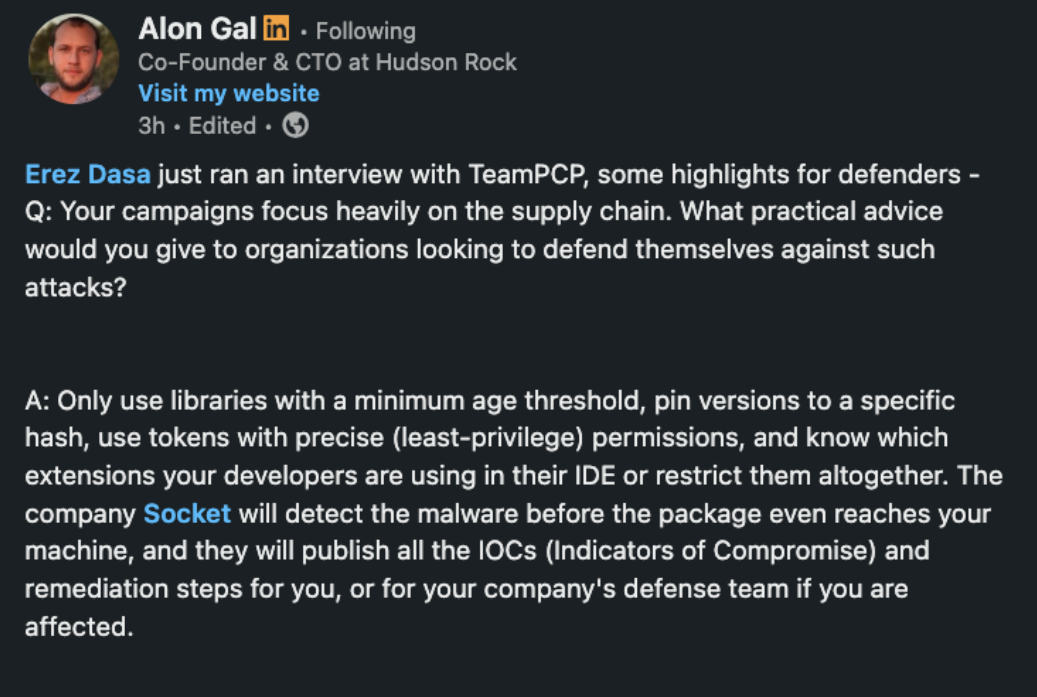
While continuous disclosures of NPM supply-chain compromises have progressively induced defensive apathy across the developer community, practitioners must remain intensely vigilant against these latent intrusion vectors. Throughout the inquiry, the threat actors proffered explicit, pragmatically optimized defensive guidelines to insulate development pipelines against their own signature supply-chain methodologies:
- Enforce Strict Package Chronological Thresholds: Malicious package dependencies are conventionally discovered and expunged by security systems shortly after ingestion into public registries. If a developer resolves a compromised package within this narrow temporal window, the execution host faces immediate credential harvesting. To decouple from this risk profile, security architects should mandate a minimum chronological age for package resolution—arbitrarily allowing deployment only after an asset has matured in the wild for seven full days. Assets failing this criteria must be programmatically bypassed during the build phase in favor of verified legacy releases, exploiting the week-long buffer to allow maintainers and security vendors to successfully identify and purge anomalous code.
- Anchor Package Resolutions to Explicit Cryptographic Hashes: Build pipelines should systematically validate package integrity via absolute cryptographic hash parameters rather than fluid semantic versioning primitives. Because an adversarial release inherently bears a divergent cryptographic signature from the untainted ancestor, enforcing explicit hash checks effectively neutralizes the hazard of a threat actor injecting a malicious update under an identical version nomenclature.
- Institutionalize Least-Privilege Identity Control: Development teams, particularly within large-scale enterprise environments, must implement granular credential governance. Access tokens must strictly reflect the bare minimum privilege boundaries required for operational execution. Over-provisioning access scopes introduces catastrophic risk; should an identity be exfiltrated, it grants the adversary an expansive canvas for lateral exploitation. Enforcing least-privilege constraints sharply curtails the overall blast radius of a credential compromise.
- Restrict Integrated Development Environment (IDE) Extensions: Organizations must implement centralized administrative governance over the installation of external plugins within developer IDE environments. Information security teams must retain absolute visibility into active developer configurations or strictly confine engineers to a white-listed repository of corporate-approved extensions, systematically insulating the enterprise from trojanized utilities.
- Integrate Highly Responsive Security Instrumentation: Within the contemporary NPM threat landscape, telemetry indicates that Socket delivers the most accelerated threat-detection velocity, routinely isolating anomalous software artifacts within mere minutes of registry publication. Acknowledging this efficacy, TeamPCP explicitly recommends the systemic deployment of Socket’s monitoring solutions to intercept malicious dependencies prior to build-time execution. Furthermore, Socket routinely disseminates rich Indicators of Compromise (IoCs) and explicit remediation playbooks, empowering affected security groups to execute rapid, precision-targeted post-incident forensic sweeps.
While TeamPCP initially functioned as a traditional ransomware cell, their extensive capital accumulation has driven a strategic retreat from destructive file-encryption tactics. The syndicate now specializes exclusively in high-value data exfiltration and intellectual property liquidation—a business model they characterize as fundamentally less catastrophic to corporate continuity compared to total infrastructure paralysis.
Regarding the GitHub infrastructure compromise, the 3,800 exfiltrated source-code repositories were initially offered at an opening valuation of $50,000. However, the asset has already commanded premium premium counter-offers scaling up to $9.5000, though this figure represents an active high bid rather than a finalized transactional closing. The true identity of the prospective acquisition entity remains heavily cloaked, leaving it ambiguous whether the bidder is an allied threat actor seeking exploit optimization or a rogue commercial enterprise intending to reverse-engineer GitHub’s core algorithms to accelerate competitive product deployment.
Support Our Threat Intelligence
If you find our technology report and cybersecurity news helpful, consider supporting our work.
 Buy Me a Coffee
PayPal
Buy Me a Coffee
PayPal