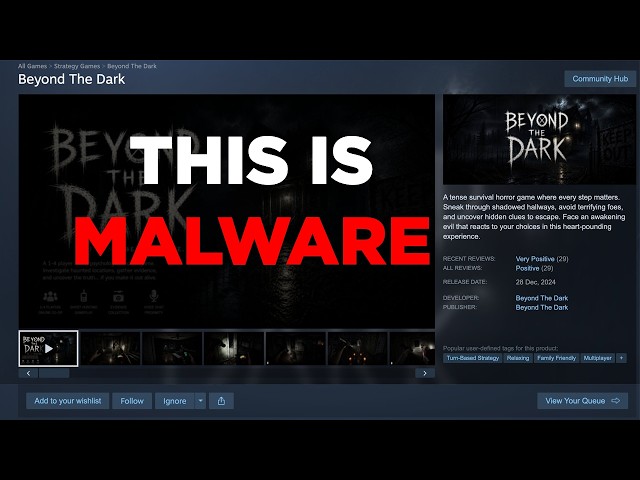
A free-to-play title on Steam has served as a stark reminder that even a familiar, trusted marketplace cannot entirely insulate users from security vectors. Beneath the seemingly innocuous facade of an indie horror game titled Beyond The Dark lurked a malicious harvest utility engineered to systematically exfiltrate localized player telemetry. While the project has since been summarily purged from the storefront, the structural simplicity of the execution pipeline remains profoundly disconcerting.
Beyond The Dark did not materialize on Steam within its final, weaponized configuration. The asset was originally deployed in December 2024 under the moniker Rodent Race, retaining entirely distinct multimedia components, marketing layouts, and algorithmic gameplay mechanics. According to historical metadata cataloged by SteamDB, the application landing page subsequently underwent rapid mutations; commencing May 4, the ancestral code structure was progressively swapped for a cooperative psychological horror experience closely mirroring the aesthetics of Phasmophobia.
This tactical blueprint represents an established, recurring adversarial methodology: a software title successfully satisfies Valve’s initial security appraisal by submitting a completely benign operational build, only for the developers to subsequently inject weaponized payloads via downstream patch updates. Analogous incursions have historically compromised the platform through titles such as Chemia and PirateFi, both of which catalyzed formal investigative actions by the FBI. Beyond The Dark, as delineated by investigative journalist Aaron Down, convincingly masqueraded as a prototypical, free-to-play multiplayer horror experience tailored for social engagement, yet its underlying runtime loop was explicitly optimized to intercept personal user metrics.
The anomalous behavior was isolated through the collective vigilance of the gaming community and specialized security researchers, prominently including Eric Parker, who forensically mapped the execution flow of the trojanized build. Following a deluge of compromised escalations, Valve permanently revoked Beyond The Dark’s distribution privileges. At the hour of publication, the title has been completely decoupled from the active marketplace.
This incident exposes a fundamental structural vulnerability inherent to centralized digital distribution networks. A threat actor can seamlessly orchestrate a verified ingestion pipeline, achieve formal ecosystem authorization via an authentic application build, and subsequently corrupt the file integrity via post-release updates. Against the contemporary backdrop of “vibe-coding”—a paradigm wherein software architectures are rapidly synthesized via generative artificial intelligence utilities such as Anthropic Claude—the volume of these dubious, unvetted software assets is projected to expand exponentially. For Valve, this evolution dictates a mandatory paradigm shift: platform validation must transcend static release-day audits to encompass continuous, dynamic post-patch telemetry review.
For the end-consumer, the primary exposure risk remains largely uncoupled from high-profile, triple-A releases, concentrating instead within low-tier, free-to-play indie experiments that promise immense utility while possessing zero historical brand equity. Although Beyond The Dark was rapidly neutralized, the underlying operational blueprint guarantees that subsequent, conceptually identical iterations will inevitably re-emerge on the platform under alternative corporate pseudonyms.
Support Our Threat Intelligence
If you find our technology report and cybersecurity news helpful, consider supporting our work.
 Buy Me a Coffee
PayPal
Buy Me a Coffee
PayPal