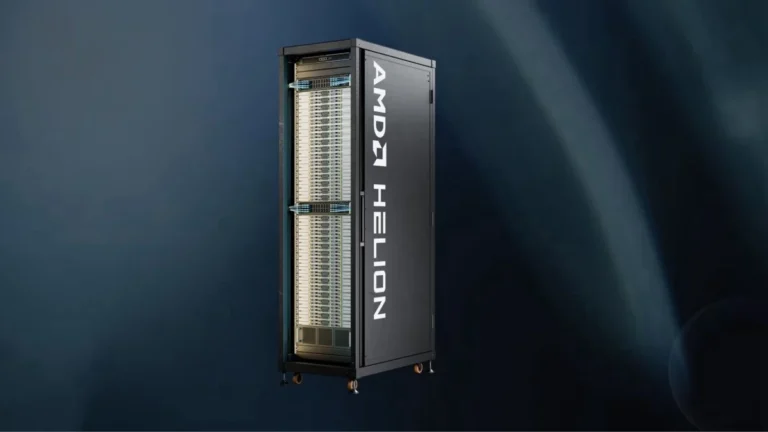
AMD had barely finished unveiling the hardware details of its new Helios rack-scale AI system. Almost immediately afterwards, the company announced a deep strategic alliance with the frontier AI startup Anthropic.
Under the agreement, Anthropic will deploy up to 2 GW of AMD Instinct MI450 Series GPUs housed in Helios rack systems. In addition, AMD has pledged a strategic equity investment in Anthropic worth as much as five billion dollars.
The first gigawatt is scheduled to come online during the first half of 2027. This represents the largest single customer commitment AMD has secured in the AI server arena to date. Moreover, it marks AMD’s formal entry into infrastructure territory long dominated by NVIDIA, armed this time with a dual strategy of compute and capital.
The Sheer Scale of Two Gigawatts
Anthropic builds the Claude family of models. As demand for frontier training and inference climbs exponentially, securing vast and reliable compute has become the only route to staying competitive.
What Sits Inside the Helios Rack
The agreement centres on AMD’s newly announced Helios rack-scale solution. That system integrates Instinct MI455X accelerators, which belong to the MI450 Series. Alongside them sit sixth-generation EPYC processors codenamed Venice, built on TSMC’s 2nm process. Pensando networking and the ROCm software stack complete the package.
Reading the Power Figure
The number itself deserves scrutiny. In data centre terms, a 2 GW load matches the energy draw of hundreds of thousands of top-tier GPUs running simultaneously.
Consequently, the hardware value of this deal likely reaches tens of billions of dollars. Anthropic already runs Instinct MI355X GPUs today. Going forward, however, the company will stake a far larger share of its core infrastructure on AMD’s next generation.
A Genuine Two-Way Exchange
This alliance is no simple arms sale. Instead, both parties gain something technical from the other.
Claude Will Sharpen ROCm
Observers have long argued that AMD builds formidable hardware but trails on software, particularly ROCm. To address that criticism, the two companies are launching a multi-year engineering collaboration.
Anthropic will apply its strongest Claude models to optimise workloads for Instinct GPUs. As a result, AMD expects to accelerate the iteration and refinement of its ROCm stack.
AMD Will Run on Claude
The traffic flows in both directions. AMD plans to adopt Claude broadly across its internal engineering teams and product development pipelines.
A virtuous circle therefore emerges. One party buys silicon to train AI, while the other uses that AI to design the next generation of chips and software. Such reciprocity binds the two companies tightly at the technical foundation.
Five Billion Dollars of Compute Venture Capital
Hardware and software form only part of the story. AMD has also committed a strategic equity investment of up to five billion dollars in Anthropic.
In today’s AI contest, pairing compute commitments with equity stakes has become standard practice among technology giants. Microsoft did precisely this with OpenAI, and Google and Amazon both invested in Anthropic earlier.
This investment therefore serves two purposes. First, it helps ensure a marquee customer does not drift elsewhere. Second, it lets AMD share in any future appreciation of Anthropic’s valuation.
Some reports further suggest AMD may provide a financial backstop for Anthropic’s future data centre leases. That element remains unconfirmed, yet it would cast AMD as the most committed backer imaginable.
Why the Deal Matters
Compute has become the decisive constraint in frontier AI. Anthropic secures the capacity it needs, and AMD secures a reference customer at gigawatt scale.
For enterprises weighing infrastructure choices, the message is clear enough. The accelerator market is no longer a single-vendor story, and the software gap that once defined it is now under direct assault.
Support Our Threat Intelligence
If you find our technology report and cybersecurity news helpful, consider supporting our work.
 Buy Me a Coffee
PayPal
Buy Me a Coffee
PayPal