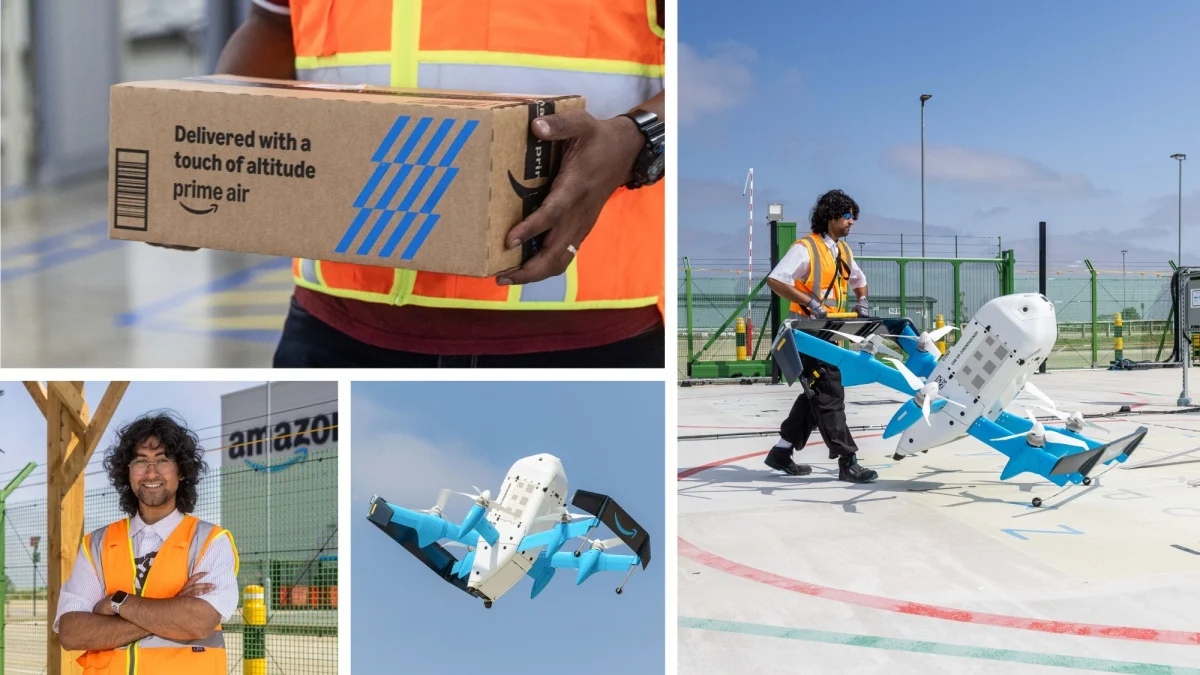
Amazon’s drone delivery service, Prime Air, has reached a significant milestone. According to the company’s latest official announcement, its fulfillment center in Darlington, in the north of England, has officially activated drone delivery service. This marks the first time Amazon has extended Prime Air’s operations beyond the United States into an international market.
The New MK30 Drone: 60-Minute Delivery as the Headline Feature
The 465,000-square-foot Darlington fulfillment center is equipped with cutting-edge automation technology, including the Hercules material-handling robot. Amazon reports that the site has been using its newest MK30 drone to deliver packages to local customers since February 2026.
Currently, the service is available exclusively to customers residing within a 7.5-mile radius of the Darlington facility – roughly 12 kilometers – who also have a garden, courtyard, or driveway. Provided an ordered item weighs no more than 5 pounds, approximately 2.2 kilograms, and fits within a specially designed Prime Air package roughly the size of a large shoebox, customers can select drone delivery at checkout.
Amazon states that these packages can arrive in as little as 60 minutes.
Rigorous Safety Systems and Obstacle Avoidance
To ensure safe operation over densely populated areas, Amazon has equipped the MK30 with industry-leading detection and obstacle-avoidance technology.
Hardware Specifications and Design
The MK30 employs a hexacopter design, capable of vertical takeoff and landing before transitioning into horizontal flight mode. The aircraft stands roughly 5 feet tall with a wingspan of approximately 5.5 feet.
Intelligent Obstacle Avoidance
The drone carries a perception system built around cameras and sensors, enabling it to identify and avoid unexpected obstacles – clotheslines, trampolines, and similar hazards absent from satellite maps – in real time during flight and landing. The system simultaneously monitors surrounding airspace to steer clear of other aircraft.
Low-Noise Engineering
Amazon has specifically optimized the MK30 for minimal noise. At cruising altitude, its sound level is comparable to an electric toothbrush or a fan running on low speed. During landing and delivery, the drone’s noise output falls below that of a delivery van idling at the curb.
John Boumphrey, Amazon’s UK country manager, remarked that the company invested years ensuring the service’s safety and reliability, noting that two-day delivery once seemed remarkable – and now drone delivery is already a reality.
Weather Constraints and Free Access for Prime Members
Before entering full operation, the MK30 completed more than 5,100 test flights, accumulating over 900 hours of flight time, and secured operating approval from the UK Civil Aviation Authority (CAA). Before every launch, ground crews conduct a rigorous 360-degree visual inspection to confirm that propellers, motors, and other components are in good condition, and install a fully charged battery.
Nevertheless, given Britain’s notoriously changeable weather, the system operates under strict climate limitations. While the MK30 can fly safely through light rain, moderate wind, and a range of temperatures, the drone delivery option automatically disappears from checkout whenever the system determines conditions are unsafe – heavy rain, strong wind, or poor visibility – ensuring flight safety is never compromised.
At this stage, Prime Air drone delivery is included as part of UK Prime membership benefits, and eligible members can use the service at no additional cost. As the service area expands further, Amazon will evaluate its pricing strategy accordingly.
From Concept to Commercial Reality: The Last-Mile Challenge Ahead
More than a decade has passed since Jeff Bezos first floated the idea of drone delivery, and Prime Air has traveled a long, regulation-laden path to reach this point. The large-scale commercial rollout in Darlington represents not only a major step forward in Amazon’s logistics automation, but also proof that drone technology has crossed the threshold for commercial viability in noise reduction, obstacle-avoidance algorithms, and weather adaptability.
That said, drone logistics still faces inherent physical constraints before it can become mainstream. The Darlington model, for instance, requires customers to have an independent yard or driveway to receive deliveries – a condition nearly impossible to replicate in highly urbanized, apartment-dense cities across Asia, such as those in Taiwan.
Moreover, how the technology navigates high-density airspace management and unpredictable weather remains the single largest variable determining whether it can spread to additional countries. Drone delivery is undeniably compelling, but truly revolutionizing the traditional last-mile delivery model still requires considerable ground to cover.
Support Our Threat Intelligence
If you find our technology report and cybersecurity news helpful, consider supporting our work.
 Buy Me a Coffee
PayPal
Buy Me a Coffee
PayPal