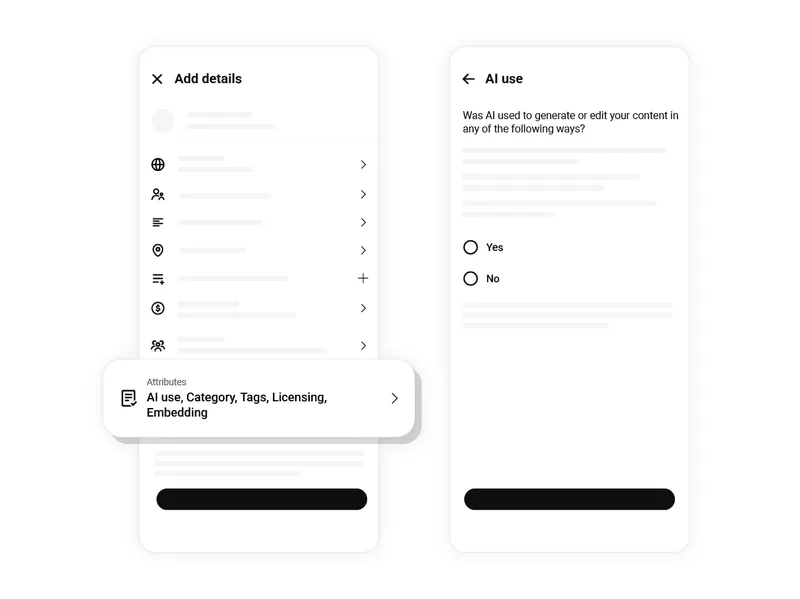
YouTube has declined to wait for content creators to voluntarily disclose artificial intelligence usage. Instead, the platform will automatically tag videos exhibiting substantial photorealistic AI generation. Consequently, this interface modification renders labeling far more conspicuous for the global audience. Furthermore, this automation eliminates the capacity for creators to obscure the architectural provenance of their media.
Escalating Oversight Within Creator Architectures
The enterprise clarified that foundational disclosure policies remain structurally unaltered. However, internal oversight matrices will become considerably more aggressive. Previously, YouTube relied almost exclusively on manual declarations completed within Creator Studio. Authors were mandated to disclose altered scenes mimicking authentic human entities, geographical environments, or historical occurrences. Conversely, whimsical or explicitly surreal concepts remained exempt from rigid disclosure protocols.
Algorithmic Identification and Platform Tool Invariance
Commencing May 2026, the ecosystem deploys proprietary telemetry to isolate generated sequences. If a practitioner fails to document synthetic assets, the platform will append the warning autonomously. Subsequently, authors may appeal erroneous designations to adjust the metadata parameters. Nevertheless, creators cannot remove labels from content generated via native instruments like Veo or Dream Screen.
Immutable Metadata Chains and Structural Layouts
Additionally, the platform will lock the warning permanently if the asset encapsulates explicit C2PA metadata. Because entities like OpenAI, Nvidia, Kakao, and Eleven Labs anchor this cryptographic alliance, these indicators are proliferating globally. Ultimately, this validation framework is integrating seamlessly into modern digital verification infrastructures.
Concurrently, the aesthetic presence of these safety tags will amplify dramatically. For long-form media, the notification will manifest prominently beneath the video playback window. In contrast, the application will overlay the warning directly onto YouTube Shorts interfaces. For minor, non-realistic adjustments, the advisory remains localized within the expanded description tier.
Neutralizing Monetization Anxieties and Deepfake Mitigations
Importantly, YouTube emphasizes that these synthetic labels will not compromise recommendations or algorithmic monetization models. Simultaneously, the enterprise is expanding its investigative deepfake detection capabilities. Following restricted trial phases with public figures, the face-matching verification matrix is now available to all adult operators.
Support Our Threat Intelligence
If you find our technology report and cybersecurity news helpful, consider supporting our work.
 Buy Me a Coffee
PayPal
Buy Me a Coffee
PayPal