The demands for storage performance and security within artificial intelligence, cloud computing, and enterprise data centers continue to escalate dramatically. In response, the NVM Express organization, responsible for defining non-volatile memory interface standards, officially announced a monumental rollout of 11 major NVMe specification updates today.
This comprehensive update encompasses the highly anticipated NVMe 2.4 Base Specification. Furthermore, it includes crucial revisions to the Command Set, Transport protocols, the NVMe Management Interface (NVMe-MI 2.2), and the NVMe Boot 1.4 specification.
Amber Huffman, President of NVM Express, stated that this new iteration establishes the foundation for post-quantum security. Additionally, it streamlines device manageability and bolsters sustainability. Ultimately, these advancements ensure NVMe storage technology remains equipped to handle the rigorous future demands of enterprise, cloud, and AI environments.
Key Update 1: Post-Quantum Cryptography for Future Threats
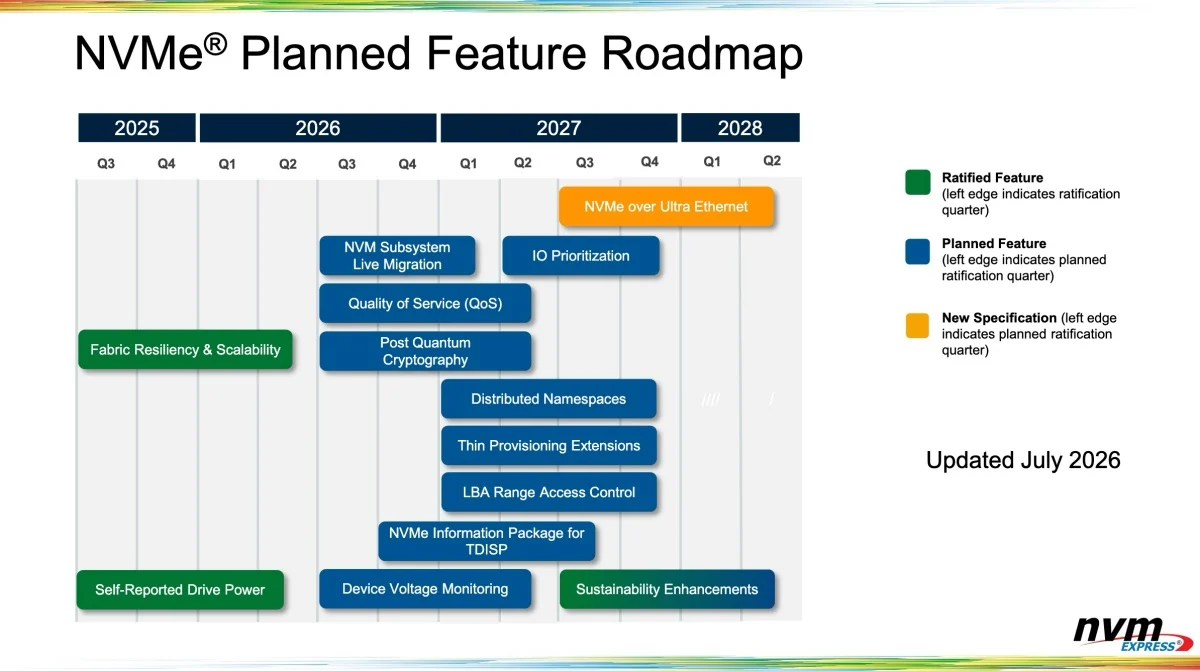
Recognizing the looming threat that future quantum computers could effortlessly shatter existing encryption technologies, the new NVMe specification proactively pioneers support for Post-Quantum Cryptography (PQC).
By updating the communication protocols, the architecture now accommodates quantum-resistant algorithms endorsed by the National Institute of Standards and Technology (NIST). This vital integration significantly fortifies the end-to-end data protection capabilities between the Host and the Solid State Drive (SSD), guaranteeing robust data resilience against future cryptographic vulnerabilities.
Key Update 2: Enhanced Virtualization and Hardware QoS
To satisfy the intense virtualization requirements of Cloud Service Providers (CSPs) and multi-tenant architectures, this update introduces two pivotal technologies optimizing management:
- PCIe Exported NVM Subsystem Migration: This feature extends NVMe virtualization capabilities directly to locally attached PCIe SSDs. It abstracts physical drives into “exported, host-defined virtualized NVM subsystems,” preserving their consistency during migration. Consequently, cloud operators can achieve seamless Virtual Machine (VM) live migrations without laboriously reconfiguring storage infrastructure or relying on heavily resource-intensive hypervisor software emulation.
- Rate Limiting: This function enforces bandwidth and IOPS restrictions directly at the NVMe SSD controller level, delivering hardware-grade Quality of Service (QoS) control. This technology guarantees consistent application performance, prevents aggressive resource contention in multi-tenant environments, and dramatically elevates overall storage efficiency.
Key Update 3: Prioritizing Device Health and Sustainability
As data center operational expenditures and sustainability face intense scrutiny, the new NVMe specification incorporates sophisticated hardware monitoring and recovery mechanisms:
- Voltage Monitoring: The newly integrated voltage telemetry technology empowers administrators with profound insights into NVMe device health. The system supports highly configurable undervoltage and overvoltage thresholds, real-time alerts, and historical measurement logs. Consequently, engineers can proactively detect and resolve power anomalies long before they compromise performance or reliability.
- Restore Manufacturing Default Settings: To drastically simplify device recovery and configuration management, a new feature permits the host to revert the NVMe subsystem directly to its original factory state. This not only streamlines complex troubleshooting workflows but also ensures meticulous configuration consistency across massive cluster deployments.
Debut at the FMS 2026 Future of Memory and Storage Summit
NVM Express strategically timed the release of this sweeping specification update to coincide with the grand opening of FMS 2026 (the Future of Memory and Storage) in Santa Clara, California. We anticipate witnessing major storage titans, such as Samsung, Kioxia, and Micron, demonstrating their next-generation AI and enterprise SSD solutions built upon the NVMe 2.4 standard.
Currently, all 11 updated NVMe specification documents are freely available for download directly from the official NVM Express website.
Support Our Threat Intelligence
If you find our technology report and cybersecurity news helpful, consider supporting our work.
 Buy Me a Coffee
PayPal
Buy Me a Coffee
PayPal