Multinational law enforcement and security agencies recently issued a joint warning stating that North Korean cybercriminal syndicates are aggressively targeting software engineers, web designers, and cryptocurrency professionals. These malicious actors utilize fraudulent technical interviews and deceptive programming assessments as bait to proliferate malware. Consequently, the hackers ingeniously disguise malicious code as benign coding assignments, collaborative project files, or video conferencing troubleshooting utilities. This sophisticated ruse successfully induces unsuspecting job seekers to download and execute the compromised payloads on their personal workstations.
Infecting Thousands of Workstations to Plunder Cryptocurrency
The Federal Bureau of Investigation, alongside the Australian Signals Directorate, the Japanese National Police Agency, and German security authorities, declared that these nefarious activities have impacted professionals across more than a hundred nations. Consequently, the cumulative total of infected devices has surpassed an alarming thirty thousand units. The primary objective driving these adversaries remains the illicit extraction of authentication credentials and digital assets.
Disturbing data reveals that these operatives have successfully plundered funds and account details from over seven thousand cryptocurrency wallets. Furthermore, meticulous investigators currently estimate the actual value of the stolen cryptocurrency exceeds a staggering ten million dollars.
Exploiting Recruitment to Execute Malicious Commands
Typically, the assailants initiate contact with their targets through popular social platforms, professional recruitment websites, freelance portals, or vibrant cryptocurrency communities. Subsequently, they assume the deceptive personas of prominent recruiters representing artificial intelligence, blockchain, NFT, or various high-tech enterprises. Upon establishing rapport, the attackers urgently request the candidate to complete a specific programming task. Alternatively, they might instruct the victim to download a file purportedly designed to resolve a fictitious video conferencing glitch or a fabricated development environment error.
Tragically, these seemingly innocuous files conceal a myriad of dangerous payloads, including remote access trojans and sophisticated information-stealing programs. Certain fragments of this malicious code remain cunningly obscured within repository files or visual studio code projects. Once the victim opens and mistakenly trusts the project directory, the insidious configuration files seamlessly download or execute secondary malicious routines.
After establishing absolute control over the compromised device, the attackers systematically siphon saved browser passwords, clipboard contents, keystrokes, screenshots, encrypted wallet data, personal identification documents, and sensitive corporate files. Moreover, the infected workstation frequently serves as a gateway to infiltrate the internal network of the candidate’s actual employer. To understand the full scope of this threat, one should review the official warning detailing how the North Korean cyber actor group targeting IT professionals orchestrates these complex campaigns.
A Sinister Collaboration Between Fraudsters and Hackers
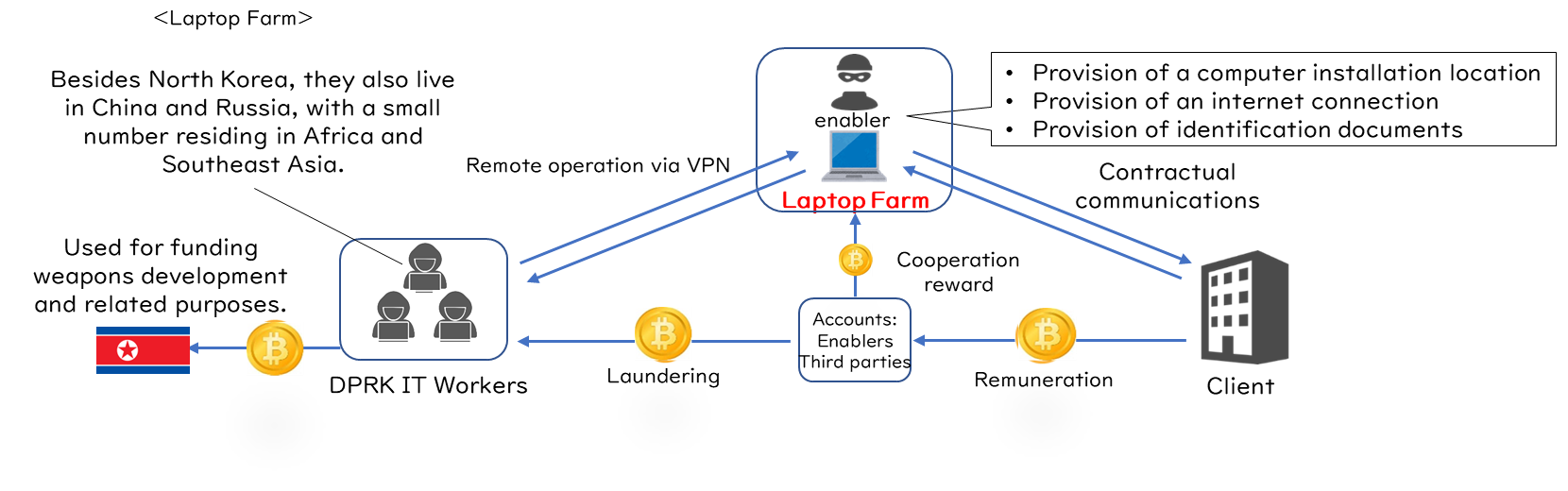
These malicious recruitment campaigns do not operate in isolation. Expert investigators assert that affiliated criminal syndicates collaborate closely with North Korean hacking consortiums to infiltrate overseas corporations utilizing fabricated identities. Furthermore, a fraction of these operatives leverage borrowed identification documents, remotely controlled laptop farms, and virtual private servers to masquerade as legitimate job seekers hailing from diverse global regions.
This calculated division of labor inflicts profound damage upon both reputable companies seeking engineering talent and honest professionals pursuing employment opportunities. The former tactic primarily involves impersonating qualified engineers to stealthily penetrate corporate infrastructures. Conversely, the latter strategy focuses entirely upon plundering the sensitive data and cryptocurrency holdings of unsuspecting applicants. Because these multifaceted attacks remain exceptionally difficult to anticipate and defend against, developers must remain eternally vigilant. Ultimately, professionals should never carelessly load unverified external repositories, thereby avoiding catastrophic system compromises.
Support Our Threat Intelligence
If you find our technology report and cybersecurity news helpful, consider supporting our work.
 Buy Me a Coffee
PayPal
Buy Me a Coffee
PayPal