Redefining the Quantum Horizon
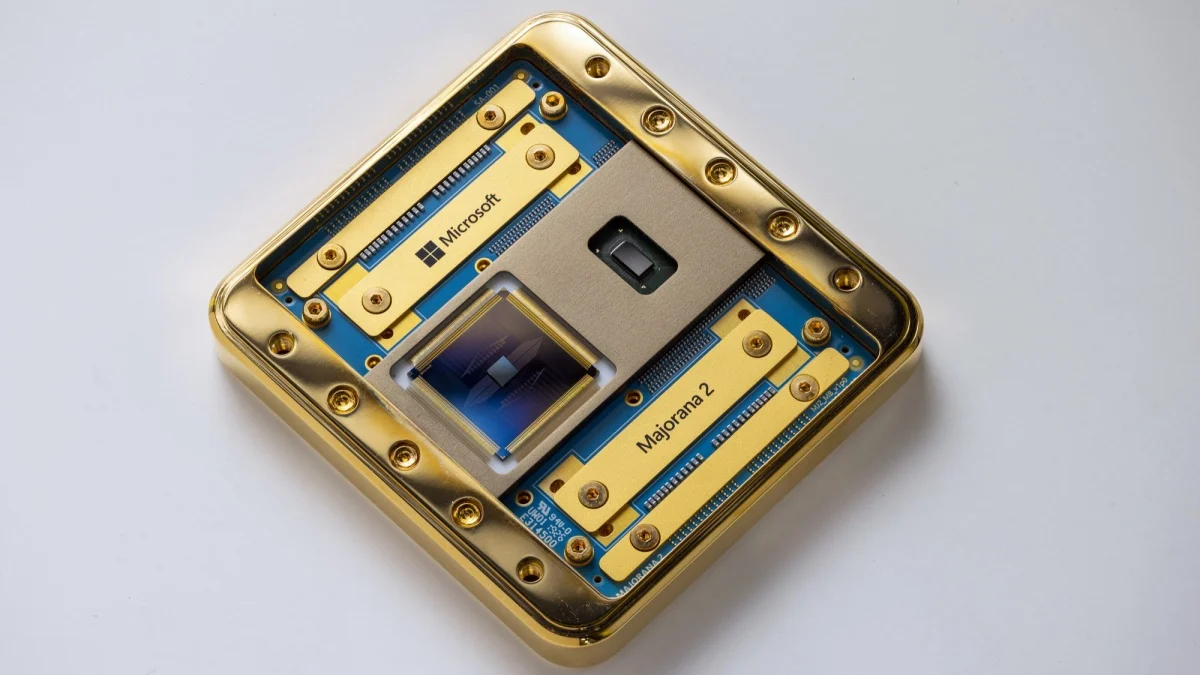
Microsoft announced its next-generation topological quantum chip, “Majorana 2,” during the Build 2026 conference. This hardware marks a profound milestone in material sciences. Furthermore, it introduces a deep integration with Microsoft’s proprietary “Microsoft Discovery” agentic AI platform. Consequently, this synergy enhances qubit reliability by a staggering thousandfold compared to its predecessor, “Majorana 1.”
From Aluminum to Lead: The Structural Secret of Majorana 2
Audacious Recalibrations in Matter
Last year, Microsoft unveiled the foundational Majorana 1 chip. This milestone demonstrated that topological superconductors can engineer entirely novel states of matter. Therefore, the breakthrough unlocked the potential for stable, resilient quantum computation. Conversely, the newly announced Majorana 2 introduces an audacious recalibration of the underlying material composite.
The Shielding Properties of Lead
Microsoft Technical Fellow Chetan Nayak noted a crucial shift in their engineering approach. Initially, the core Majorana superconductors relied heavily on aluminum. In this latest generation, however, the engineering collective pivoted to lead due to its exceptional radiation-shielding properties. Thus, within the hyper-sensitive environment of a quantum computer, this lead-based superconductor gracefully insulates fragile qubits. Crucially, it shields them from cosmic rays and destabilizing environmental interference.
Exponential Extensions in Coherence
This elemental transition yielded dramatic operational results. Historically, the physics sector measured qubit coherence periods in mere microseconds. Instead, Majorana 2 delivers an average qubit lifespan spanning twenty seconds. In optimal conditions, this coherence persists for nearly a full minute. Microsoft compares this leap to extending a mobile phone’s battery life to three years on a single charge.
Launching Into the Future
Therefore, Microsoft maintains immense confidence due to a thousandfold reliability increase and microsecond-velocity computations. Additionally, the hardware features a microscopic form factor of one-hundredth of a millimeter. Consequently, the enterprise believes this trajectory will propel quantum computing out of laboratory confines by 2029. Ultimately, these advanced machines will address complex global challenges like healthcare, sustainability, and clean energy production.
The Global Release of Microsoft Discovery
Accelerating Scientific Discovery
Microsoft successfully halved the timeline for commercial quantum computing. This acceleration stems primarily from the general availability of its vanguard research platform, “Microsoft Discovery.” Engineered specifically for advanced scientific inquiry, this ecosystem synthesizes autonomous AI agent collectives with a proprietary Discovery Engine. Essentially, the framework empowers scientists to deploy human-guided artificial assistants. Subsequently, these agents autonomously parse two decades of dense scientific literature. Thus, they effortlessly synthesize novel hypotheses, optimize experimental parameters, and automate complex quantum measurements.
Precision Atom-by-Atom Engineering
Zulfi Alam, Corporate Vice President of Microsoft Quantum, characterized quantum hardware design as meticulous, atom-by-atom engineering. Previously, discovering the optimal material ratios required exhaustive, repetitive physical experimentation. Today, agentic AI simulations completely bypass this tedious process. The system precisely pinpoints the most viable molecular configurations. Ideally, researchers can now isolate the correct material composition with a single physical experiment.
Bridging the Interdisciplinary Chasm
Furthermore, these autonomous agents serve as flawless translators for massive, cross-functional global networks. These technical groups frequently span physics, mechanical engineering, and fabrication processes. Consequently, the platform seamlessly consolidates vast, fragmented repositories of highly technical telemetry. Then, it uncovers subtle correlations that easily elude human observation.
Democratizing Advanced Research
Concurrently, Microsoft released an early preview of the core Microsoft Discovery application. Users can download this utility for free using their GitHub Copilot accounts. Because the software executes locally, it drastically lowers the barrier to entry for AI-driven scientific research. Ultimately, this democratic rollout benefits both commercial enterprises and academic institutions globally.
Support Our Threat Intelligence
If you find our technology report and cybersecurity news helpful, consider supporting our work.
 Buy Me a Coffee
PayPal
Buy Me a Coffee
PayPal