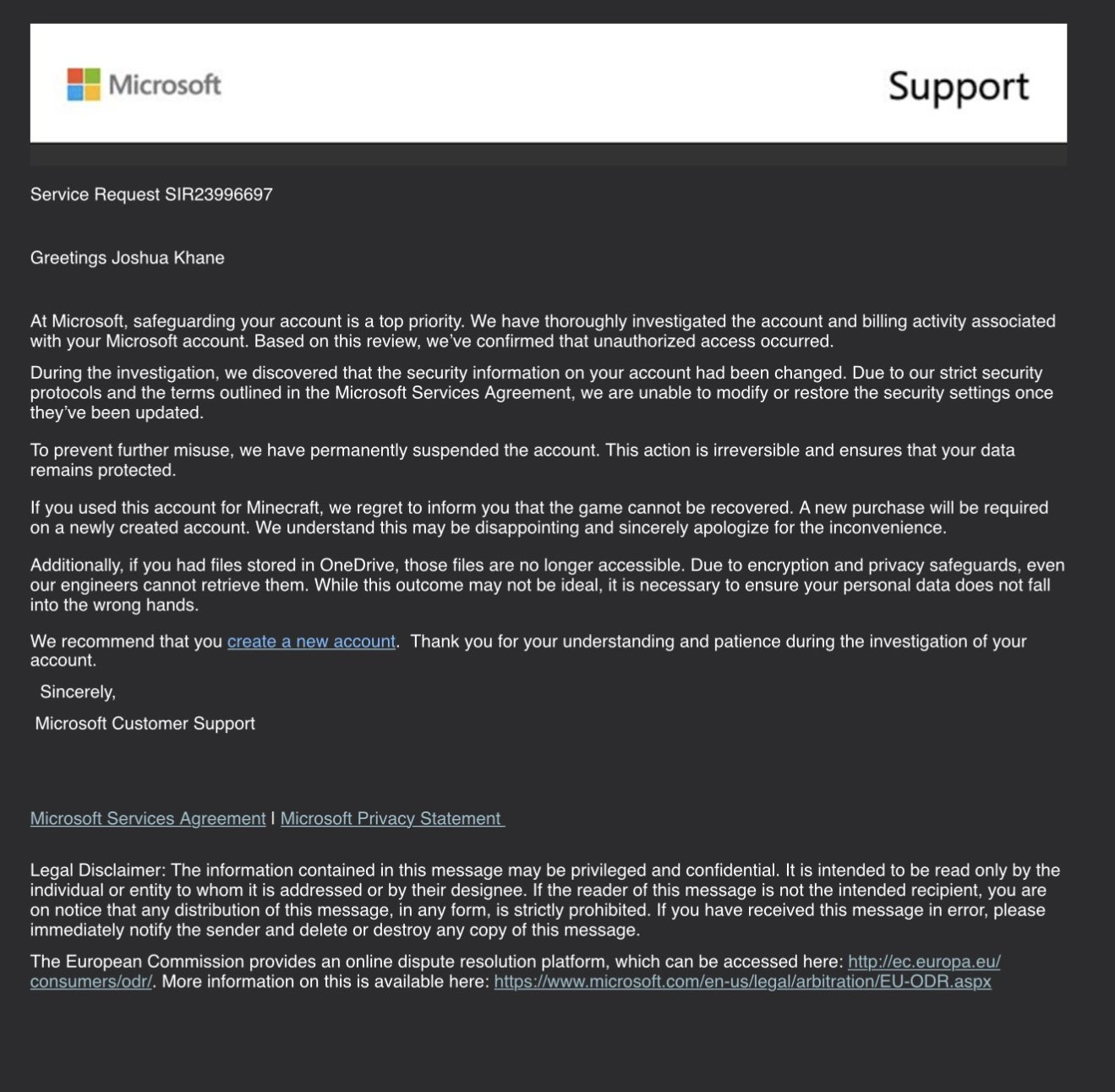
Recently, a user reported on X that hackers had compromised his Microsoft account. After detecting the anomaly, Microsoft responded by banning the account outright. The problem is that the user stored an enormous photo library on Microsoft OneDrive. Once the ban landed, those photos and other data became unretrievable. Despite contacting Microsoft repeatedly, he never got his account back.
This is hardly an isolated incident. A LibreOffice developer previously lost his Microsoft account, and support simply closed his ticket without restoring anything. The developer of the renowned encryption software VeraCrypt was banned as well, leaving him unable to sign drivers and bootloaders. Likewise, the WireGuard developer’s account was suspended before Microsoft, dismissing “conspiracy theories,” agreed to lift the ban.
Community Attention Is the Only Real Fix
Like many large companies, Microsoft runs an extremely rigid account management system. First, reaching a genuine human support agent is remarkably difficult. Even worse, bombarding Microsoft with emails until a human responds often accomplishes nothing. The human agent may deliver the same verdict as the bot: the account cannot be recovered. Numerous users and developers have already endured this exact ordeal.
Ultimately, the only reliable remedy is posting in the community and asking others to amplify the story. Only after a case attracts widespread attention does Microsoft revisit the ban. In this new case, the ban rendered all of the user’s data inaccessible. Naturally, the game licenses he had purchased through Xbox evaporated along with it.
Once the story gained traction, Xbox Support publicly apologized. The team admitted that the earlier handling — a permanent, unrecoverable ban — fell short of its expected service standards. Xbox Support says it is now working to restore the user’s account and his access to purchased games. To be clear, however, only an apology and a promise of help exist so far. The account itself remains banned.
The Data Backup Principle, Yet Again
Why does owning your own NAS and backup drives matter so much? Cloud storage is undeniably convenient and cheap. Nevertheless, one account ban can vaporize everything you stored, especially with providers like Microsoft. These companies operate internal risk-control systems that ban accounts upon detecting anomalies or abuse. Unfortunately, the false-positive rate is high.
Therefore, keeping data on a local server under your own control matters most. Of course, NAS hardware carries its own disk-failure risk. Accordingly, users should adopt a layered backup strategy. For example, encrypt the data on your NAS and back it up to a cloud drive on a regular schedule. That way, if any single service dies, at least one recoverable copy survives.
Support Our Threat Intelligence
If you find our technology report and cybersecurity news helpful, consider supporting our work.
 Buy Me a Coffee
PayPal
Buy Me a Coffee
PayPal