The Hidden Threat in Your Living Room
LG Electronics USA has initiated a rigorous audit of applications available on its webOS smart TV platform. Consequently, the company has mandated that developers immediately eradicate functionalities that surreptitiously transform user devices into residential proxy network nodes. Applications failing to comply with this stringent directive face suspension and outright removal from the digital storefront.
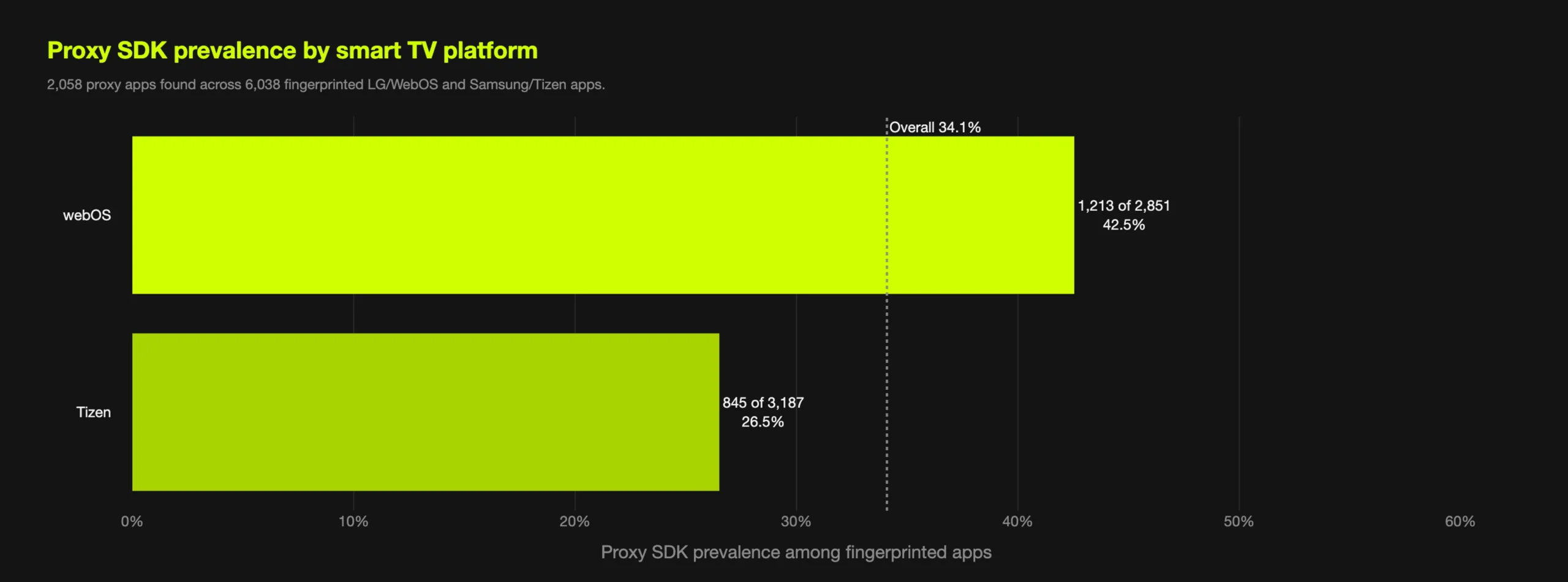
This decisive action follows an alarming investigation conducted by Spur. Their security specialists detected embedded residential proxy components within more than 42% of applications accessible on the LG webOS store. Alarmingly, the proportion of such compromised apps on Samsung Tizen OS exceeded a quarter. You can read the detailed findings regarding smart TV apps and residential proxy SDKs on Spur’s official blog.
Understanding Residential Proxy Networks
A residential proxy network essentially consists of ordinary household devices. Third-party clients route their internet traffic through these devices. An external service connects silently to a user’s television, commandeering its internet connection as an intermediary relay. To any visited website, the incoming request appears to originate authentically from the television owner’s private residence, utilizing their personal home IP address.
The television owner remains blissfully unaware, as nothing unusual manifests on the screen. The television flawlessly streams movies or runs games. However, clandestinely in the background, foreign requests traverse the user’s home network connection.
These proxy networks are highly coveted by corporations seeking to scrape website data, verify advertising campaigns, aggregate regional pricing, or test the geographical availability of internet services. Home IP addresses are significantly more valuable than server IPs because they rarely trigger automated security blocklists and masquerade perfectly as legitimate user traffic.
The Mechanics of Monetization and Consent
Application developers receive lucrative financial compensation from proxy network operators for integrating these specialized software modules. Spur discovered these modules lurking within simplistic games, screensavers, and rudimentary file utilities across television app stores. In certain instances, users faced a dubious ultimatum: endure advertisements or authorize the application to exploit the television as a proxy node.
The primary peril does not lie in direct, malicious control of the television hardware. Rather, the danger stems from linking foreign, potentially illicit activity directly to the owner’s personal internet address. This hijacked home connection could be exploited for aggressive mass data scraping, circumventing geographic restrictions, launching automated request floods, or accessing resources that actively block data center traffic.
If a proxy client violates a website’s terms of service or commits illegal acts, the television owner’s IP address is permanently etched into the connection logs. This scenario can result in the blacklisting of the home address, the incessant appearance of CAPTCHA challenges, temporary bans from online services, or severe inquiries from the internet service provider.
Furthermore, the continuous transmission of extraneous traffic inherently consumes the home network’s bandwidth. Depending upon the proxy’s activity level, this can noticeably degrade connection speeds, inflate data transfer volumes, and impose unnecessary strain on both the television and the household router.
The Illusion of Control and Verification
The mere presence of a proxy component does not inherently guarantee its use for criminal endeavors. Network operators insist they rigorously vet their clients, strictly limit permissible tasks, and technologically prohibit access to other devices residing on the local network. However, the television owner exercises absolutely no control over the specific requests traversing their IP address and remains ignorant of who is currently renting their connection.
Spur considers the mechanism for obtaining user consent particularly problematic. A user might hastily accept a dense terms-of-service agreement when launching a game, entirely failing to comprehend they just authorized continuous third-party traffic routing. Subsequently, this function can operate covertly for months, persisting as long as the app remains installed and the device maintains an internet connection.
Moreover, televisions are shared communal devices. A child, a guest, or a household member who does not bear the financial responsibility for the internet connection could easily grant this sweeping authorization.
LG’s Decisive Remediation Efforts
The vast majority of the proxy modules identified by Spur were directly associated with the Bright Data service. The corporation maintains it solely connects devices following explicit user consent, rigorously verifies clients, and provides participants with tangible rewards or benefits. It further claims robust technical limitations safeguard the device owner’s local network.
Nevertheless, LG has resolved to comprehensively eliminate residential proxies from webOS applications. The corporation has already communicated with developers and commenced a systematic review of published software. Moving forward, the vetting process for new submissions will be drastically fortified to ensure analogous modules do not re-enter the marketplace under deceptive guises.
Owners of LG televisions should proactively scrutinize their installed applications. It is prudent to uninstall unused games, screensavers, and utilities. Users must exercise extreme caution regarding applications that offer an ad-free experience in exchange for sharing their internet connection, bandwidth, or network resources.
Support Our Threat Intelligence
If you find our technology report and cybersecurity news helpful, consider supporting our work.
 Buy Me a Coffee
PayPal
Buy Me a Coffee
PayPal