Modders have gained early access to one of Nvidia’s foremost graphics technologies long before its official release. The Neural Rendering library from the forthcoming DLSS 5 was found in the files of an early build of NBA 2K27, whereupon enthusiasts coaxed it into working in Control, Cyberpunk 2077, Skyrim, GTA V, and other games. Within a few days, the experiment spilled beyond the RTX 50 series and reached RTX 40 and even RTX 30 cards.
An Unexpected Discovery in a Basketball Game
The find surfaced on 26 August. In the NBA 2K27 directory, researchers uncovered the library nvngx_dlssnr.dll, roughly 158 MB in size. Windows identifies the file as NVIDIA DLSSNR version 310.8.0.0. By comparison, modern DLSS Super Resolution libraries typically occupy around 20 to 50 MB.
The mere presence of the DLL in NBA 2K27 does not mean the game already uses DLSS 5. There is no corresponding mode in the NBA 2K27 settings, and Nvidia has not named the basketball simulator among the confirmed projects supporting the new technology. The most cautious interpretation, for now, is that the developers accidentally included a working component in the public build.
The RenoDX Community Takes Over
The experimental library quickly reached the RenoDX community. As early as 27 August, the modder speedlemur released a modification for Control that connects Neural Rendering through ReShade and allows the processing to be applied to the protagonist’s model. Analogous experiments then appeared for Cyberpunk 2077, Skyrim, GTA V, Hogwarts Legacy, Kingdom Come: Deliverance II, The Last of Us Part II Remastered, and a number of other games.
What Makes Neural Rendering Different
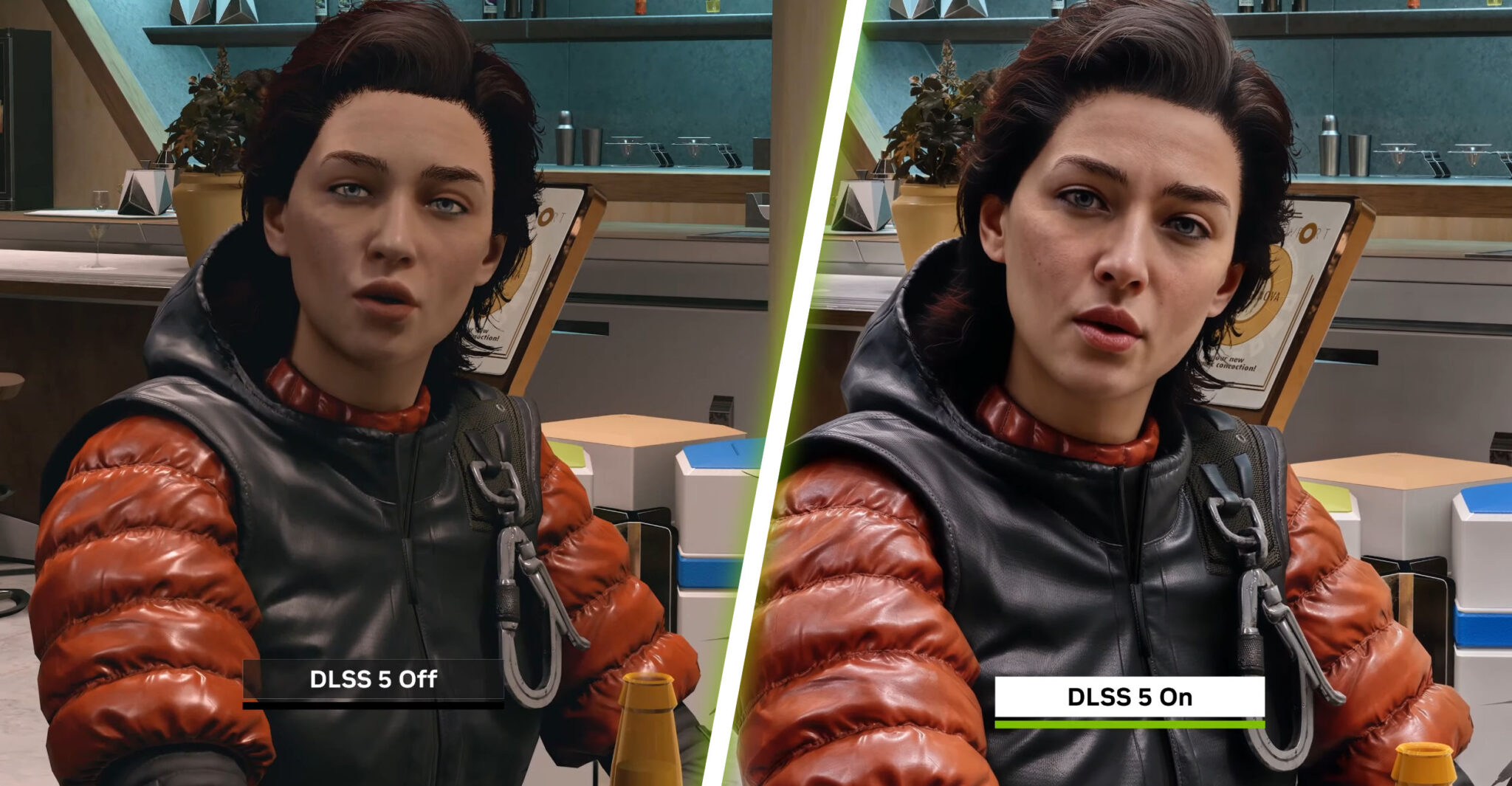
Unlike conventional upscaling, the neural rendering of DLSS 5 changes more than resolution or frame count. The model receives colour and motion vectors from the game engine and then reworks lighting and materials. Skin takes on a more intricate structure, hair gains additional shadows, and fabrics and surfaces respond to light differently. In effect, the neural network becomes yet another stage of the graphics pipeline.
Nvidia’s Own Presentation
During its official presentation in March, Nvidia stressed that developers would be able to control the intensity of the processing, the colour, and the masks of individual objects. Such control is essential, since the generative model can noticeably alter faces, materials, and the overall atmosphere of a scene. It was precisely this excessive intrusion into artistic style that stirred debate after the first DLSS 5 demonstrations.
The Steep Computational Cost
The leaked version also reveals another side of the technology. Neural Rendering still demands enormous computational resources. In one of the first independent tests, Control on an RTX 5070 Ti at 4K resolution saw its frame rate fall from roughly 71 to 35 FPS once character processing was enabled. The test conditions are not fully described, so the result cannot be taken as a proper benchmark of the final DLSS 5.
Reaching Ada Lovelace
Initially, the library ran only on Blackwell RTX 50 cards. Community members then modified the CUDA binaries and achieved operation on RTX 40. The patch allowed the code to execute on the Ada Lovelace architecture, even though Nvidia does not support such a configuration and offered no compatibility guarantees.
Pushing Down to Ampere
The next frontier was Ampere cards. By 30 August, the experimental code was running on RTX 30, including the RTX 3080, RTX 3090, and mobile models. Practical benefit, however, is so far almost nonexistent. In Deep Rock Galactic, an RTX 3080 dropped from about 130 frames per second to 4 after Neural Rendering was enabled, and some RTX 3050 and RTX 3060 Ti cards managed around a single frame per second. On a laptop RTX 3070, rendering latency in one test soared from roughly 29 to 3,326 ms.
Why the Older Cards Falter
The reason for such a collapse is not merely a lack of optimisation. The leaked library makes heavy use of FP8 computations, for which the Blackwell architecture is far better suited. Ada Lovelace could be made to execute the required code after modifications, whereas Ampere handles the task so slowly that the mere fact of running it is, for now, more interesting than the frame rate obtained.
What the Experiment Does and Doesn’t Prove
The modders’ results also do not prove that Nvidia artificially restricted DLSS 5 to the RTX 50 series. The ability to make an early library run on an old GPU and the ability to deliver acceptable speed, power consumption, image quality, and stability represent entirely different challenges. The RTX 30 tests illustrate precisely how vast that gap can be.
What makes the experiment especially intriguing is the speed with which the technology spread across old games. Nvidia designed DLSS 5 as a feature that a developer integrates into the engine and tunes for specific objects. In a matter of days, modders turned the early runtime into a near-universal post-processing tool, connecting it through RenoDX, ReShade, and additional bridges to projects for which Nvidia planned no support at all.
Still a Laboratory Experiment
For now, such modifications remain a laboratory experiment. Users report performance drops, incompatibility with certain rendering modes, HDR problems, and increased video-memory consumption. The early DLL also lacks the entire control system Nvidia is preparing for developers, so comparing today’s clips and screenshots with the quality of the future release is inaccurate.
Nvidia plans to release DLSS 5 in the autumn of 2026. The company has already confirmed support for AION 2, Assassin’s Creed Shadows, Delta Force, Hogwarts Legacy, Resident Evil Requiem, Starfield, The Elder Scrolls IV: Oblivion Remastered, Where Winds Meet, and other games. The leak revealed something else well before release. As soon as generative rendering fell into modders’ hands, the technology almost immediately ceased to be bound to the games, or even the GPU generations, for which it was originally intended.
Support Our Threat Intelligence
If you find our technology report and cybersecurity news helpful, consider supporting our work.
 Buy Me a Coffee
PayPal
Buy Me a Coffee
PayPal