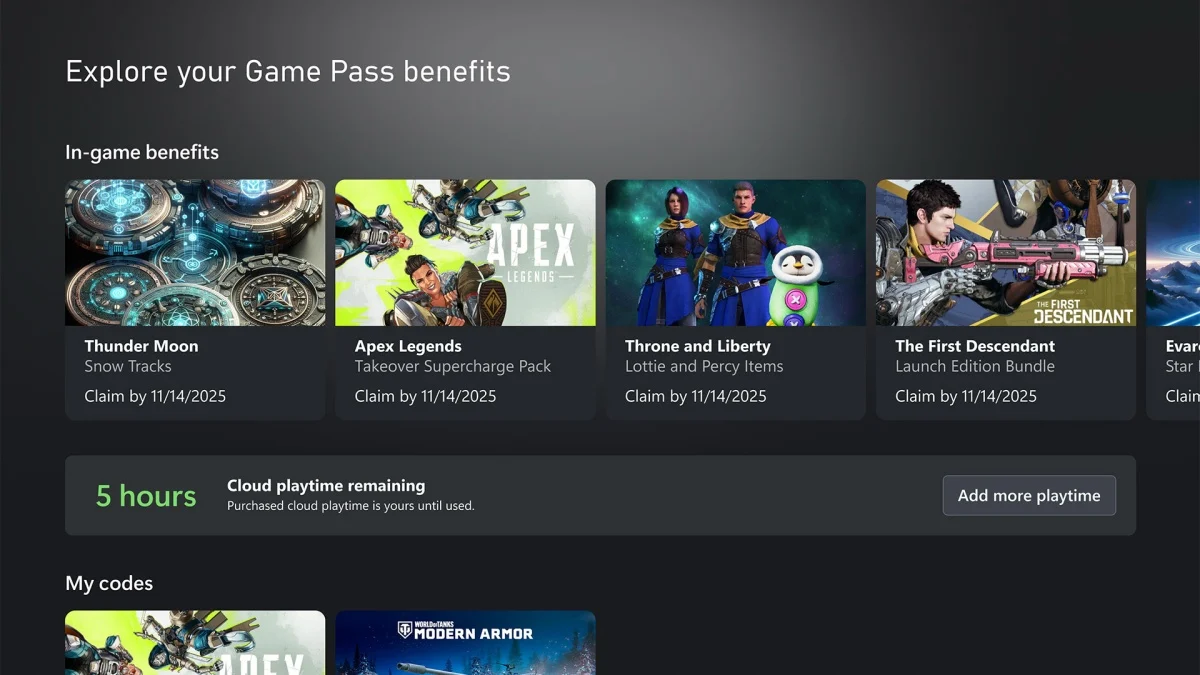
Microsoft once endeavored to paint for gamers worldwide a cloud-streaming vision in which “no physical console is needed, and any screen is an Xbox.” Confronted, however, by the colossal operating costs of its data centers, this ideal has at last reached the day of its reckoning with reality.
Xbox has officially announced a sweeping overhaul of its Xbox Cloud Gaming service beginning this November. The central change is the formal abolition of the “unlimited hours” streaming benefit for Game Pass Ultimate subscribers, replaced by a fixed monthly allotment of hours. Concurrently, non-subscribers will be permitted to purchase additional “cloud playtime hours” through the Xbox Store, thereby extending their play.
Tiered Game Pass Allowances: At Most 15 Hours a Month
Under the new scheme, Xbox Game Pass cloud playtime will be strictly stratified by subscription tier:
- Game Pass Ultimate: 15 hours of cloud streaming per month.
- Game Pass Premium: 10 hours of cloud streaming per month.
- Game Pass Essential: 5 hours of cloud streaming per month.
For players who have long leaned on mobile devices or smart televisions for heavy streaming, this represents an undeniable erosion of their entitlements. Microsoft’s statement emphasizes that the change is expected to affect only about 4% of Game Pass subscribers, an attempt to soften the market’s perception of the blow. Nevertheless, set against Ultimate’s monthly price of $22.99, the loss of unlimited play still marks a conspicuous retreat in the history of Xbox’s subscription model.
Compute Priced Separately: Cloud Playtime Without a Subscription
The other face of this policy, however, is that Microsoft has for the first time thoroughly decoupled cloud compute from the Game Pass subscription. From November onward, cloud gaming will no longer be an exclusive privilege of Game Pass members. Any player may purchase cloud playtime hours directly through the Xbox Store and stream titles from their own digital library.
For those still holding legacy Xbox One consoles, this is a considerable boon. In theory, by simply purchasing cloud hours, they can stream next-generation Xbox Series X|S exclusives on their older hardware without laying out a substantial budget for an upgrade. As for the precise pricing of these hours, Xbox has indicated that it will vary by market.
Executive Reshuffle and a Strategic Pivot
Behind this momentous shift lies the pragmatic strategic reorientation that has taken hold since new Xbox chief executive Asha Sharma assumed her post.
In the past, Xbox poured vast sums into constructing cloud servers and launched the polarizing “This Is An Xbox” marketing campaign, seeking to trade losses for cross-platform market share. Under Asha Sharma’s leadership, however, Xbox has recently trimmed its base subscription prices and carried out sweeping internal layoffs. Moreover, it has refocused its resources upon exclusive titles and physical hardware development.
The True Cost of Cloud GPU Compute Ends the “Burn Cash for Share” Era
Viewed through the lens of infrastructure and enterprise computing architecture, Xbox’s about-face is hardly surprising.
Cloud gaming, in essence, is Microsoft leasing to consumers the costly server-grade GPU and CPU compute within its data centers, which is in fact composed of bespoke Xbox Series X blade servers, at an extremely low “all-you-can-eat” price. In the era before AI truly erupted, Microsoft could perhaps absorb the depreciation of idle Azure server capacity. Yet now, when every unit of GPU compute can be converted into lucrative enterprise AI revenue, allowing players to monopolize server resources without limit for a mere $22.99 a month is plainly a gravely loss-making enterprise.
This practice of pricing streamed gaming by the hour is, in substance, the importation of the pay-as-you-go model of AWS and Azure enterprise cloud computing to the consumer end.
Ironically, as global memory prices soar and Microsoft’s forthcoming next-generation “Project Helix” console potentially faces steep manufacturing costs, the barrier to purchasing a physical console will grow ever higher. By choosing this moment to make cloud streaming user-pays, Microsoft ends the utopia of unlimited play. Yet it also establishes a genuinely financially sustainable business model for the stable operation of high-end AAA gaming in the cloud.
Support Our Threat Intelligence
If you find our technology report and cybersecurity news helpful, consider supporting our work.
 Buy Me a Coffee
PayPal
Buy Me a Coffee
PayPal