The Intersection of High-Performance Computing and Infrastructure
Massive artificial intelligence clusters increasingly intertwine computational processing with energy infrastructure. Consequently, cybersecurity researchers have demonstrated how standard graphics processing unit workloads can be weaponized. These synchronized computational loads can act as a sophisticated mechanism to disrupt local electrical grids. This novel vector of digital assault has been designated the Bit2Watt attack. Crucially, the execution of this protocol requires no physical breaches. Attackers do not need to compromise data center hardware, cloud environments, or electrical infrastructure management software. A comprehensive analysis of this method is detailed in a recent academic research paper.
Mechanics of Load Manipulation
A prospective adversary can legally lease an extensive pool of graphics processing units. They then initiate resource-heavy artificial intelligence operations or advanced mathematical computations. A bespoke software program rapidly alternates these computational accelerators between states of peak operational intensity and total dormancy. This rapid shift causes energy consumption profiles to vary erratically. Ultimately, these synchronized processors generate highly controlled electrical current fluctuations within the immediate power distribution system.
Two Methods of Execution
The creators of this model outlined two primary strategies for inducing structural grid stress:
- The CUDA-Based Method: This approach utilizes specialized low-level code to cycle between maximum and minimal hardware utilization at frequencies reaching 6 kHz.
- The Neural Training Method: This technique embeds load manipulation directly into standard deep learning processes. It achieves this by dynamically altering data batch sizes, injecting superfluous mathematical operations, and modifying structural model parameters. While this approach acts at a reduced frequency, it generates more severe electrical variations and blends seamlessly with benign computational tasks.
Empirical Findings and Grid Vulnerabilities
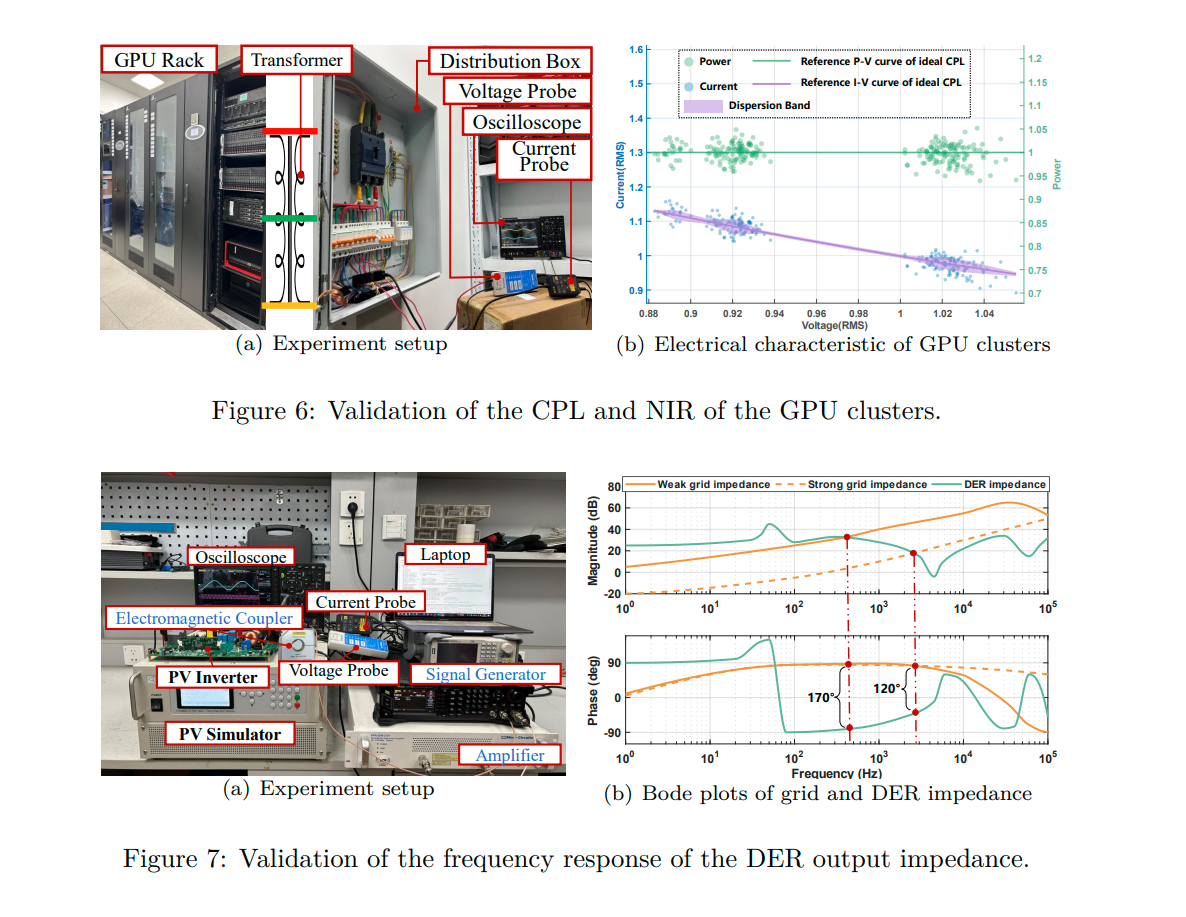
Empirical measurements conducted on a testbed cluster of roughly one hundred accelerators verified that these rapid utilization shifts project directly into local power distribution hardware. Additional investigations targeting solar inverters exposed specific resonant frequencies. At these critical points, the induced electrical waves degraded general power quality, elevated harmonic distortion levels, and eroded overall distribution system resilience. The authors clarified that no actual infrastructure sabotage took place against live public utilities.
Simulating Grid Destabilization
In a controlled computer model simulating a 1 MW regional distribution network, the synchronized behavior of several hundred to a thousand computing cores forced electrical metrics beyond acceptable regulatory limits. Under conditions where distributed energy generation accounted for ninety percent of the network supply, the simultaneous manipulation of one thousand accelerators forced current distortion levels up to 46.8%. The simulation also revealed a high probability of compounding resonant variations, which could potentially propagate outward to impact larger grid areas.
The Dual Vector: Watt2Bit Complications
Conversely, the researchers identified a reciprocal phenomenon termed the Watt2Bit effect. Severe electrical anomalies within the external power supply can feed back into the data center infrastructure. This feedback loops into hardware power units and voltage conversion systems, triggering integrated thermal protections and abruptly halting complex computations. Furthermore, this bidirectional interface theoretically enables data exfiltration. Adversaries can encode information within the specific frequency and size of energy draw patterns, subsequently reconstructing the signal via external electromagnetic radiation or remote electrical measurements.
Support Our Threat Intelligence
If you find our technology report and cybersecurity news helpful, consider supporting our work.
 Buy Me a Coffee
PayPal
Buy Me a Coffee
PayPal