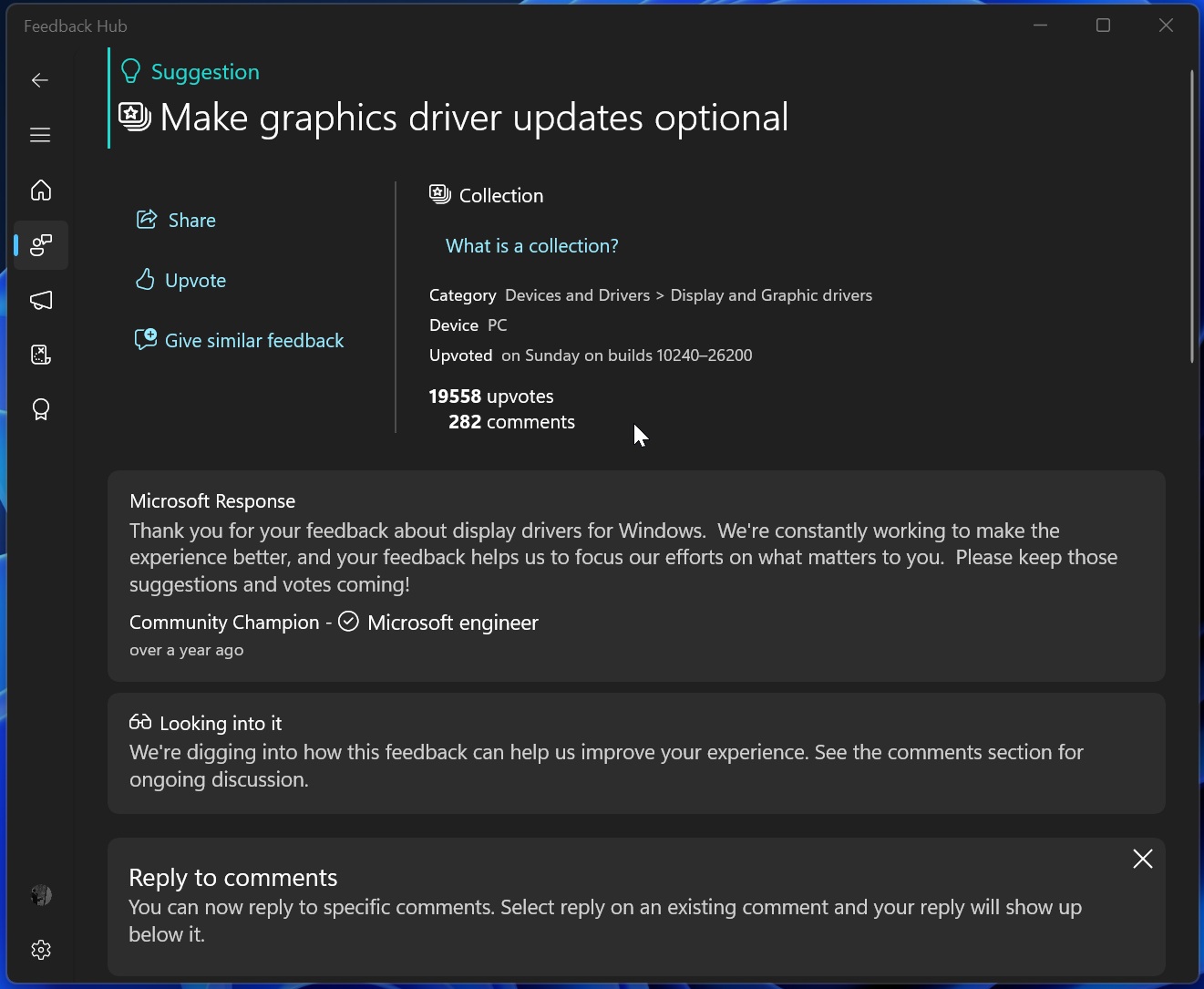
Recently, a multitude of users have observed that their manually installed GPU drivers are being summarily superseded by legacy versions through Windows 11’s automated update mechanism. Under conventional circumstances, Windows 11 facilitates the download of hosted drivers upon installation; while these versions are typically antiquated, they suffice for rudimentary operations. However, power users invariably opt for the latest distributions provided directly by manufacturers.
The crux of the frustration lies in the system’s propensity to overwrite even the most current drivers with obsolete iterations. Consequently, optimized drivers from NVIDIA, AMD, and Intel—which boast enhanced gaming performance and novel features—are being displaced, thereby depriving users of an optimal computing experience.
Within the Microsoft Feedback Hub, an increasing volume of grievances has surfaced. Users have reported instances where the latest drivers installed in April 2026 were downgraded to versions originating in 2024 or earlier, contingent upon specific hardware configurations and the contents of the Microsoft Update Catalog. One poignant feedback report noted the inexplicable nature of Microsoft’s inability to maintain a repository of contemporary, verified drivers; the user further contended that, at the very least, the system should acknowledge the presence of a superior version and permit the user to bypass the unnecessary update.
While this phenomenon is not universal, afflicted users find themselves in a perpetual cycle: unless they explicitly disable driver updates, the system will repeatedly overwrite any manual reinstallation of current software with the legacy alternative.
Microsoft has elucidated that the current anomalies stem from the methodology by which Windows 11 ranks and disseminates display drivers. The corporation has formally acknowledged that users are occasionally being subjected to redundant “downgrade” updates, though a definitive resolution remains elusive.
Starting this year, a more nuanced, two-part targeting system has been introduced for new hardware, utilizing both Hardware IDs and Computer IDs. The latter identifies specific machine models and hardware configurations, empowering Windows Update to discern the precise targets for each driver. This refined targeting model is designed to ensure that updates are confined to their intended systems, thereby mitigating the incidence of inadvertent driver regressions across the ecosystem. Nevertheless, this enhancement is exclusively applicable to novel drivers for emerging hardware; drivers for extant devices remain susceptible to these involuntary downgrades.
Support Our Threat Intelligence
If you find our technology report and cybersecurity news helpful, consider supporting our work.
 Buy Me a Coffee
PayPal
Buy Me a Coffee
PayPal